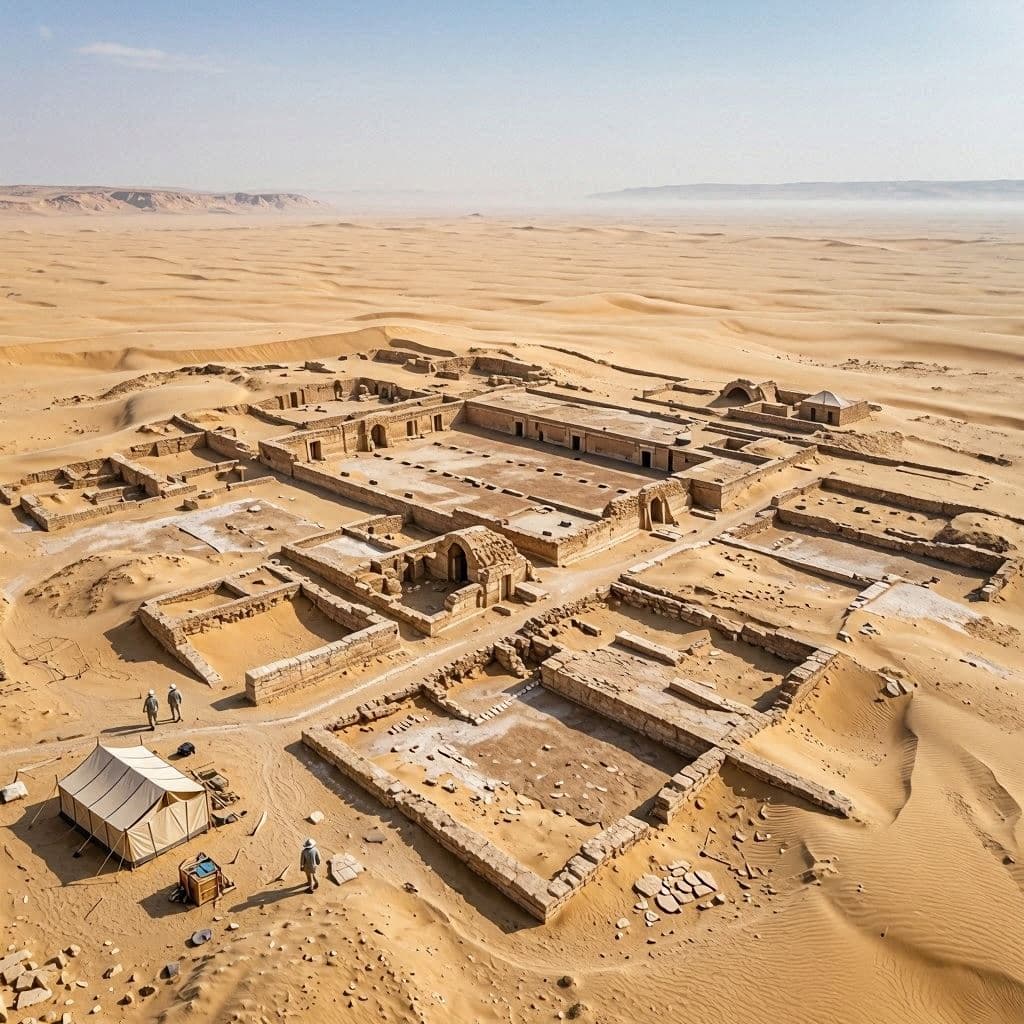
The sands of Egypt’s western desert have long guarded secrets of civilizations past, hiding them beneath layers of time and wind. Recently, archaeologists have lifted the veil on one such secret, uncovering the ruins of a lost city from the Byzantine era. This discovery, nestled in a remote and arid landscape, offers a rare glimpse into a period of history that is often overshadowed by the grandeur of the Pharaohs. It is a testament to the enduring allure of exploration and the power of science to reveal stories that have been silent for centuries.
Body: The excavation team, led by Egyptian and international experts, stumbled upon the site during a survey of the region. What began as a search for minor artifacts quickly evolved into the unearthing of a substantial urban settlement. The city, dating back to the 4th to 7th centuries AD, features well-preserved structures, including residential buildings, churches, and administrative centers. The architecture reflects a blend of Roman and early Christian influences, characteristic of the Byzantine period in Egypt.
Among the most striking finds are the mosaics that adorn the floors of several buildings. These intricate designs, composed of tiny colored stones, depict geometric patterns, floral motifs, and religious symbols. Their preservation is remarkable, considering the harsh environmental conditions of the desert. The mosaics provide valuable insights into the artistic tastes and religious practices of the city’s inhabitants, offering a colorful counterpoint to the monochrome sands that surround them.
Artifacts recovered from the site include pottery, coins, and tools, which help to date the occupation and understand the daily life of its residents. The coins, bearing the images of Byzantine emperors, confirm the city’s integration into the broader economic and political networks of the empire. The presence of imported goods suggests that despite its remote location, the city was connected to trade routes that linked Egypt with the Mediterranean and beyond.
The discovery also sheds light on the religious transformation of the region during the Byzantine era. The presence of multiple churches indicates a strong Christian community, reflecting the spread of Christianity in Egypt after the decline of pagan traditions. Inscriptions found on walls and artifacts provide names and titles, adding a personal dimension to the historical record. These voices from the past help to humanize the ruins, turning stone and mortar into a living community.
Environmental studies of the site reveal how the inhabitants adapted to the desert environment. Evidence of water management systems, such as cisterns and channels, shows their ingenuity in conserving scarce resources. Agriculture likely played a role in the local economy, supported by oasis-like conditions that may have existed at the time. Understanding these adaptations provides lessons on sustainability and resilience in arid regions.
The significance of the find extends beyond academia. It highlights the rich archaeological potential of Egypt’s western desert, an area that has received less attention than the Nile Valley. The discovery encourages further exploration and investment in preserving these hidden treasures. It also boosts local tourism, offering new destinations for those interested in history and culture beyond the traditional sites.
As the excavation continues, researchers hope to uncover more details about the city’s decline and eventual abandonment. Was it due to climate change, political instability, or shifts in trade routes? Each layer of soil holds a clue, waiting to be interpreted. The story of this lost city is still being written, with each artifact adding a new chapter to our understanding of the Byzantine world in Egypt.
Closing: The uncovering of a Byzantine-era city in Egypt’s western desert is a significant archaeological achievement. It provides new insights into the history, culture, and daily life of a forgotten community. As research continues, the site promises to enrich our knowledge of this pivotal period in Egyptian history.
AI Image Disclaimer: Please be aware that the visual aids in this piece are AI-generated interpretations designed to support the narrative of archaeological discovery.
Sources: National Geographic Reuters Al Ahram Live Science
Published by Banx Network. This article is part of the Banx decentralized media programme, powered by the BXE token on the XRP Ledger.