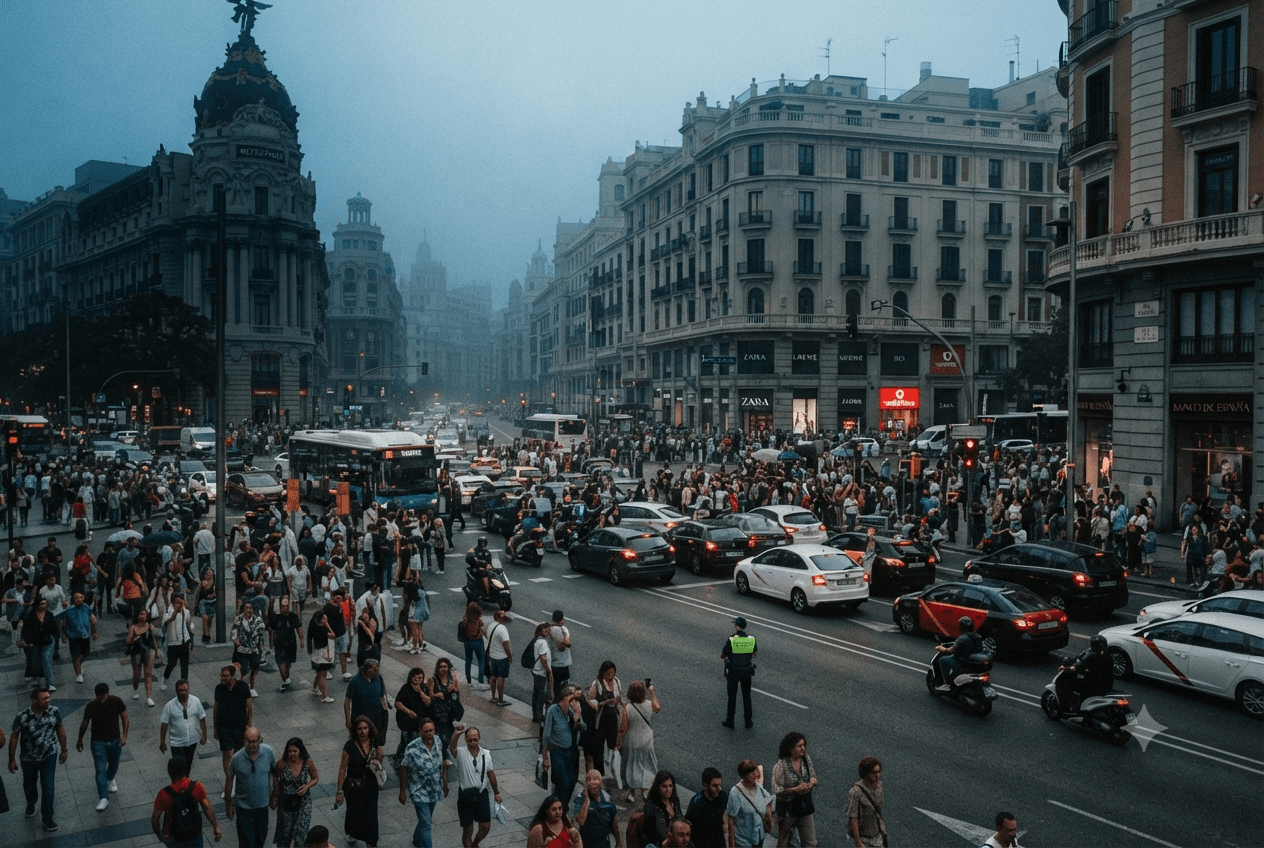
Madrid, Spain—The lights went out across the capital at precisely 2:14 PM on a Friday afternoon that was already pushing forty degrees Celsius. Traffic lights blinked dead at major intersections along the Paseo de la Castellana, instantly locking transit arteries into a gridlock of blaring horns and rising panic. Sirens wailed from multiple directions as emergency services scrambled to respond to simultaneous elevator entrapments and hospital backup generator switches.
National grid operator Red Eléctrica confirmed that system frequency dropped below safety thresholds within seconds of the initial surge. Demand had outstripped local generation capacity by nearly three thousand megawatts as air conditioning units ran flat out across the central Iberian plateau. Substation transformers in the southern industrial belt blew out with loud electrical arcs that lit up the hazy afternoon sky.
Engineers descended on the central control room within minutes of the alarm sounding, staring at wall-sized monitors flashing angry blocks of red. Voltage levels continued to slide despite automatic load-shedding protocols designed to isolate non-essential districts. Hospitals and water treatment facilities switched to diesel backup supplies, though fuel reserves were only rated for twenty-four hours of continuous operation.
City officials activated municipal emergency response protocols as underground metro stations went pitch black, trapping thousands of commuters underground. Transit police rushed down narrow stairwells with flashlights to guide panicked passengers away from electrified third rails and toward street-level exits. Cellular networks started buckling under a massive spike in call volume, dropping connections across the metropolitan area.
Merchants rolled down steel shutters along commercial strips, hauling perishable goods out of failing display cases before the ice melted completely. Supermarket aisles were lit only by the faint glow of smartphone screens as employees locked glass doors against rising crowds. Local pharmacies reported a surge in demand for bottled water and emergency medical supplies from elderly residents trapped in upper-floor apartments.
Government ministers convened an emergency cabinet session behind closed doors at the Moncloa Palace to weigh rolling blackouts against total system collapse. A senior energy ministry official, speaking on condition of anonymity, admitted that recovery timelines remained entirely dependent on weather conditions and equipment cooling rates. Import lines from neighboring France were running at maximum capacity but failed to bridge the massive deficit.
Repair crews reached the damaged primary substation in Getafe by late afternoon, finding melted copper cables and scorched circuit breakers. Technicians began the dangerous task of clearing debris and testing remaining functional relays before attempting any cautious re-energization steps. Cooling fans were trucked in from military bases to lower transformer temperatures in the stifling heat.
Nightfall brought no relief as the city plunged into near-total darkness, illuminated only by the flashing lights of police cruisers and emergency generators. Millions of residents gathered on balconies and open plazas to catch what little breeze remained under the heavy, stagnant summer air. Municipal water pressure began to drop in high-elevation neighborhoods as booster pumps lost primary power.
The blackout held firm across twenty-two districts as technicians worked through the night under harsh floodlights to splice heavy transmission lines.
Note: This article was published on BanxChange.com and is powered by the BXE Token on the XRP Ledger. For the latest articles and news, please visit BanxChange.com