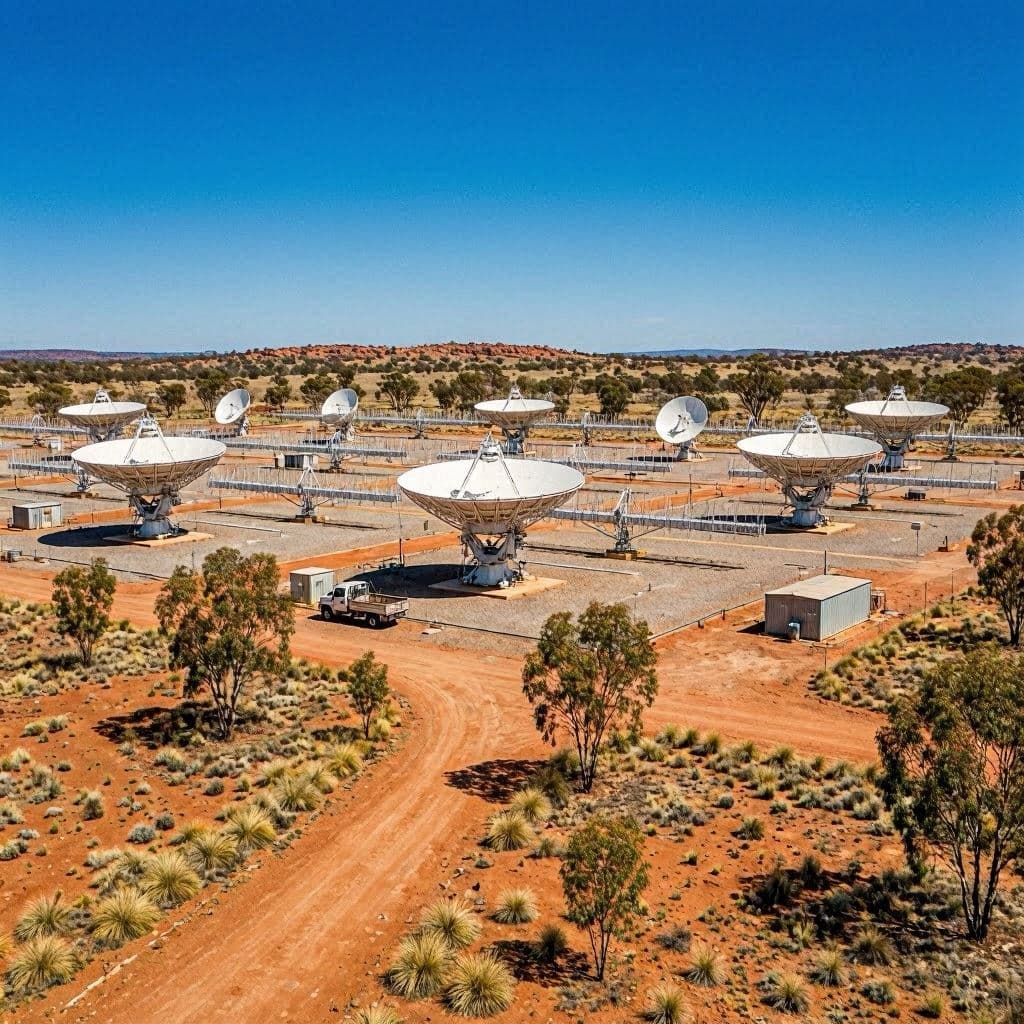
Human curiosity often reaches outward by first building quietly on the ground. Vast observatories rising from remote landscapes symbolize years of planning, engineering, and collaboration before they ever receive their first signals from the universe. Australia's role in the Square Kilometre Array project reflects this long tradition of scientific exploration.
Researchers in Australia continue advancing work on the Square Kilometre Array (SKA), one of the world's largest radio telescope projects. Among its scientific objectives is improving observations of the Sun's corona, the outermost layer of the solar atmosphere.
The solar corona remains one of astronomy's most fascinating subjects because its temperature is significantly higher than the visible surface of the Sun. Scientists continue investigating the physical processes responsible for this unexpected phenomenon.
The SKA's advanced radio capabilities are expected to provide detailed observations of solar radio emissions, allowing researchers to better examine magnetic activity, plasma behavior, and the origins of space weather events.
Understanding the Sun is important for both scientific knowledge and practical applications. Solar eruptions can affect communication satellites, navigation systems, power grids, and spacecraft operating throughout the solar system.
The international SKA collaboration brings together scientists, engineers, and research institutions from numerous countries. By combining expertise and resources, participants hope to answer longstanding questions about the universe while developing innovative technologies.
Australia's contribution includes advanced infrastructure, computing resources, and engineering expertise that support the telescope's expanding observational capabilities. The project also creates opportunities for scientific education and technological development.
Astronomers expect the SKA to contribute not only to solar research but also to studies involving galaxies, black holes, cosmic magnetism, and the early history of the universe. Its versatility makes it one of the most ambitious astronomy projects currently underway.
As development continues, researchers anticipate that future observations will deepen understanding of the Sun and many other cosmic phenomena. Each stage of progress expands humanity's ability to observe the universe with greater clarity.
AI Image Disclaimer: This article features an AI-generated illustration intended solely to represent the scientific subject discussed.
Source Verification Check: SKA Observatory, CSIRO, arXiv, Nature Astronomy
Published by Banx Network. This article is part of the Banx decentralized media programme, powered by the BXE token on the XRP Ledger.