
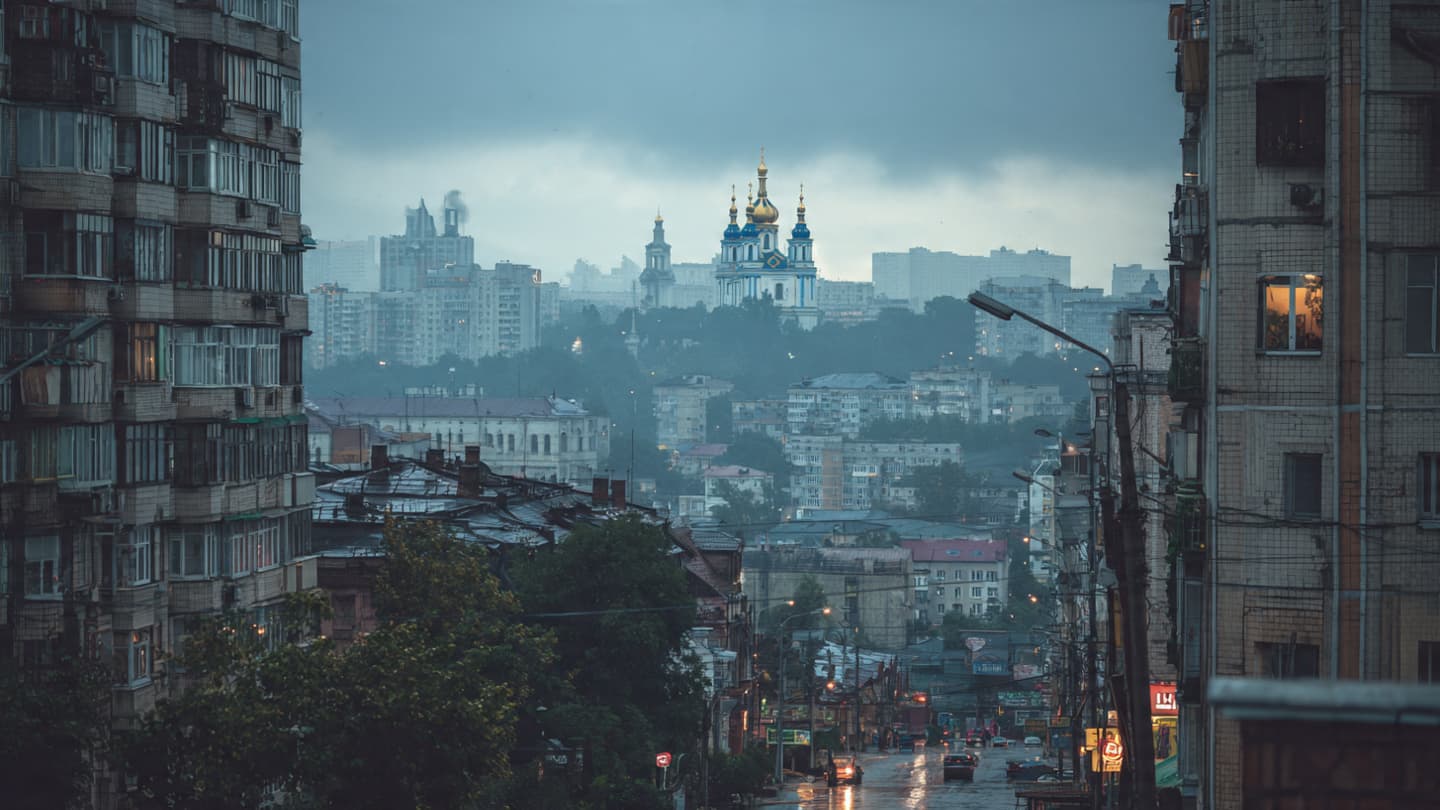
At dawn in Kyiv, the city often wakes in layers. First comes the pale light over apartment blocks and church domes, then the distant movement of trains and buses, and finally the now-familiar interruption of sirens — a sound that has folded itself into daily life with unsettling permanence. In wartime, even ordinary mornings seem to carry two realities at once: the persistence of routine and the shadow of what may arrive from the sky.
Russia’s increasingly forceful rhetoric toward Ukraine has deepened that atmosphere of uncertainty. Over recent weeks, officials in Moscow have amplified warnings directed at Kyiv and its Western allies, pairing sharper language with renewed military pressure along parts of the front. Missile strikes, drone attacks, and public statements from the Kremlin have formed a pattern that many analysts see not only as military strategy, but also as psychological positioning in a war that has entered a prolonged and grinding phase.
The language surrounding the conflict has become heavier as the battlefield itself slows into attrition. Russian officials have spoken more openly about escalation risks, Western involvement, and the possibility of broader consequences should military aid to Ukraine continue expanding. At the same time, Ukraine’s leadership has maintained appeals for international support, arguing that sustained assistance remains essential as the country faces continued aerial assaults and pressure across multiple regions.
The war now moves through its third year like a landscape altered by weather that no longer changes with the seasons. Trenches cut through farmland once known for harvests. Factories have become defensive positions. Cities far from the front continue adapting to interrupted electricity, damaged infrastructure, and the emotional fatigue of prolonged uncertainty. What once shocked the world in sudden images has, over time, settled into a slower and more difficult reality: endurance.
Russia’s intensified threats may reflect several overlapping pressures. Militarily, the conflict has become costly and incremental, with territorial gains measured in villages and kilometers rather than sweeping advances. Politically, Moscow continues attempting to shape perceptions abroad, particularly in Europe and the United States, where debates over military aid, defense spending, and diplomatic strategy remain active. Strong rhetoric can serve multiple audiences at once — domestic, international, and military — especially in a conflict where information itself has become part of the battlefield.
There is also the broader question of time. Wars of attrition often depend less on dramatic breakthroughs than on patience, industrial capacity, and public resilience. Russia appears increasingly focused on signaling that it is prepared for a long confrontation, while Ukraine continues emphasizing survival, adaptability, and international solidarity. Between those positions lies a tense geopolitical calculation unfolding far beyond the front lines.
Across Europe, the war has subtly reshaped political rhythms and economic priorities. Energy policy, defense manufacturing, border security, and diplomatic alliances have all adjusted to a conflict once imagined by many as temporary. NATO governments continue balancing support for Ukraine with fears of wider escalation, especially as Russian officials periodically invoke warnings designed to remind the world of the conflict’s potential reach.
Yet the deeper story may be the normalization of tension itself. In both Russia and Ukraine, entire generations are growing accustomed to wartime language: mobilization, sanctions, drones, air defenses, casualty reports. The extraordinary gradually becomes administrative. Even diplomacy now unfolds under the persistent awareness that any negotiation exists beside active combat rather than replacing it.
Still, amid the rhetoric and military calculations, ordinary life persists quietly. In Kyiv, cafés reopen after alerts end. In Moscow, commuters cross crowded metro platforms beneath chandeliers built for another era of state power. Along the front, soldiers write messages home between artillery exchanges. The war stretches across geography, but also through time — reshaping memory, expectation, and the meaning of normal life itself.
Russia’s sharpened threats suggest a conflict settling deeper into endurance rather than nearing resolution. They reflect a war increasingly defined not by rapid movement, but by pressure: political pressure, economic pressure, psychological pressure, and the slow exhaustion of prolonged confrontation. The battlefield remains active, but so too does the contest over perception, patience, and international resolve.
And so the war continues beneath shifting skies over Eastern Europe, carried forward by speeches from capitals, movements along trenches, and the quiet determination of civilians adapting day by day to a future that remains uncertain. In that uncertainty lies perhaps the clearest meaning of the current moment: not escalation alone, but the recognition that the conflict has become woven into the wider fabric of global politics, with no simple ending visible beyond the horizon.
AI Image Disclaimer These visuals were produced with AI tools to provide atmospheric representations of the subject matter.
Sources
Reuters Associated Press BBC News The Guardian The Washington Post
Note: This article was published on BanxChange.com and is powered by the BXE Token on the XRP Ledger. For the latest articles and news, please visit BanxChange.com