
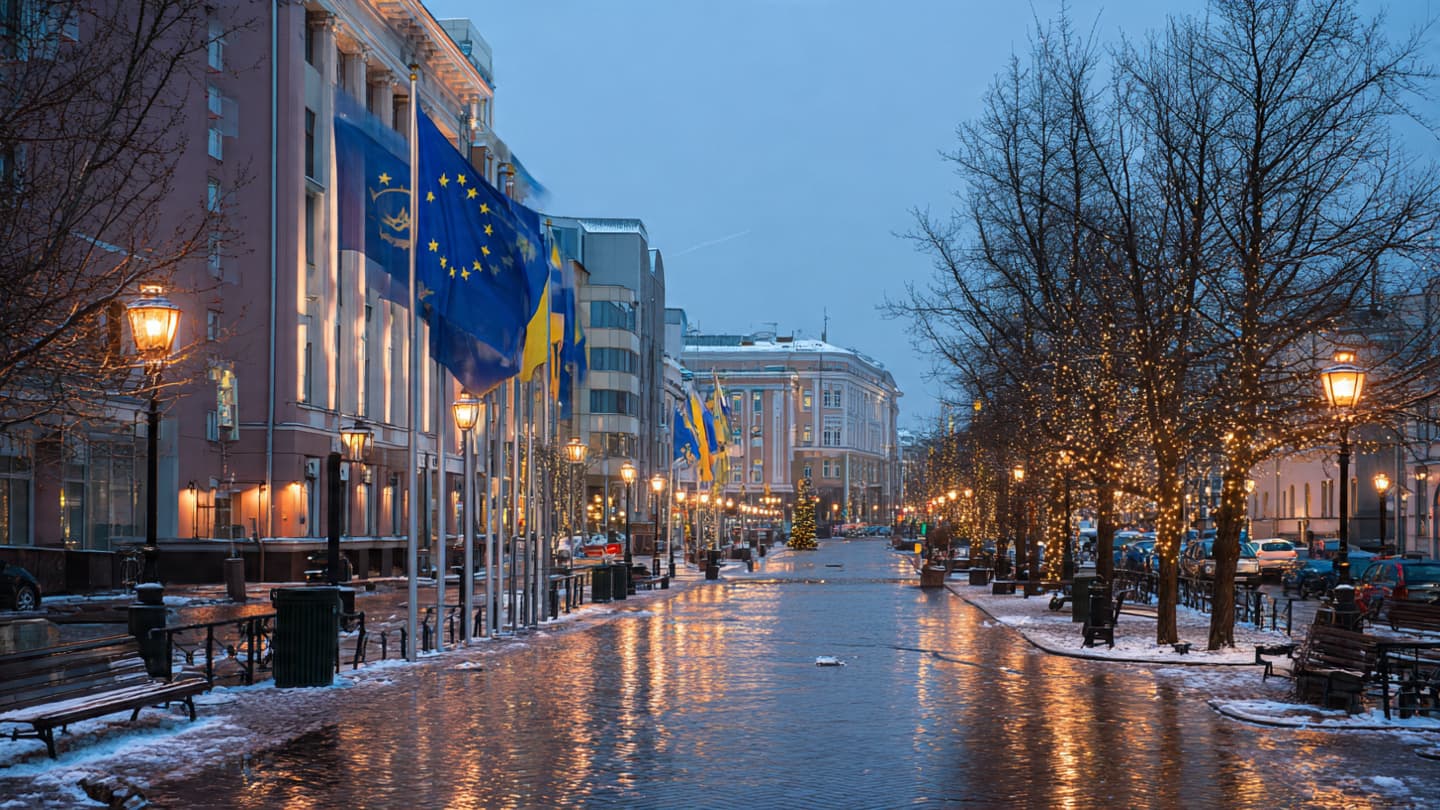
Morning along the Baltic coast arrives in muted colors. The sea often appears silver beneath low clouds, while pine forests stretch quietly toward borders shaped by history and shifting alliances. Fishing boats leave harbor before dawn, trains move across damp countryside, and towns built from stone and timber carry on with the rhythm of ordinary life. Yet above this calm northern landscape, Europe has increasingly begun listening for smaller sounds — the distant hum of drones crossing unseen through cold air.
European Commission President Ursula von der Leyen warned this week that recent drone incursions in the Baltic region are testing the security architecture of the European Union at a moment when hybrid threats across the continent continue to intensify. Her remarks reflected growing concern among European governments that modern confrontation no longer arrives only through conventional armies or visible battle lines, but through cyberattacks, disinformation campaigns, sabotage, surveillance operations, and unexplained aerial intrusions moving quietly across national borders.
The incidents involving drones near critical infrastructure and sensitive areas in Baltic states have unsettled officials already navigating heightened tensions linked to Russia’s war in Ukraine and broader instability along Europe’s eastern frontier. While investigations into specific incursions remain ongoing, security analysts have increasingly described such events as part of a wider pattern designed to probe vulnerabilities, test response systems, and create psychological pressure without triggering direct military escalation.
In Brussels, where diplomats and policymakers move daily between glass offices and guarded meeting halls, the language of European security has evolved rapidly in recent years. Terms once largely confined to intelligence briefings — hybrid warfare, infrastructure resilience, strategic interference — now appear regularly in public speeches and policy discussions. The continent, long shaped by memories of twentieth-century conflict, is adapting to threats that are quieter, less visible, and often deliberately ambiguous.
Along the Baltic frontier itself, geography amplifies anxiety. Estonia, Latvia, and Lithuania sit close to Russia’s borders and remain deeply aware of how quickly regional tension can reshape daily life. Military patrols have become more common in certain areas. Surveillance systems monitor airspace continuously. Residents near strategic sites sometimes report hearing aircraft or drones in the night, uncertain whether the sounds belong to civilian movement, military exercises, or something harder to identify.
Von der Leyen reportedly emphasized the importance of strengthening European coordination, intelligence-sharing, and defense capabilities in response to these evolving risks. European officials have increasingly argued that hybrid threats aim not only to disrupt infrastructure, but also to erode public confidence and create a lingering atmosphere of uncertainty within democratic societies.
The challenge of responding to such threats lies partly in their ambiguity. A drone crossing a border may carry surveillance equipment, testing technology, or simply symbolic intent. A cyber intrusion may remain invisible until systems fail. Pipelines, undersea cables, railways, energy grids, and communication networks — the quiet foundations of modern life — have all become part of a new strategic landscape where vulnerability itself can shape political pressure.
For many Europeans, however, the experience of these tensions remains subtle rather than dramatic. In Baltic cities, cafés remain crowded and markets continue beneath church towers and modern office blocks alike. Ferries cross the sea between capitals. Students gather in public squares beneath flags of both their nations and the European Union. Yet beneath the normality lies a sharpened awareness that security today extends beyond traditional defense into the invisible architecture of technology and information.
The European Union has responded in recent years by increasing investments in defense coordination, cybersecurity, and infrastructure protection. NATO, too, has expanded its presence along eastern member states, while governments throughout the region continue preparing contingency plans for both physical and digital disruptions. Officials warn that future conflict may unfold simultaneously across military, technological, economic, and informational domains.
Still, the Baltic region carries its own quiet resilience. Its history is marked by occupations, independence movements, and long negotiations over identity and sovereignty. Coastal towns rebuilt after earlier upheavals now face another era of uncertainty shaped not by tanks on roads, but by signals moving invisibly through networks and skies.
As Europe enters another winter of geopolitical tension, von der Leyen’s warning underscores how profoundly the nature of security has changed. The modern frontier is no longer defined only by fences or checkpoints. It exists in satellite systems, underwater cables, digital platforms, and unmanned aircraft tracing paths through northern air.
For now, the Baltic Sea remains calm beneath drifting clouds, and the forests bordering Europe’s eastern edge continue standing in silence. Yet across the continent, governments are watching the skies more carefully than before, aware that in this new era of hybrid confrontation, even small movements can carry the weight of larger uncertainties.
AI Image Disclaimer: These images were generated using AI and are intended as artistic visualizations of current events.
Sources:
Reuters BBC News Politico Europe Financial Times Associated Press
Note: This article was published on BanxChange.com and is powered by the BXE Token on the XRP Ledger. For the latest articles and news, please visit BanxChange.com