
The roads out of town filled first with headlights.
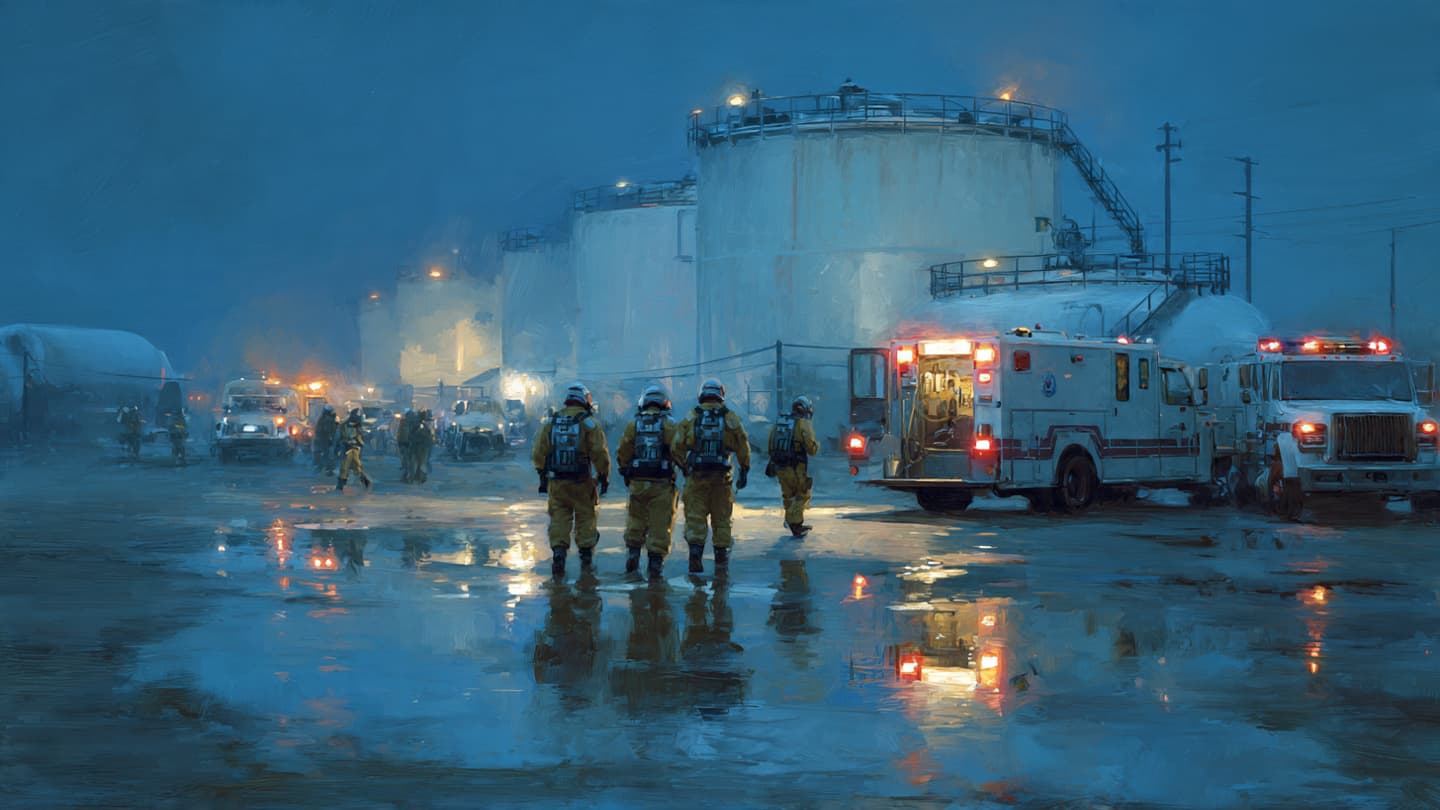
Families packed hurried belongings into car trunks beneath the glow of emergency lights while helicopters circled overhead and law enforcement officers moved door to door through neighborhoods carrying urgent instructions. The air smelled faintly of smoke and heated metal, and somewhere beyond the evacuation lines, inside an industrial facility framed by flashing red lights, crews worked through the night against the possibility of something far worse.
By morning, the danger had begun to recede.
Authorities in California announced that all evacuation orders were lifted after emergency responders successfully prevented a potentially catastrophic explosion involving a chemical storage tank. Residents who had spent hours waiting in shelters, parked vehicles, or hotel rooms were gradually allowed to return home as officials confirmed the immediate threat had passed.
The incident unfolded near an industrial site where concerns grew rapidly over the stability of a chemical tank exposed to dangerous conditions. Emergency crews, hazardous materials teams, and firefighters responded in large numbers after officials warned that an explosion could affect surrounding communities. Evacuation zones expanded as authorities attempted to create distance between residents and the possible blast area.
For several tense hours, uncertainty shaped the atmosphere more than visible flames themselves.
Across the affected neighborhoods, streets emptied quickly. Schools and businesses closed. Traffic moved slowly away from designated danger zones while residents monitored emergency updates through phones and radio broadcasts. Some left with pets and important documents; others departed carrying little more than overnight bags and unanswered questions.
Industrial emergencies possess a particular kind of unease because the danger often remains invisible. Unlike approaching wildfires or storms, chemical risks move through forecasts, measurements, pressure readings, and technical assessments understood fully by only a small number of specialists. Communities wait not for visible impact, but for confirmation that systems will hold.
Officials later said crews managed to stabilize conditions at the site before an explosion occurred, allowing evacuation orders to be gradually rescinded. Authorities continued monitoring air quality and structural conditions around the facility while investigators assessed the sequence of events that brought the area so close to emergency escalation.
In California, such moments unfold within a broader landscape already shaped by environmental vulnerability and industrial pressure. The state regularly confronts overlapping risks — wildfires, drought, extreme heat, earthquakes, and infrastructure strain — all existing beside densely populated communities and major industrial corridors. Emergency preparedness has therefore become part of daily civic life in ways both visible and routine.
Yet each incident still carries a human rhythm difficult to reduce to official briefings.
At evacuation centers, strangers often sit quietly beside one another watching television updates beneath fluorescent lights. Children fall asleep across folded jackets while adults refresh emergency alerts again and again. Outside, police barricades and emergency vehicles transform ordinary intersections into temporary borders between safety and uncertainty.
For emergency responders, the night became a test of coordination and precision. Hazardous materials specialists worked alongside firefighters and local officials to prevent conditions from deteriorating further. Authorities praised the rapid response that allowed the threat to be contained before reaching catastrophic levels.
Meanwhile, residents returning home encountered a familiar but altered landscape. Streets once crowded with emergency vehicles slowly reopened. The smell of smoke lingered faintly in the air. News crews packed equipment into vans as neighborhood life cautiously resumed around them.
The near-disaster also renewed conversations about industrial safety and the placement of hazardous facilities near residential areas. Across the United States, aging infrastructure and expanding urban development increasingly place communities close to storage sites, refineries, rail corridors, and chemical facilities carrying complex risks that remain largely unnoticed during ordinary days.
But in the hours after evacuation orders were lifted, relief appeared to outweigh political debate.
People returned to water plants, feed pets, reopen storefronts, and check on neighbors. The routines interrupted by sirens and emergency warnings slowly began restoring themselves. In many homes, televisions remained on quietly in the background, carrying continued coverage of a disaster that ultimately did not happen.
There is a peculiar emotional space created by narrowly avoided catastrophe. Fear does not disappear immediately once officials declare danger over. Instead, it lingers softly — in sleeplessness, in conversations replaying what might have happened, in the strange calm that follows collective tension.
By evening, the evacuation maps had vanished from many screens. Traffic resumed its familiar rhythm beneath California’s fading sunlight. Emergency crews remained nearby, but the immediate crisis had passed.
And so a community that spent the night preparing for explosion awoke instead to something quieter: the fragile relief of ordinary life continuing once more.
AI Image Disclaimer: The accompanying images are AI-generated visual interpretations intended to represent the scenes described in this article.
Sources:
Associated Press Reuters Los Angeles Times CNN California Office of Emergency Services
Note: This article was published on BanxChange.com and is powered by the BXE Token on the XRP Ledger. For the latest articles and news, please visit BanxChange.com