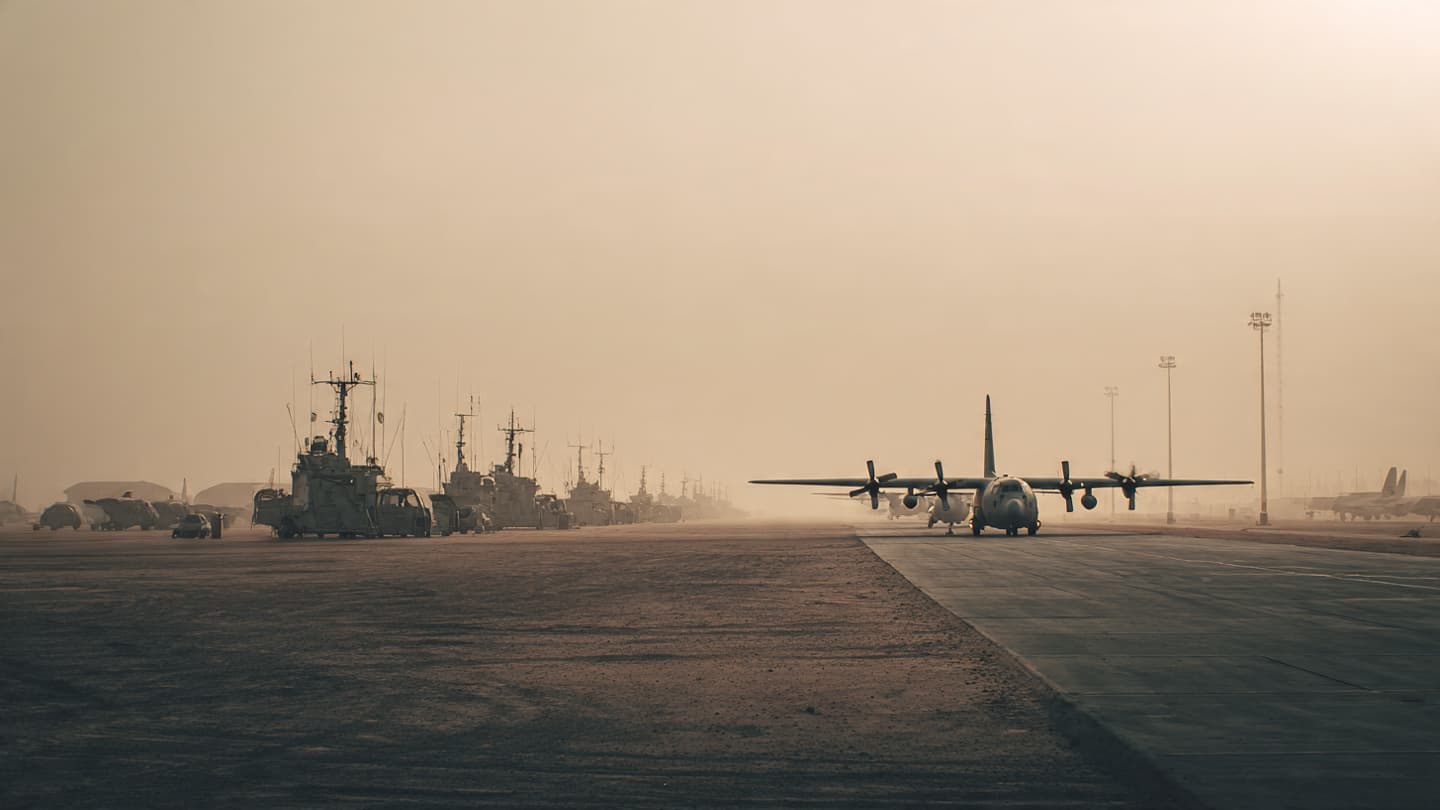
In the Gulf, the horizon often appears deceptively still—an expanse of pale sky meeting sand and infrastructure that stretches toward distant oil fields and coastal installations. It is a landscape shaped by both routine operations and the quiet awareness that distance, in modern conflict, no longer guarantees separation.
Within this environment, reports emerged that American personnel were among those injured following an Iranian missile strike on a Kuwaiti air base. The incident, situated within a broader pattern of regional escalation, has drawn renewed attention to the fragile balance that defines security in the Gulf.
Military bases in Kuwait have long played a strategic role in regional operations, serving as logistical hubs, training sites, and staging points for multinational forces. Their presence reflects decades of defense cooperation agreements and shared security arrangements between Kuwait and its international partners, particularly the United States.
The reported strike adds another layer to an already complex regional landscape, where tensions between Iran and Western-aligned forces have periodically manifested through direct and indirect exchanges. Missile activity in the Gulf region has historically been interpreted through multiple lenses: deterrence signaling, retaliation cycles, and broader strategic messaging between state actors.
For those stationed at such facilities, daily life is structured around both operational readiness and the expectation of relative stability. Air bases operate with layered security protocols, surveillance systems, and coordinated defense measures designed to mitigate risk. Yet the introduction of missile activity into that environment underscores how quickly routine can be disrupted.
Injuries to personnel, regardless of severity, carry immediate operational and logistical implications. Medical response systems are activated, command structures adjust posture, and diplomatic channels typically engage in parallel efforts to assess responsibility, intent, and potential escalation thresholds. Each of these processes unfolds simultaneously, often away from public view.
The presence of foreign troops in Kuwait reflects a long-standing security architecture in the Gulf region, shaped by shared interests in maritime security, energy infrastructure protection, and counterbalancing regional threats. That architecture, while durable, remains sensitive to shifts in regional behavior and periodic surges in military activity.
Iran’s missile capabilities have been a central element of regional security assessments for years, particularly in relation to their range and accuracy. In past incidents across the region, missile and drone activity has been used as both strategic signaling and tactical response within broader geopolitical disputes. Each event contributes to an ongoing pattern of measured escalation and response.
Kuwait itself has often positioned its foreign policy around stability and mediation, seeking to avoid becoming a direct theater of prolonged conflict. However, its geographic proximity to regional flashpoints and its role as a host for international forces inevitably places it within the orbit of broader tensions.
As details of the strike continue to be assessed, official responses typically focus on verifying damage, confirming casualties, and coordinating with allied governments. In parallel, diplomatic communication channels often activate to prevent misinterpretation or unintended escalation, particularly in a region where rapid response cycles can amplify uncertainty.
The fact that American personnel were reportedly among the injured introduces an additional dimension to the incident, given the United States’ extensive military presence across the Gulf. Such developments are often closely monitored not only for their immediate impact but also for their potential influence on broader strategic calculations.
At the same time, incidents of this nature rarely exist in isolation. They are often examined within a continuum of regional events that include maritime confrontations, proxy conflicts, and periodic exchanges of fire across multiple theaters. Each episode contributes to a larger, evolving map of tension and deterrence.
The facts, as currently reported, indicate that an Iranian missile strike targeted a Kuwaiti air base, resulting in injuries that included American personnel. Beyond that immediate description lies a complex web of military posture, diplomatic signaling, and regional insecurity that continues to shape the Gulf’s strategic environment.
In such moments, the distance between geopolitical calculation and human consequence narrows sharply. What is often discussed in terms of strategy and deterrence becomes, on the ground, a matter of medical response, disrupted routines, and the sudden interruption of assumed stability.
And in the quiet aftermath of such reports, the region once again returns to its familiar condition: a landscape of strategic importance where calm and tension exist side by side, separated not by distance, but by timing.
AI Image Disclaimer The visuals accompanying this article are AI-generated conceptual representations intended to illustrate reported events and are not actual photographs.
Sources Reuters Associated Press U.S. Department of Defense Kuwait News Agency (KUNA) International Institute for Strategic Studies (IISS)
Published by Banx Network. This article is part of the Banx decentralized media programme, powered by the BXE token on the XRP Ledger.