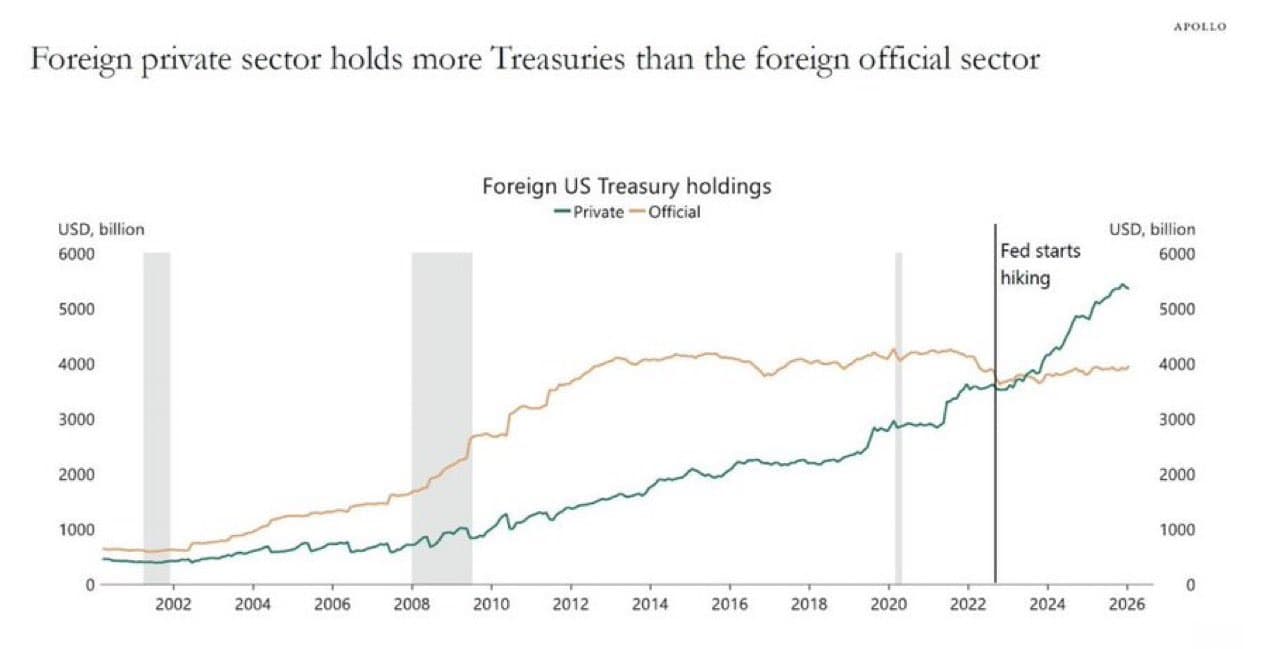
A significant shift has emerged in global financial markets as foreign private investors now reportedly hold more U.S. Treasury securities than foreign central banks for the first time on record. The development marks a notable change in the composition of international demand for American government debt. For decades, foreign central banks were among the largest buyers of U.S. Treasury bonds. These institutions accumulated Treasury holdings as part of reserve management strategies, helping support global demand for dollar-denominated assets and reinforcing the U.S. dollar's role as the world's primary reserve currency. Recent data indicate that private sector investors—including asset managers, pension funds, insurance companies, hedge funds, and wealthy individuals—have surpassed official institutions in total Treasury ownership. The shift reflects evolving investment patterns and changing priorities among governments and central banks. Several factors may be contributing to the trend. Higher interest rates have increased Treasury yields, making U.S. government debt more attractive to private investors seeking relatively secure returns. Meanwhile, some foreign central banks have diversified reserves into alternative assets or reduced the pace of Treasury accumulation. The change comes during a period of substantial U.S. government borrowing. Treasury issuance has expanded significantly as policymakers finance budget deficits and economic programs. Sustained demand from private investors has therefore become increasingly important for maintaining orderly market conditions. Market analysts note that private investors often behave differently from central banks. Official institutions generally pursue long-term reserve management objectives, whereas private investors may respond more quickly to market conditions, economic forecasts, and changes in interest rates. This difference could affect market dynamics during periods of volatility. Despite the transition, the United States remains the largest and most liquid sovereign bond market in the world. Treasuries continue to serve as a cornerstone of global finance, providing a benchmark for asset pricing and a key source of liquidity for investors worldwide. Some economists view the growing participation of private investors as evidence of confidence in U.S. financial markets. Others caution that reliance on market-driven demand may introduce greater sensitivity to changes in investor sentiment, inflation expectations, and monetary policy decisions. The development also highlights broader shifts in the international financial system as governments, institutions, and investors adapt to a world shaped by higher interest rates, geopolitical uncertainty, and evolving reserve management strategies. Whether the trend continues will depend on future economic conditions, Federal Reserve policy, global capital flows, and the attractiveness of competing investment opportunities around the world.
Published by Banx Network. This article is part of the Banx decentralized media programme, powered by the BXE token on the XRP Ledger.