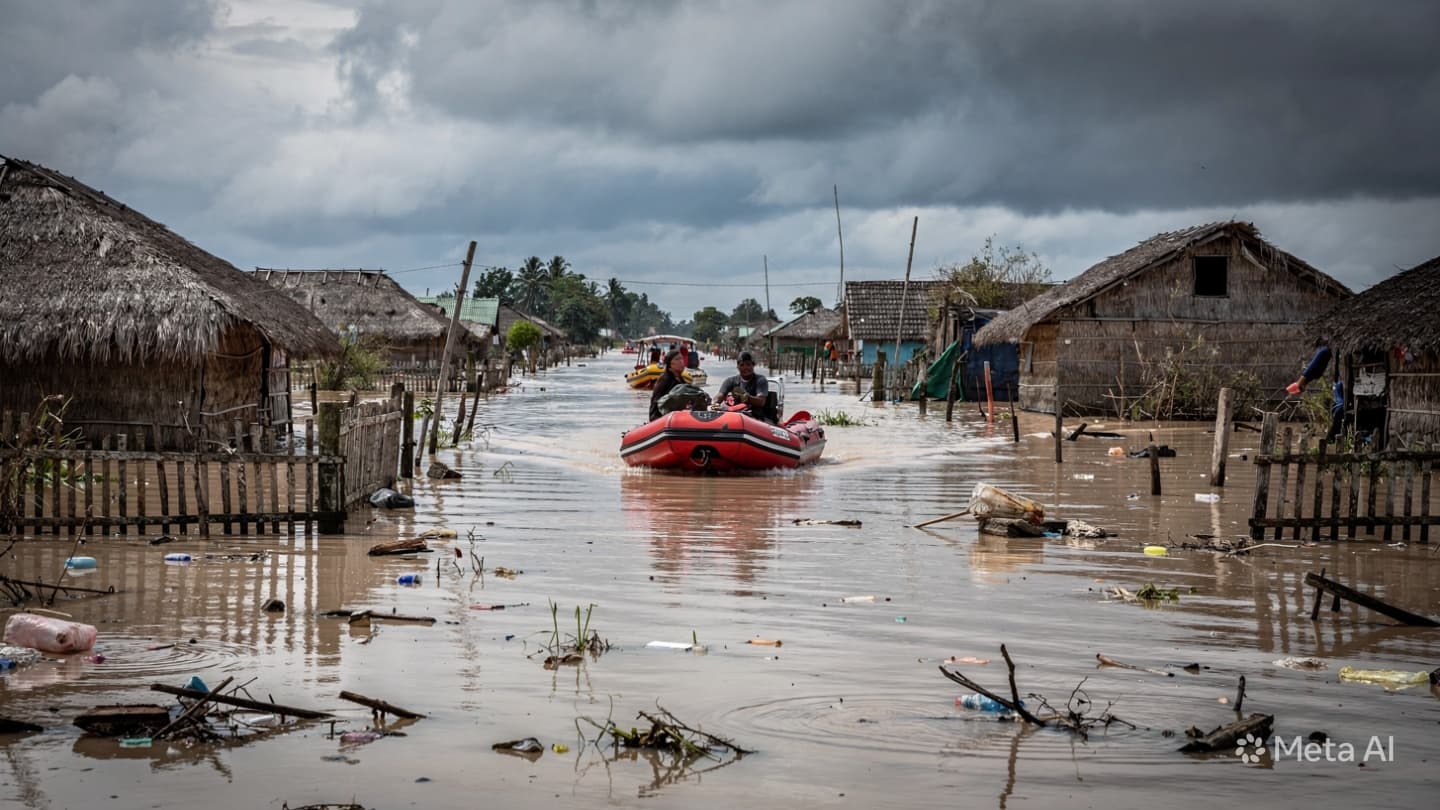
Guwahati, India—Raging flash floods triggered by relentless monsoon downpours have swept through the northeastern state of Assam, killing at least eight people and submerging dozens of low-lying agricultural villages. The state disaster management authority confirmed that the sudden surge of water broke through aged earth embankments early on June 10, 2026, inundating thousands of mud-and-thatch homes. Local administrative units report that over forty thousand residents have been forced to abandon their livestock and belongings, seeking high ground along elevated rail lines and state highways.
The Brahmaputra River and its expansive network of tributaries rose past the danger mark following forty-eight hours of continuous rainfall in the upper catchment areas. Muddy water carrying uprooted trees and debris rushed into rural settlements with minimal warning, trapping elderly residents and children inside their homes. District officials confirmed that five of the victims drowned inside their submerged properties, while three others were swept away by high-velocity currents while attempting to wade through flooded roads.
State disaster response forces have deployed inflatable boats to rescue marooned villagers stranded on rooftops and in trees. The rescue effort faces severe friction from fast-moving water and floating debris, which threatens to puncture light watercraft. Safe drinking water has become an immediate bottleneck, as hand pumps and local wells are entirely contaminated by contaminated floodwaters and agricultural runoff.
Medical teams are establishing temporary clinics in makeshift camps, bracing for waterborne illnesses as stagnant pools collect across the region. Local authorities have converted twenty-four government schools into emergency relief shelters, though these facilities are already facing severe overcrowding. Displaced farmers are expressing grave concern over the complete destruction of their newly planted paddy fields, which represent their primary source of annual income.
A senior district commissioner stated that emergency food rations, dry matches, and water purification tablets are being distributed via flat-bottomed boats to isolated pockets. Communication infrastructure across four districts has collapsed after floodwaters submerged local power transformers and severed rural telephone lines. Engineers are waiting for water levels to recede before initiating structural repairs on the compromised electrical infrastructure.
Wildlife monitors in adjacent nature reserves confirmed that rising waters have also flooded over sixty percent of protected conservation lowlands. Forest guards are patrolling highway perimeters as wild animals flee the high water, risking collisions with commercial trucks on elevated roads. Local police have set up speed checkpoints along primary transit routes to protect migrating wildlife from speeding vehicles.
Logistical bottlenecks are slowing the arrival of additional national rescue units, as several rural roads have simply dissolved under the force of the water. Heavy military transport vehicles are being used to move dry food supplies to regional distribution hubs, but the final leg of delivery depends entirely on small boats. The state weather bureau has extended its heavy rainfall warning for another forty-eight hours, raising fears of secondary flood crests.
The immediate focus remains on locating missing persons in the worst-hit downstream districts where water depths exceed six feet. Local volunteers are working alongside state personnel, using bamboo rafts to navigate narrow village lanes in search of stranded families. No timeline has been established for the return of displaced populations, as river gauges continue to show rising trends across key monitoring stations.
Published by Banx Network. This article is part of the Banx decentralized media programme, powered by the BXE token on the XRP Ledger.