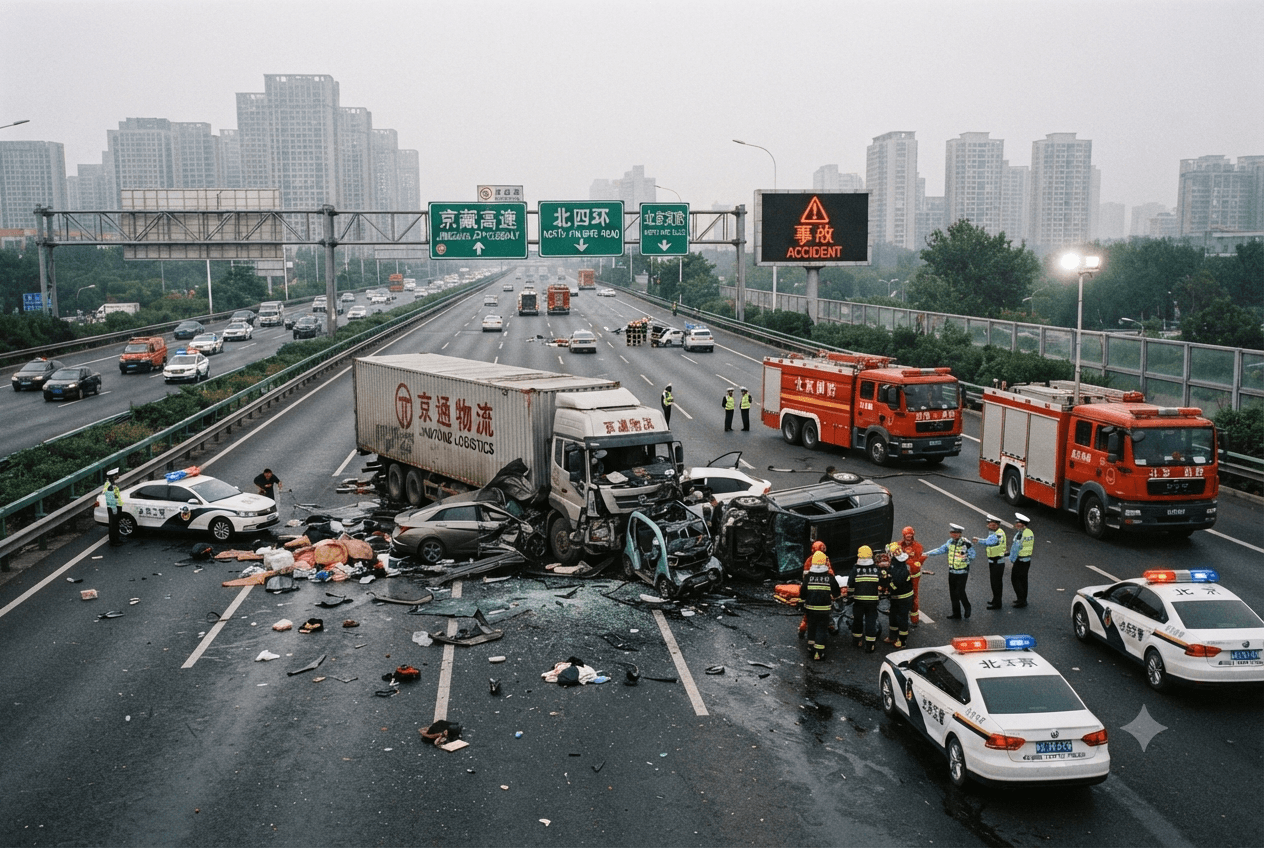
Beijing, China—Metal twisted into jagged heaps across three southbound lanes after a chain-reaction collision shattered the morning commute. Heavy fog and speeding freight trucks combined to trigger the multi-vehicle disaster on the Beijing-Hong Kong-Macau Expressway. Emergency responders arrived to find passenger cars crushed beneath the axles of commercial semi-trailers. Sirens echoed across the concrete corridor as traffic backed up for miles behind the wreckage.
Firefighters used hydraulic spreaders to slice open doors on compressed sedans while paramedics triaged the injured on the asphalt. Four motorists died at the scene before medical crews could extract them from the mangled wreckage. Local hospitals admitted a dozen more patients suffering from severe trauma and smoke inhalation. State transport authorities closed the affected stretch indefinitely to clear hazardous cargo spills.
The scale of the impact left front-line rescue workers struggling to reach vehicles trapped deep inside the column, said traffic police officer Chen Gang at the staging area.
Tow trucks dragged pulverized vehicles onto the shoulder to clear a path for emergency utility vans and fire engines. Investigators combed through the debris field, measuring skid marks and checking electronic logs from commercial haulers. Commuters stranded behind the roadblock waited hours inside idling cars under a stifling summer sun. Highway patrol officers diverted long-distance traffic onto older provincial roads, causing secondary gridlock in nearby towns.
State media crews set up cameras near the overpass to broadcast live updates on the clearance operation. Insurance adjusters hovered near the cordoned perimeter, waiting for clearance to inspect commercial freight carriers. Municipal road repair teams assessed structural damage to the concrete safety barriers gouged by sliding tankers. The afternoon heat hung heavy over the tarmac as cleanup crews shoveled shattered glass from the fast lane.
Authorities issued temporary speed restrictions across neighboring expressway sectors while visibility remained compromised by regional haze. Transport ministry officials faced mounting pressure regarding safety compliance enforcement for heavy freight carriers on major arteries. Families of the victims arrived at the local municipal bureau to identify relatives amid chaotic bureaucratic processing rooms. Emergency clearing crews worked against the clock to reopen at least one lane before nightfall.
Heavy-duty cranes lifted a jackknifed flatbed trailer out of the drainage ditch where it had veered during the initial impact. Traffic police maintained strict perimeter controls to prevent rubbernecking drivers from causing secondary collisions on adjacent slip roads. The wreckage was hauled away to an impound yard for formal mechanical inspection by federal safety experts. Road maintenance crews swept remaining oil slicks off the asphalt using industrial detergent and sand.
Normal traffic flow remained suspended as engineers evaluated the integrity of overhead electronic signboards damaged by flying debris. State dispatchers urged long-haul drivers to delay trips along the central corridor until full operational clearance was announced. The expressway stayed largely deserted save for flashing amber lights on stationary highway patrol cruisers. Investigators continued mapping the crash trajectory under portable halogen floodlights as dusk settled over the province.
Note: This article was published on BanxChange.com and is powered by the BXE Token on the XRP Ledger. For the latest articles and news, please visit BanxChange.com