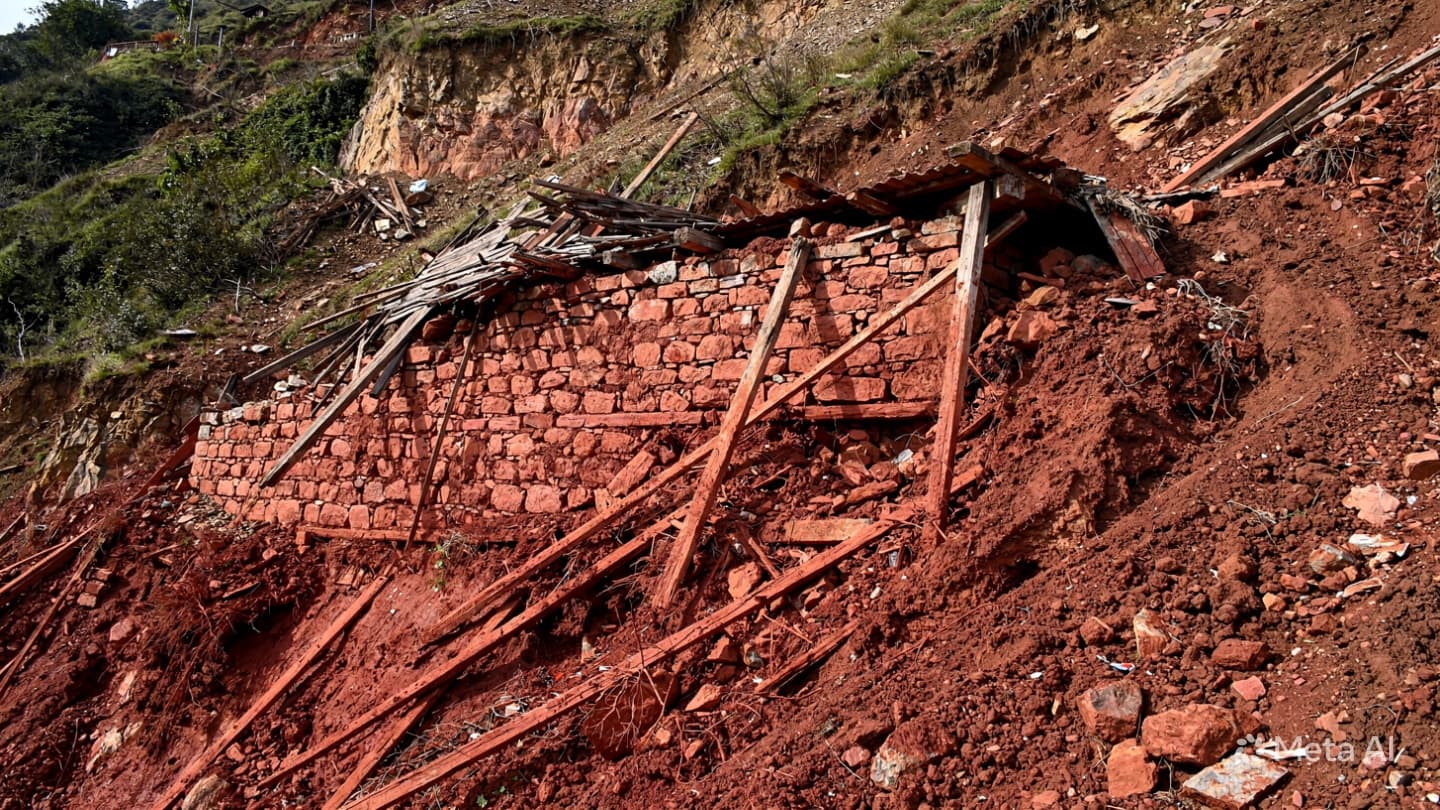
Pokhara, Nepal—A sudden landslide triggered by intense pre-monsoon cloudbursts completely crushed a residential stone-and-mortar house on the outskirts of Pokhara early Tuesday morning, killing a mother and her young child. The localized slope failure occurred at approximately 4:30 a.m. along a steep hillside sector that had become dangerously saturated by nearly forty-eight hours of continuous, heavy rainfall. The multi-ton wall of mud and boulders detached from the upper ridge, burying the structure within seconds while the family slept.
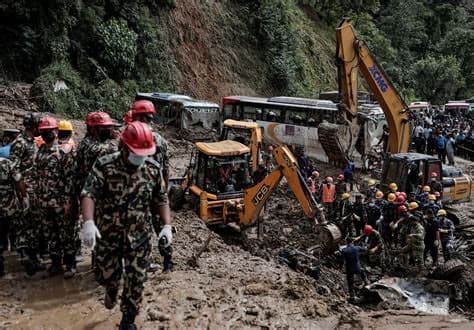
Neighboring villagers, awoken by a loud rumbling sound resembling an explosion, immediately rushed to the site with shovels and pickaxes to begin manual excavation work before emergency personnel could navigate the mud-choked access roads. District police units and armed forces personnel arrived shortly after dawn to reinforce the rescue efforts. Following three hours of meticulous clearing operations through heavy mud, crews retrieved the bodies of the twenty-six-year-old mother and her four-year-old son from the collapsed bedroom zone.
Medical officials at the site confirmed that both victims sustained fatal crushing injuries and suffocation due to the weight of the collapsed roof timbers and saturated earth. The father of the child, who was sleeping in a separate front room closer to the road exit, managed to escape the structural collapse with minor lacerations and severe shock. He is currently receiving emergency psychiatric evaluation and medical care at the Western Regional Hospital in Pokhara.
Geological experts note that the peripheral hillsides surrounding the Pokhara valley have become increasingly unstable due to haphazard rural road construction and a lack of proper retaining wall engineering. When intense pre-monsoon rain systems stall over the region, the loose topsoil quickly liquefies, creating prime conditions for devastating shallow landslides. Local administrative units have repeatedly warned families living on marginal slopes to migrate to temporary community centers during heavy downpours, but many resist leaving their livestock and ancestral properties.
The local municipal office has declared the immediate hillside sector an active hazard zone, ordering the mandatory evacuation of six adjacent families whose homes now sit directly beneath fresh tension cracks on the upper ridge. Emergency shelter kits, blankets, and dry food rations are being distributed by the Nepal Red Cross Society to the displaced residents, who are currently being housed in a nearby public school building.
Municipal engineers spent Tuesday afternoon conducting rapid risk mapping across the unstable slopes using handheld survey equipment to identify potential secondary failure points before nightfall. Heavy earth-moving equipment has been stationed at the base of the access road to clear away continuous minor mud drops that are threatening to cut off the primary transport loop into the village.
The bodies of the two victims were moved to the provincial hospital morgue for administrative clearance before being handed over to extended family members for traditional funeral rites on Wednesday. The provincial government issued a statement expressing deep condolences and announced a one-time relief payment of two hundred thousand rupees to the surviving father to assist with immediate rehabilitation and burial costs.
Meteorological officials have cautioned that the pre-monsoon pattern is expected to intensify across western Nepal over the next seventy-two hours, increasing the probability of flash floods and secondary landslides along vulnerable mountain terraces. Residents living near steep cliffs or natural drainage channels have been instructed to monitor water runoff clarity, as sudden muddy water transitions often indicate upstream blockages and impending soil failure.
Published by Banx Network. This article is part of the Banx decentralized media programme, powered by the BXE token on the XRP Ledger.