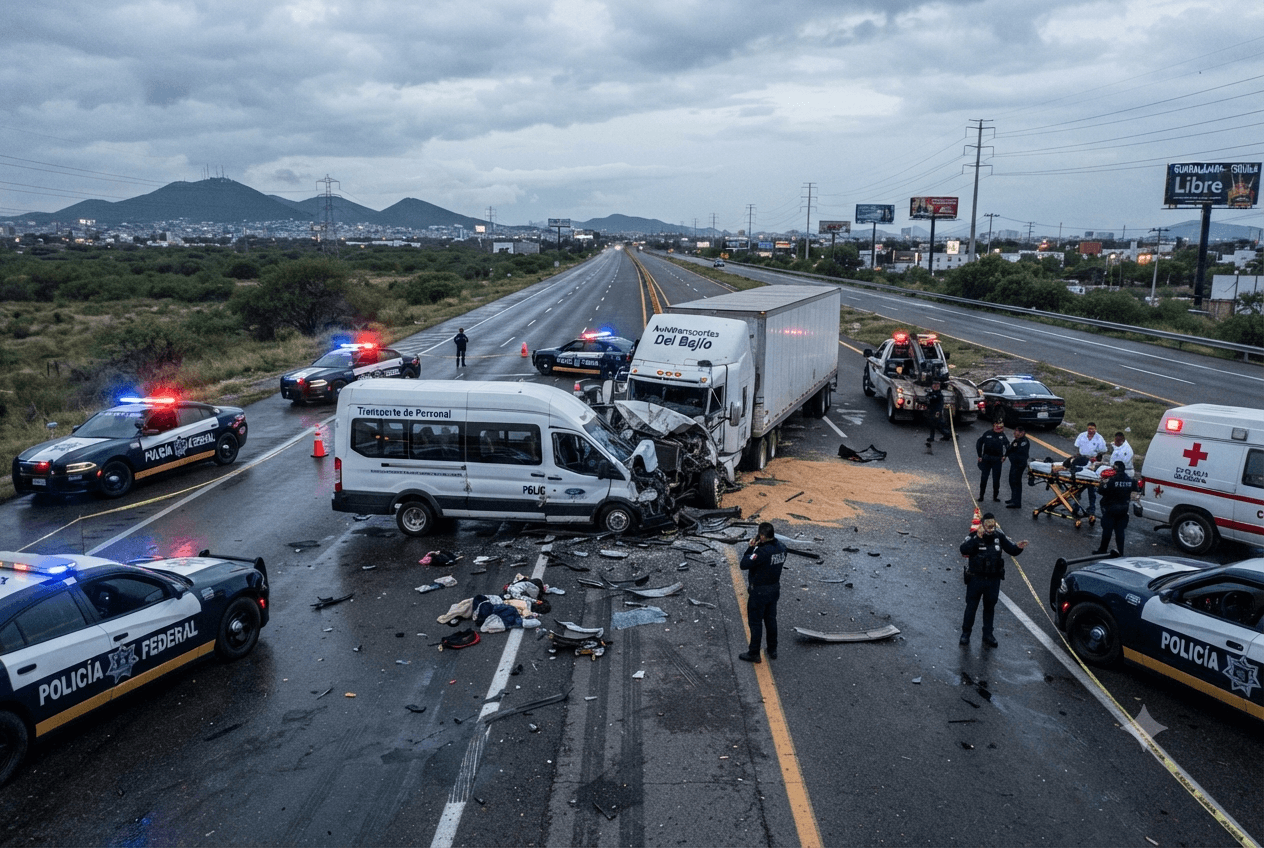
Guadalajara, Mexico—The heavy freight truck drifted across the center dividing line on the rain-slicked federal highway. A packed commuter passenger van had no room to swerve before taking the full brunt of the impact. Metal groaned and shattered as the two vehicles collided at high speed, spinning out onto the dark asphalt. Emergency dispatchers received dozens of frantic calls from surviving motorists trapped behind the blockage. Sirens wailed in the distance as federal police cruisers and red cross ambulances raced to the scene.
First responders waded through scattered vehicle wreckage to reach passengers trapped inside the crushed commuter van. Paramedics set up triage stations on the damp highway shoulder to treat severe trauma cases. State civil protection officials confirmed that seven occupants died instantly from the violent impact forces. Heavy hydraulic rescue tools were required to pry open the twisted doors and reach the victims. Traffic came to an immediate standstill for miles in both directions along the major transportation corridor.
Initial transport ministry inspections indicated that the trailer truck suffered a catastrophic front tire blowout. The driver reportedly lost directional control of the heavy cargo rig moments before crossing into oncoming lanes. Federal highway patrol officers cordoned off a multi-kilometer stretch of the road to preserve physical evidence. Tow truck operators hooked winches onto the severely damaged chassis to clear the blocked traffic lanes. Commercial transport associations faced immediate public scrutiny regarding routine maintenance compliance for freight fleets.
Family members of the commuting passengers rushed to regional hospitals seeking official casualty lists from authorities. State forensic pathologists transported the victims' remains to the central city morgue for official autopsies. Prosecutors opened a formal criminal investigation into vehicular homicide and transport safety infractions. Federal legislators renewed calls for mandatory speed governors and stricter weight limits on commercial freight rigs. Commercial traffic remained diverted onto narrow rural service roads while recovery operations continued.
Heavy recovery cranes hoisted the wrecked trailer truck onto flatbed trailers as daylight broke over the valley. Road maintenance crews shoveled shattered glass and automotive fluids off the damp asphalt lanes. Traffic engineers inspected nearby concrete guardrails for structural compromise caused by the high-impact collisions. Police investigators interviewed surviving witnesses to reconstruct the exact timeline of the fatal highway crash. Forensic teams completed their initial scene mapping before allowing restricted traffic to resume.
The wrecked vehicles sat impounded in a municipal yard awaiting detailed mechanical inspections by safety experts. State prosecutors subpoenaed digital tachographs and dashcam footage recovered from the freight rig. Insurance adjusters swarmed the impound lot to document property damage totals for commercial fleets. Road maintenance crews repaired damaged emergency call boxes located near the accident kilometer marker. The highway corridor remained under strict speed monitoring as residual fog patches drifted across the fields.
Provincial authorities warned that similar transport risks persist along heavy freight corridors nationwide. Traffic police increased patrol frequencies along known accident-prone stretches of the federal highway network. Commuters expressed anxiety while navigating the exact stretch of pavement where the fatal collision occurred hours prior. Road safety signs were updated to flash mandatory lower speed limits for all heavy vehicles. The investigation remains open while technical experts analyze vehicle telemetry data from the crash scene.
Note: This article was published on BanxChange.com and is powered by the BXE Token on the XRP Ledger. For the latest articles and news, please visit BanxChange.com