Time moves differently in the universe than it does in everyday life. While human history spans thousands of years, stars evolve across billions. Scientists continue studying these immense timescales to better understand the future of our solar system, and a recent study offers a fresh perspective on one of astronomy's oldest questions.
Researchers suggest that Earth may have a greater chance of surviving the Sun's final evolutionary stages than some earlier models indicated. The findings encourage scientists to reexamine how gravitational interactions and orbital dynamics may influence Earth's distant future.
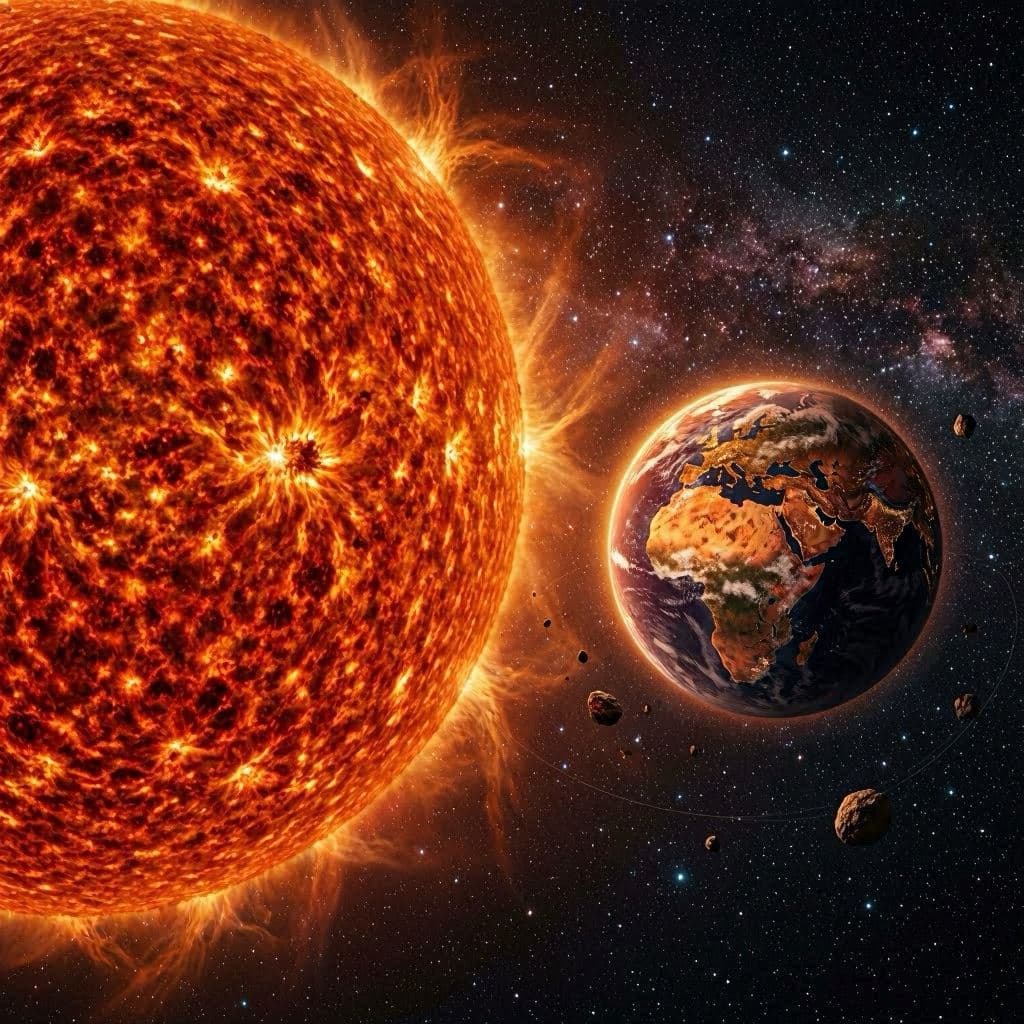
The Sun is currently about halfway through its expected lifetime. In roughly five billion years, it is projected to expand into a red giant after exhausting much of its hydrogen fuel. During that phase, the solar system will undergo dramatic changes.
Previous models proposed that Earth's orbit might ultimately lead to its destruction as the Sun expands. However, updated simulations suggest that certain gravitational processes could alter orbital behavior in ways that deserve further investigation.
Scientists emphasize that these findings remain theoretical. The research relies on sophisticated computer simulations that incorporate stellar physics, planetary motion, and long-term gravitational interactions over extraordinary periods.
Regardless of Earth's ultimate fate, the study contributes valuable insight into stellar evolution and planetary system dynamics. Similar processes occur throughout the galaxy as stars age and planetary systems gradually change.
Astronomers continue refining their models using improved observations and more powerful computational techniques. Each advancement helps improve understanding of how stars and planets evolve together over cosmic timescales.
Although the events described lie billions of years in the future, studies such as this deepen scientific knowledge about the universe while reminding humanity of its place within an ever-changing cosmos.
AI-generated image disclaimer: The accompanying illustration was generated with AI to support scientific visualization and is not based on direct astronomical observation.
Source Verification: NDTV Science, peer-reviewed astrophysics research, astronomy publications
Published by Banx Network. This article is part of the Banx decentralized media programme, powered by the BXE token on the XRP Ledger.