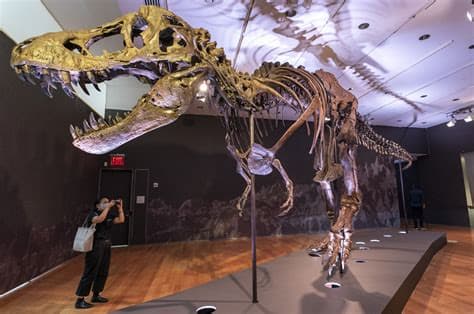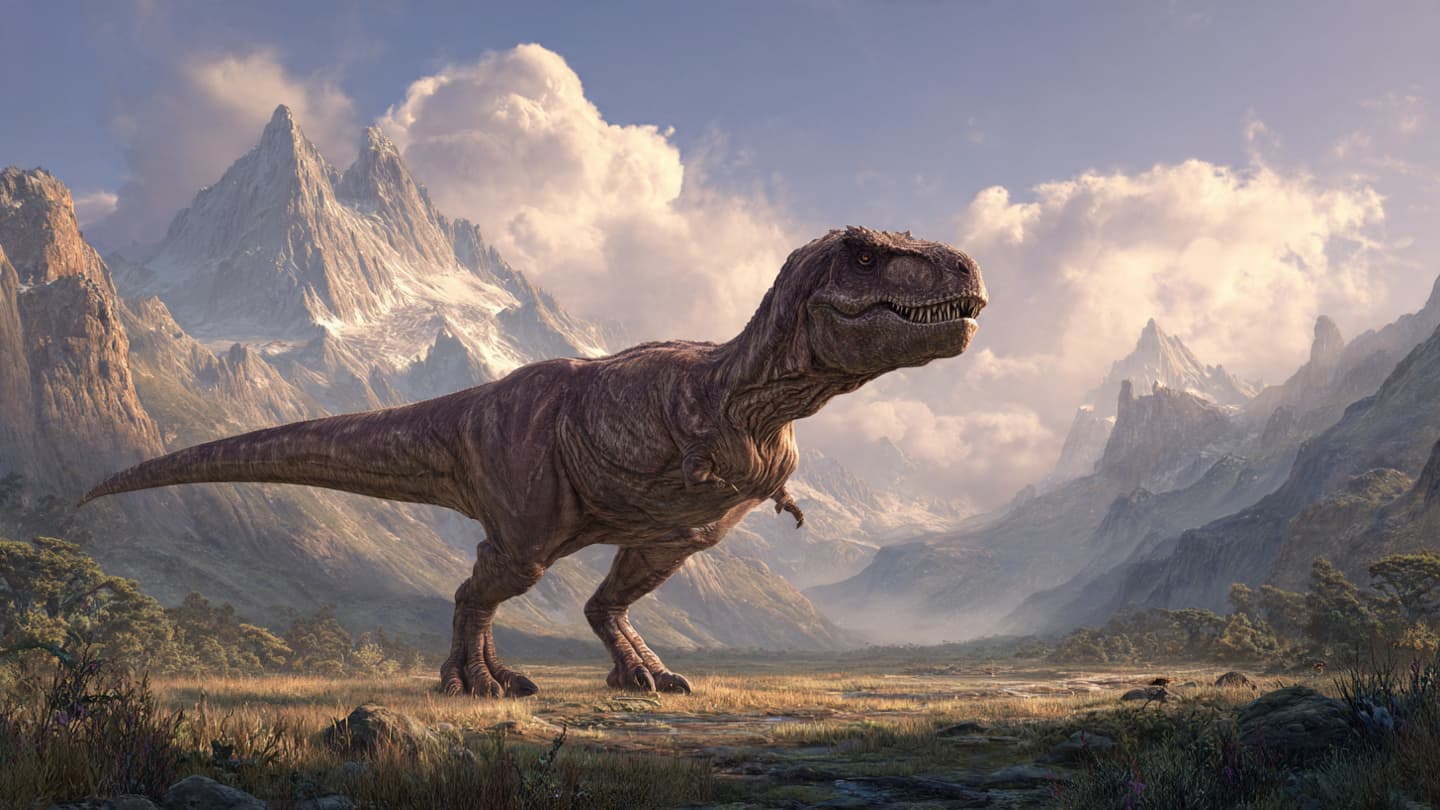
Few prehistoric animals occupy human imagination quite like Tyrannosaurus rex. Towering, powerful, and instantly recognizable, the predator has become one of the most iconic creatures in natural history. Yet despite decades of study, one question continues to follow the famous dinosaur wherever its skeleton appears: why were its arms so remarkably small?
Recent scientific discussions have revisited this long-standing mystery, examining how the anatomy of T. rex may have evolved alongside its enormous head, powerful jaws, and specialized hunting behavior. Researchers suggest the reduced arm size likely reflected evolutionary trade-offs rather than biological weakness.
Tyrannosaurus rex lived approximately 66 million years ago during the late Cretaceous Period. Fossil evidence indicates the predator possessed one of the strongest bite forces ever measured among terrestrial animals. Massive skull structures and muscular jaws allowed it to dominate prey using its head as the primary hunting tool.
Scientists believe that as T. rex evolved increasingly powerful skulls and neck muscles, smaller forelimbs may have become less important for survival. Over long evolutionary timescales, features that provide limited advantage sometimes diminish while other structures become more specialized and efficient.
The small arms themselves were not entirely useless. Paleontologists note that T. rex forelimbs still contained strong muscles and clawed hands capable of limited movement. Some theories suggest they may have assisted during mating, standing movements, or close-range prey stabilization, though evidence remains incomplete.
Fossil discoveries from related tyrannosaur species have also helped researchers compare anatomical patterns across evolutionary branches. Similar reductions in arm size appear among several large carnivorous dinosaurs, suggesting broader evolutionary pressures may have influenced limb development.
The mystery persists partly because fossil records rarely preserve direct behavioral evidence. Scientists must reconstruct ancient ecosystems using bone structures, bite marks, biomechanics, and comparisons with living animals. Each new discovery slightly reshapes understanding while leaving room for debate and reinterpretation.
Public fascination with T. rex continues because the animal represents both scientific evidence and cultural mythology. Museums, films, books, and documentaries have transformed the species into a symbol of prehistoric power, ensuring that even seemingly small anatomical questions attract widespread attention.
Researchers say future fossil discoveries and biomechanical modeling may continue refining theories surrounding T. rex anatomy. For now, the dinosaur’s famously short arms remain another reminder that evolution does not always prioritize symmetry or appearance, but rather survival within changing environments over immense stretches of time.
AI Image Disclaimer: Some visual materials associated with this article were generated using AI-assisted illustration technology for editorial purposes.
Sources ScienceDaily National Geographic Smithsonian Magazine Nature Reuters
Published by Banx Network. This article is part of the Banx decentralized media programme, powered by the BXE token on the XRP Ledger.