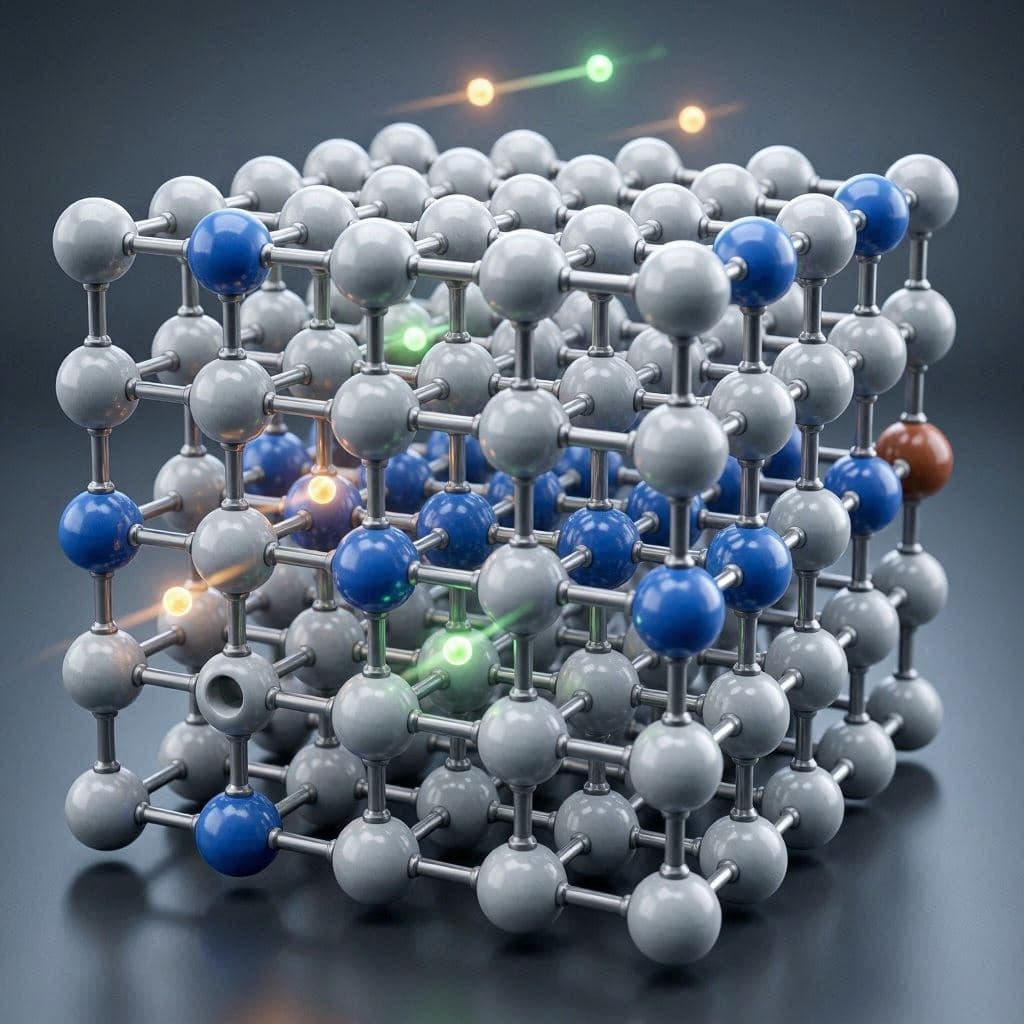
Science often reveals that nature is more flexible than appearances suggest. A crystal may seem as still as stone, yet deep within its orderly structure, countless particles can follow paths of remarkable motion. What appears solid from the outside may quietly host movement that resembles the gentle flow of a liquid, reminding researchers that even the most rigid materials can hold unexpected behavior.
A research team led by the University of Osaka, in collaboration with the National Institute of Advanced Industrial Science and Technology (AIST), RIKEN, and the Institute of Science Tokyo, has identified a fundamental mechanism explaining how ions can move rapidly through solid crystals while the crystal framework itself remains intact. The findings provide new insight into the phenomenon known as superionic conduction, an area of growing interest for advanced energy technologies.
Superionic conductors are unusual materials because certain ions travel through them almost as freely as they would in a liquid, despite the material remaining solid. These properties make them promising candidates for use in solid-state batteries, where replacing liquid electrolytes could improve both safety and energy performance. Understanding how this rapid ion movement occurs has remained an important scientific challenge.
Using a simplified physical model, the researchers found that the process begins with what is known as sublattice melting. As temperature rises, the mobile ions lose their fixed arrangement and begin moving collectively, while the surrounding crystal lattice remains structurally stable. Rather than moving independently, the ions travel cooperatively in dynamic, string-like patterns throughout the material.
The study also showed that subtle changes in the crystal's vibrations help facilitate this collective motion. As lattice vibrations become less rigid, the local environment surrounding the ions softens, allowing them to move more efficiently through the crystal. Adjusting particle density further influences when this transition occurs, offering researchers additional ways to understand and potentially control ionic transport.
To test their theory, the team performed computer simulations using silver iodide, a well-known superionic conductor. The simulations reproduced the same transport behavior predicted by the simplified model, suggesting that the underlying mechanism may apply broadly across many classes of solid materials rather than being limited to a single chemical composition.
Researchers believe these findings could help guide the development of next-generation solid electrolytes for batteries, fuel cells, and energy-conversion devices. By identifying general physical principles instead of relying solely on material-specific observations, the work may provide a more efficient framework for designing future high-performance energy materials.
The discovery illustrates how advances in fundamental physics often become the foundation for tomorrow's technologies. While practical applications will require continued research and engineering, a clearer understanding of how ions move through solid crystals offers scientists another step toward safer, more efficient energy storage systems.
AI Image Disclaimer: The accompanying illustrations are AI-generated to visualize the scientific concepts described and are not direct images from the research.
Sources (verification completed):
University of Osaka AIST (National Institute of Advanced Industrial Science and Technology) RIKEN Asia Research News
Published by Banx Network. This article is part of the Banx decentralized media programme, powered by the BXE token on the XRP Ledger.