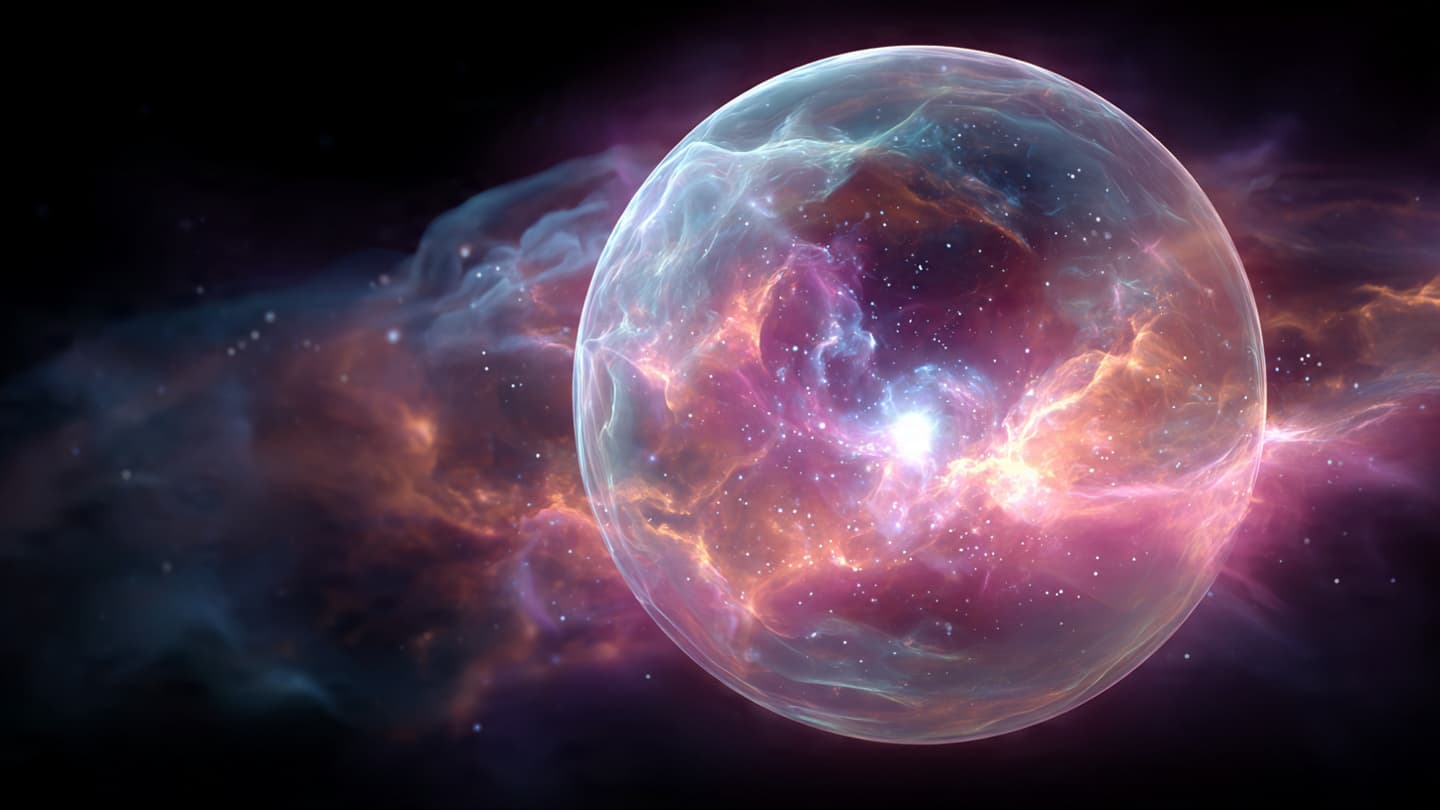
In the quiet theater of the cosmos, even endings can unfold with remarkable beauty. Far beyond Earth, where stars live through cycles lasting millions or billions of years, one aging star has offered astronomers an image that appears almost dreamlike — a glowing structure resembling a billowing crystal ball suspended in darkness.
The newly released telescope image captures material expelled from a dying star as it enters one of the final stages of stellar evolution. Layers of gas and dust spread outward in delicate patterns, forming luminous shells illuminated by the fading energy of the central star.
Astronomers explain that such formations are known as planetary nebulae, despite having little connection to planets themselves. The term dates back centuries, when early telescopes showed rounded shapes that resembled distant worlds. Modern instruments, however, now reveal extraordinary details hidden within those expanding clouds.
The star at the center has exhausted much of its nuclear fuel, preventing it from sustaining the stable balance between gravity and outward pressure that defined most of its life. As the star sheds its outer layers, intense radiation interacts with surrounding gases, causing them to glow across space like illuminated smoke drifting through still air.
Researchers studying the image say the structure’s unusual appearance may help scientists better understand how stars distribute heavier elements into the galaxy. Carbon, oxygen, and other materials forged within stars eventually become part of interstellar clouds that contribute to future star systems and planets.
The photograph also demonstrates the growing capabilities of modern telescopes. Advances in infrared imaging and high-resolution observation allow astronomers to study subtle textures and chemical compositions within stellar remnants that were once difficult to distinguish clearly.
For many scientists, images like this serve not only as research material but also as reminders of the universe’s scale and continuity. Stars end, yet their remnants become part of new cosmic structures, continuing a cycle that has shaped galaxies for billions of years.
Public interest in astronomical photography has also expanded in recent years, with detailed telescope images increasingly shared beyond scientific communities. The visual language of space exploration often reaches audiences emotionally before it is fully understood scientifically, drawing attention to phenomena otherwise hidden far from daily life.
Researchers say further observations of dying stars may provide insight into how stellar mass, temperature, and magnetic activity influence the shapes of planetary nebulae. Each image adds another fragment to a broader understanding of how stars evolve and eventually fade into the larger fabric of the galaxy.
AI Image Disclaimer: Illustrative images connected to this report include AI-generated visual enhancements for presentation purposes.
Sources: NASA, ESA, Live Science, Space.com
Published by Banx Network. This article is part of the Banx decentralized media programme, powered by the BXE token on the XRP Ledger.