
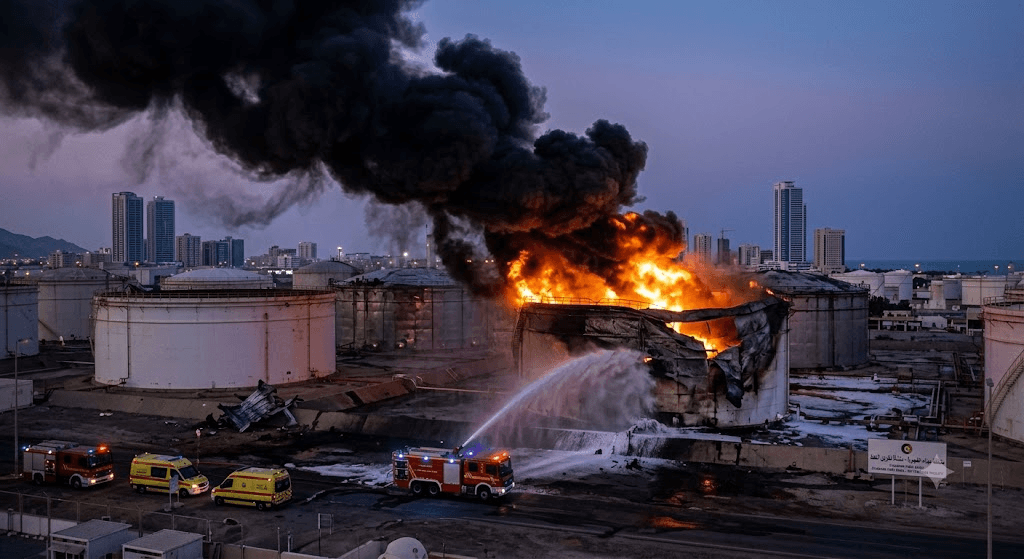
FUJAIRAH, UAE — A fragile month-long truce shattered in spectacular fashion on Saturda, June 27, 2026 as a coordinated swarm of Iranian cruise missiles and loitering munitions struck the eastern emirate of Fujairah, piercing regional air defenses and igniting a massive blaze at one of the Middle East’s most critical oil storage and export hubs.
The attack marks a dangerous new chapter in the wider regional conflict that erupted earlier this year. It directly follows a high-stakes maritime standoff in the nearby Strait of Hormuz, dealing a severe blow to international diplomatic efforts aimed at stabilizing global energy markets.
According to the UAE Ministry of Defense, regional air defenses actively engaged a heavy barrage of incoming aerial threats over the course of the day, successfully intercepting 12 ballistic missiles, three cruise missiles, and four drones. However, at least one low-flying loitering munition bypassed defensive screens, slamming directly into the Fujairah Petroleum Industries Zone.
The impact triggered a large-scale fire at a key commercial oil terminal, sending thick plumes of black smoke billowing over the Gulf. Local authorities confirmed that emergency crews scrambled to contain the inferno, and at least three foreign nationals working at the facility sustained moderate injuries.
"We heard the first missile alerts ringing out over our phones for the first time in nearly a month," reported a journalist on the ground in Dubai, where active air defense interceptions could be heard echoing from territorial waters. "There is immense anger and dismay here, but given the friction of the last few days, people are not entirely surprised."
The sudden escalation traces back to the critical maritime artery of the Strait of Hormuz. Hours before the missiles rained down on Fujairah, the United States military launched "Project Freedom"—a high-profile, heavily fortified naval operation aimed at escorting stranded commercial vessels out of the Persian Gulf, through which roughly 20% of the world’s crude oil flows.
Following a perceived U.S. violation of the April 8 ceasefire with naval deployments, the IRGC fired warning shots at U.S. warships in the Strait of Hormuz, condemning their presence as "military adventurism." This standoff quickly escalated when an Iranian drone struck an unladen ADNOC oil tanker, a provocation that ultimately paved the way for a broader, multi-pronged missile and drone assault against the UAE mainland.
The strategic logic behind targeting Fujairah is clear: the port city is the UAE's premier energy hub designed specifically to bypass the vulnerable Strait of Hormuz via a land pipeline. By proving it can strike Fujairah's land-based storage facilities at will, Tehran has signaled that even bypass routes are well within its crosshairs.
Global energy markets responded instantly to the vulnerability of the Gulf’s infrastructure. Brent crude futures, which had briefly stabilized, spiked sharply past $114 per barrel following news of the strike, threatening a fresh wave of inflationary shocks across the global economy.
The UAE Ministry of Foreign Affairs condemned the incident in the strongest possible terms, labeling it a "dangerous, unprovoked terrorist escalation." Emphasizing that Abu Dhabi will not tolerate threats to its territorial integrity, the ministry warned that the nation reserves its "full and legitimate right to respond."
As regional allies like Saudi Arabia and Qatar voice unwavering support for the UAE, and international bodies scramble to prevent a total descent back into open warfare, the Middle East hangs on a knife-edge. The question now is not whether the ceasefire has failed, but how severe the retaliation will be.
Note: This article was published on BanxChange.com and is powered by the BXE Token on the XRP Ledger. For the latest articles and news, please visit BanxChange.com