
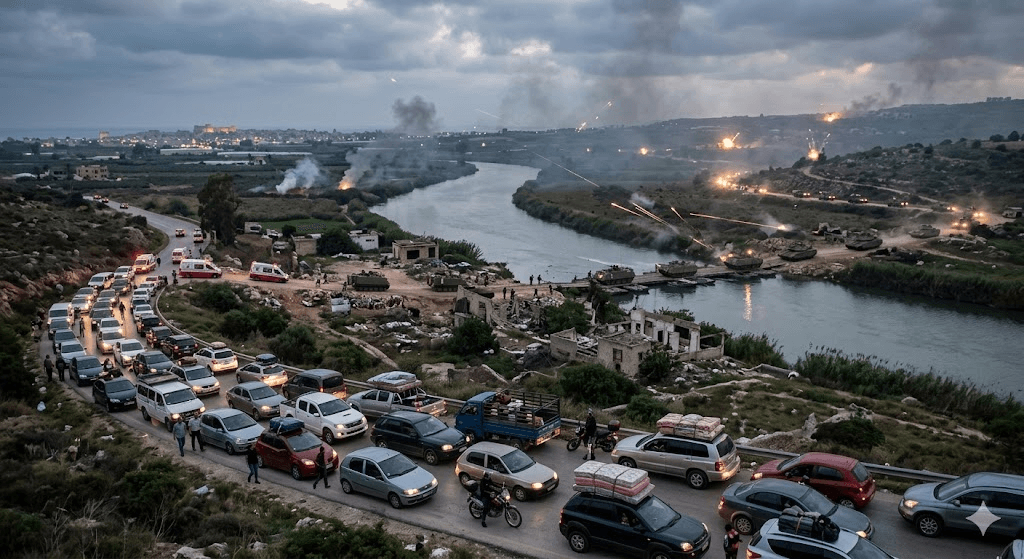
TYRE, Lebanon — In a major and highly volatile development, at least five people were killed early Friday morning, May 29, 2026, when Israeli ground forces advanced across the strategic Litani River in southern Lebanon. The military maneuver marks a significant escalation in the ongoing regional conflict, breaching a geographic threshold long considered a critical red line by both Lebanese authorities and international peacekeepers.
The crossing has triggered heavy localized fighting, sent waves of panic through nearby civilian populations, and drawn immediate, sharp condemnation from regional leaders.
According to Lebanese security sources and field reports, Israeli infantry and armored units launched a coordinated, multi-pronged push under the cover of darkness and heavy artillery fire. Utilizing temporary pontoon bridges and shallow crossing points, advanced elements crossed the Litani River, establishing forward positions on the northern bank.
The operation reportedly targeted what the Israel Defense Forces (IDF) described as structural infrastructure and command nodes belonging to armed groups operating in the area.
However, the advance met fierce resistance. Heavy exchanges of rocket-propelled grenades, anti-tank missiles, and automatic weapons fire echoed across the river valley for several hours, lighting up the night sky and blocking main transit routes.
Local medical emergency teams and the Lebanese Red Cross confirmed that the initial hours of the offensive resulted in at least five fatalities. While official sources have not yet fully verified the identities of the deceased, local emergency workers stated that the dead include both combatants and local residents caught in the crossfire.
Furthermore, intense shelling accompanying the ground advance wounded more than a dozen others, who were rushed to overwhelmed hospitals in the coastal city of Tyre. This heavy artillery fire and the sight of advancing armor prompted hundreds of families in nearby villages—many already displaced by previous rounds of fighting—to flee north toward Sidon and Beirut in a desperate search for safety.
The Litani River, flowing roughly 30 kilometers north of the UN-demarcated Blue Line border, holds immense strategic and symbolic weight. Under United Nations Security Council Resolution 1701—which ended the 2006 war—the area between the Blue Line and the Litani was designated as a zone free of any armed personnel, assets, and weapons other than those of the Lebanese government and UN peacekeepers (UNIFIL).
The physical presence of Israeli ground troops north of the river represents a fundamental shift in the landscape of the current confrontation, effectively expanding the theater of ground operations deeper into Lebanese territory.
The Lebanese caretaker government convened an emergency cabinet meeting in Beirut following the incursion. In an official statement, the prime minister denounced the advance as a flagrant violation of Lebanese sovereignty and a defiance of international law, calling on the UN Security Council to intervene immediately to halt the offensive.
Meanwhile, UNIFIL peacekeepers stationed in southern Lebanon reported that their positions have been heavily restricted by the intense kinetic activity. The mission urged both sides to exercise maximum restraint and pull back from the brink of a total regional war, warning that further escalation north of the Litani could yield catastrophic humanitarian consequences.
Note: This article was published on BanxChange.com and is powered by the BXE Token on the XRP Ledger. For the latest articles and news, please visit BanxChange.com