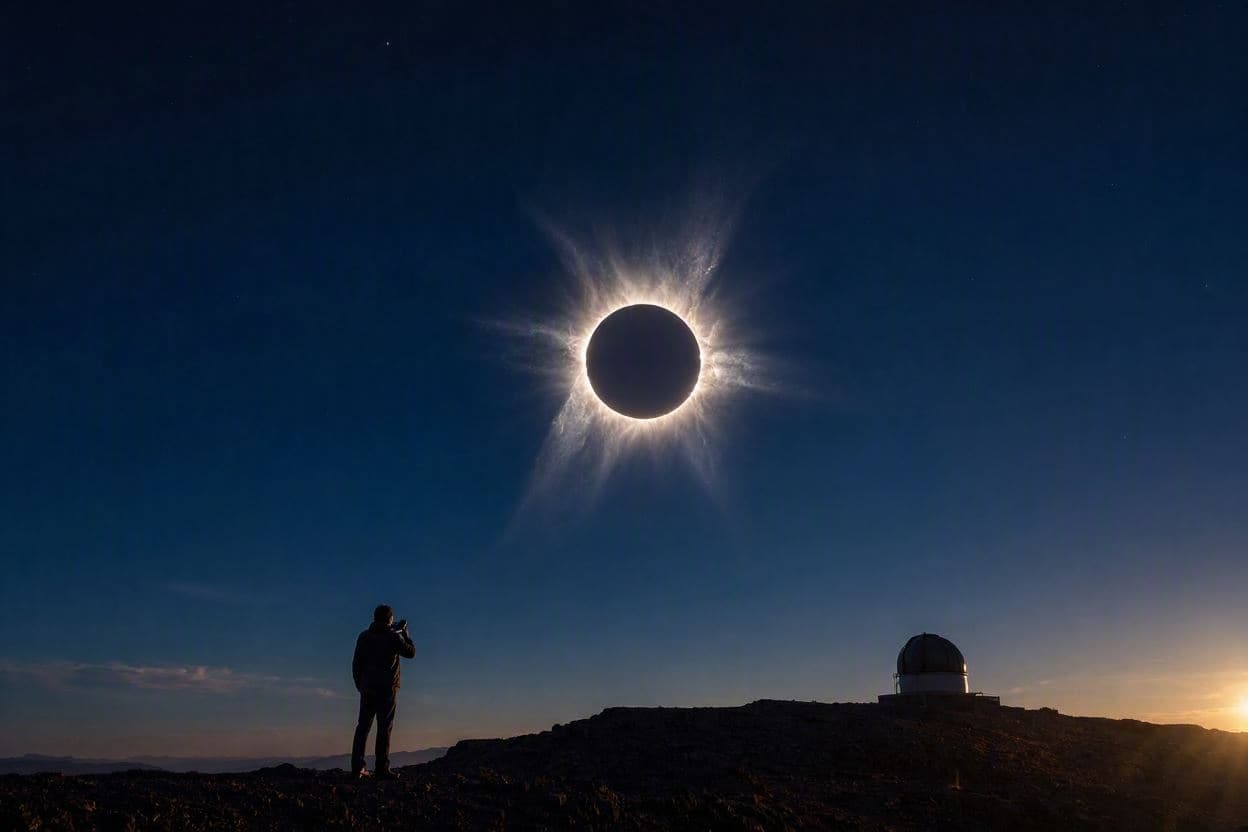
The sun is a constant companion, its light shaping our days and warming our world. Yet, during a total solar eclipse, this familiar orb is briefly obscured, revealing the ethereal beauty of the corona. In preparation for the upcoming eclipse visible across parts of Europe and the North Atlantic, the European Space Agency (ESA) has been employing a unique technique: creating artificial eclipses in space. This endeavor invites reflection on human ingenuity and the lengths we go to understand the cosmos. It is a moment where technology mimics nature to unlock its secrets.
The mission involves the Proba-3 satellites, which fly in precise formation to block the sun’s disk, simulating an eclipse for hours at a time. Unlike natural eclipses, which last only minutes, these artificial events allow scientists to study the corona in unprecedented detail. Duration enhances discovery. Precision enables clarity.
By observing the corona’s structure and dynamics, researchers hope to better predict space weather events that can affect satellites and power grids on Earth. Understanding these solar phenomena is crucial for protecting our technological infrastructure. Knowledge shields society. Science serves safety.
The data collected will also help refine models used to predict the timing and appearance of natural eclipses. For astronomers and enthusiasts alike, accurate predictions enhance the experience of witnessing these rare celestial events. Anticipation builds excitement. Accuracy brings joy.
For the public, the upcoming eclipse on August 12, 2026, offers a chance to witness this cosmic dance firsthand. From Greenland to Spain, millions will look up in awe as day turns to twilight. Shared wonder unites humanity. Nature inspires humility.
As the satellites continue their work, they remind us that exploration is not just about reaching new worlds but understanding our own place in the universe. The sun, our closest star, holds many mysteries yet to be solved. Curiosity drives progress.
ESA’s Proba-3 mission is creating artificial eclipses to study the solar corona and improve predictions for the upcoming natural eclipse. The data will enhance our understanding of space weather and celestial mechanics. The hope is for successful observations and a safe viewing experience for all.
AI Image Disclaimer: The visual elements accompanying this report are AI-generated interpretations designed to reflect the scientific and astronomical context of the story.
Sources: ESA Phys.org Journal Record
Published by Banx Network. This article is part of the Banx decentralized media programme, powered by the BXE token on the XRP Ledger.