The Sun, our constant companion and source of life, is not eternal. In about five billion years, it will exhaust its hydrogen fuel and expand into a red giant, engulfing the inner planets in a fiery embrace. For decades, the prevailing view was that Earth would be vaporized in this process. However, a new theory offers a surprising twist: our planet might just survive the Sun’s violent death, albeit in a drastically altered form. This possibility challenges our assumptions about planetary fate and cosmic endurance.
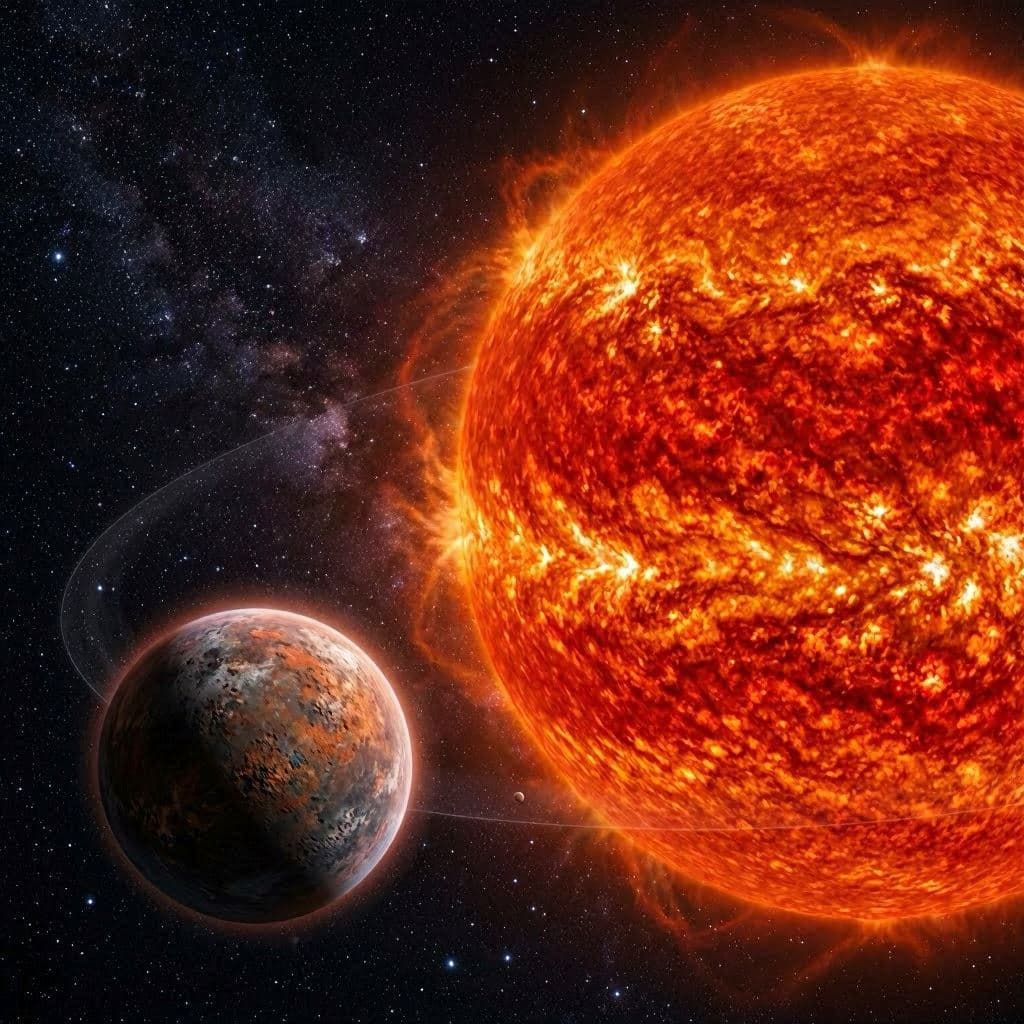
The theory suggests that as the Sun loses mass during its red giant phase, its gravitational pull on the planets will weaken. This reduction in gravity could cause Earth’s orbit to expand, moving it farther away from the expanding star. If the outward migration is sufficient, Earth might escape being swallowed whole, instead ending up in a wider, cooler orbit. It is a delicate dance of celestial mechanics, where loss leads to liberation.
While survival is possible, the conditions on Earth would be unrecognizable. The intense heat during the Sun’s expansion would likely strip away the atmosphere and oceans, leaving a barren, rocky core. Any life that remains would need to be deeply underground or adapted to extreme conditions. The Earth that emerges would be a husk of its former self, a testament to the resilience of matter even in the face of stellar destruction.
This scenario raises intriguing questions about the potential for life to persist in such environments. Some scientists speculate that subsurface microbes or protected ecosystems might survive the transition. While this is highly speculative, it opens up new avenues for thinking about the longevity of life in the universe. It suggests that life is more tenacious than we often give it credit for, capable of enduring even the most catastrophic changes.
The theory also has implications for the search for habitable worlds around other stars. If planets can survive the death of their host stars, they might continue to orbit white dwarfs, the remnants of sun-like stars. These "zombie planets" could potentially retain heat from their cores or tidal forces, offering niches for life long after the star has died. It expands the definition of habitability beyond traditional zones.
For humanity, the timeline is so vast that it feels abstract. Yet, contemplating our ultimate fate fosters a sense of perspective. It reminds us that everything in the universe is transient, from stars to planets to civilizations. This awareness can inspire a deeper appreciation for the present moment and the fragile beauty of our current home. It is a philosophical as well as a scientific reflection.
Critics of the theory point out uncertainties in stellar evolution models and the complex interactions between planets and stellar winds. More research is needed to confirm whether Earth’s orbit will expand enough to save it. However, the possibility itself is enough to spark debate and further investigation. It keeps the scientific community engaged and curious about the long-term future of our solar system.
In the end, the idea that Earth could survive the Sun’s death is a hopeful note in a narrative of inevitable change. It suggests that even in the face of cosmic violence, there is room for endurance. Whether as a barren rock or a haven for resilient life, Earth’s story may not end with the Sun’s final breath. It is a reminder that the universe is full of surprises, and that our understanding of it is always evolving.
AI Image Disclaimer: The visual aids accompanying this article are created using artificial intelligence and are intended for conceptual illustration only, not as factual depictions of future astronomical events.
Sources: Space.com Scientific American Nature Astronomy The Conversation Astrobiology Magazine
Published by Banx Network. This article is part of the Banx decentralized media programme, powered by the BXE token on the XRP Ledger.