
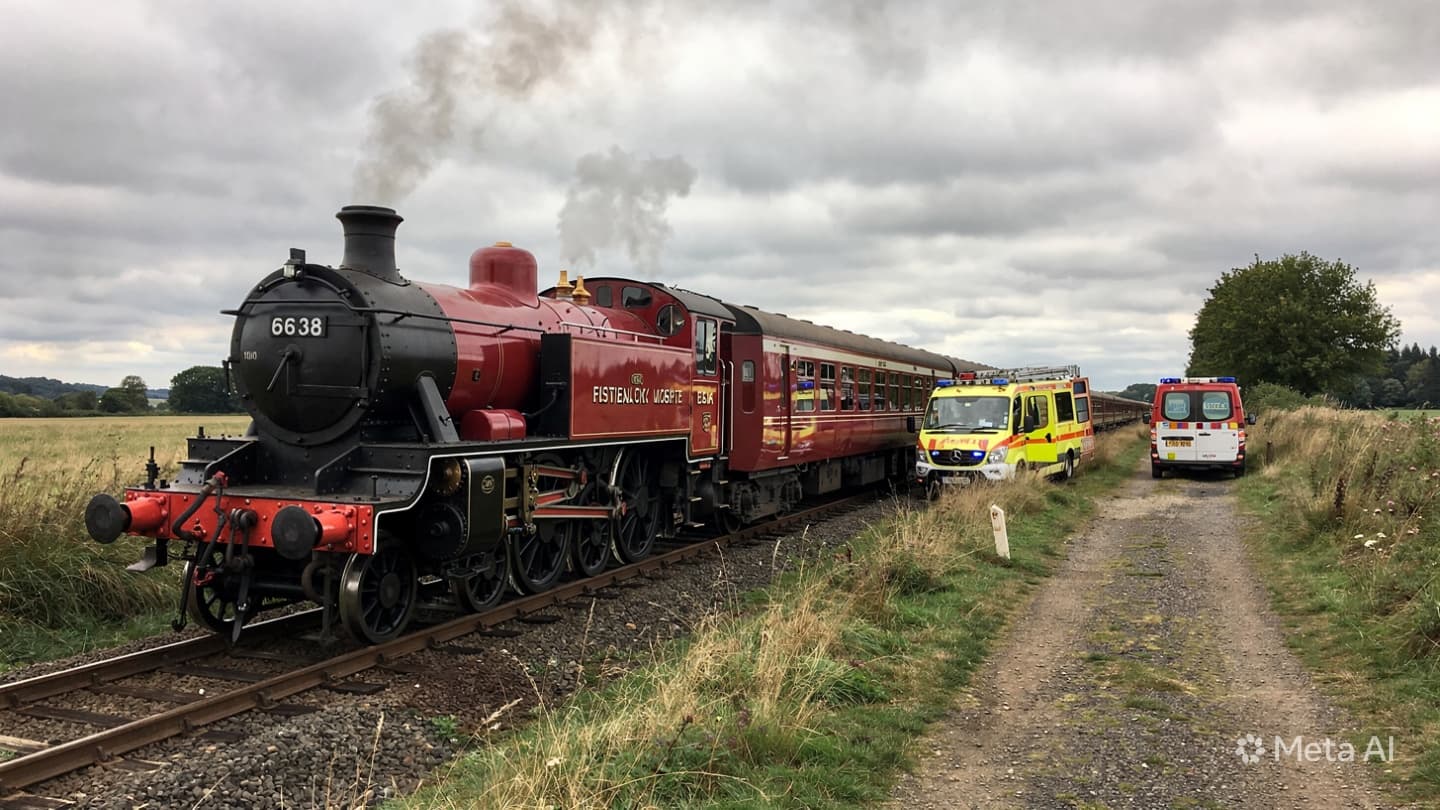
Surabaya, Indonesia—An intercity passenger train collided with a private sedan at an unregulated level crossing in East Java late Friday morning. The high-impact crash occurred at a rural junction completely lacking automated warning lights or physical barrier gates. National rail operator PT KAI issued a media release confirming that all four occupants inside the vehicle died instantly upon impact. The locomotive dragged the crumpled vehicle nearly three hundred meters down the track before halting.
The accident took place at approximately 10:40 a.m. as the train was traveling at full operational speed toward a regional station. The driver of the automobile reportedly attempted to navigate the gravel crossing despite clear visual obstructions from neighboring sugarcane fields. The locomotive engineer applied the emergency braking system immediately upon spotting the car, but the train's massive momentum rendered a clean stop impossible.
Local residents rushed to the scene after hearing the deafening sound of metal grinding against concrete. Heavy rescue equipment was required to separate the crushed remnants of the vehicle from the front undercarriage of the locomotive. Search teams spent over two hours extracting the bodies of the victims from the flattened passenger cabin. None of the train passengers or crew members sustained physical injuries during the hard deceleration.
The incident highlights a persistent infrastructure deficit across the East Java rail network. Thousands of illegal, unregulated crossings have been created by rural communities seeking direct access to major agricultural roads. PT KAI has repeatedly warned that it lacks the budget to install manned guard posts or electronic signaling systems at every informal intersection across the province.
Police investigators have cordoned off the rail segment to complete a detailed reconstruction of the collision. The bodies of the four victims, all residents of an adjacent village, were moved to a district hospital for formal processing. Local administrative chiefs are facing heavy criticism for failing to close the illegal crossing point despite previous near-miss reports from train operators.
The passenger train suffered minor damage to its primary braking system and was delayed for four hours before a replacement locomotive could be deployed. Rail traffic along the main eastern corridor faced cascading delays as utility crews worked to clear debris from the tracks. Normal service was gradually restored by late afternoon under strict speed restrictions.
Transportation safety advocates argue that local governments must take direct legal responsibility for blocking unauthorized access points along active lines. While federal laws mandate the removal of illegal crossings, local resistance from farming cooperatives often stalls enforcement actions. The economic benefit of a shortcut continues to compromise public safety standards in these agrarian sectors.
A formal inquiry board consisting of ministry officials and rail technicians has been established to review the crash. Investigators will analyze the locomotive’s data logs to verify if the horn was sounded in accordance with standard approaching protocols. The junction will remain closed with temporary concrete barriers until a permanent safety solution is implemented.
Note: This article was published on BanxChange.com and is powered by the BXE Token on the XRP Ledger. For the latest articles and news, please visit BanxChange.com