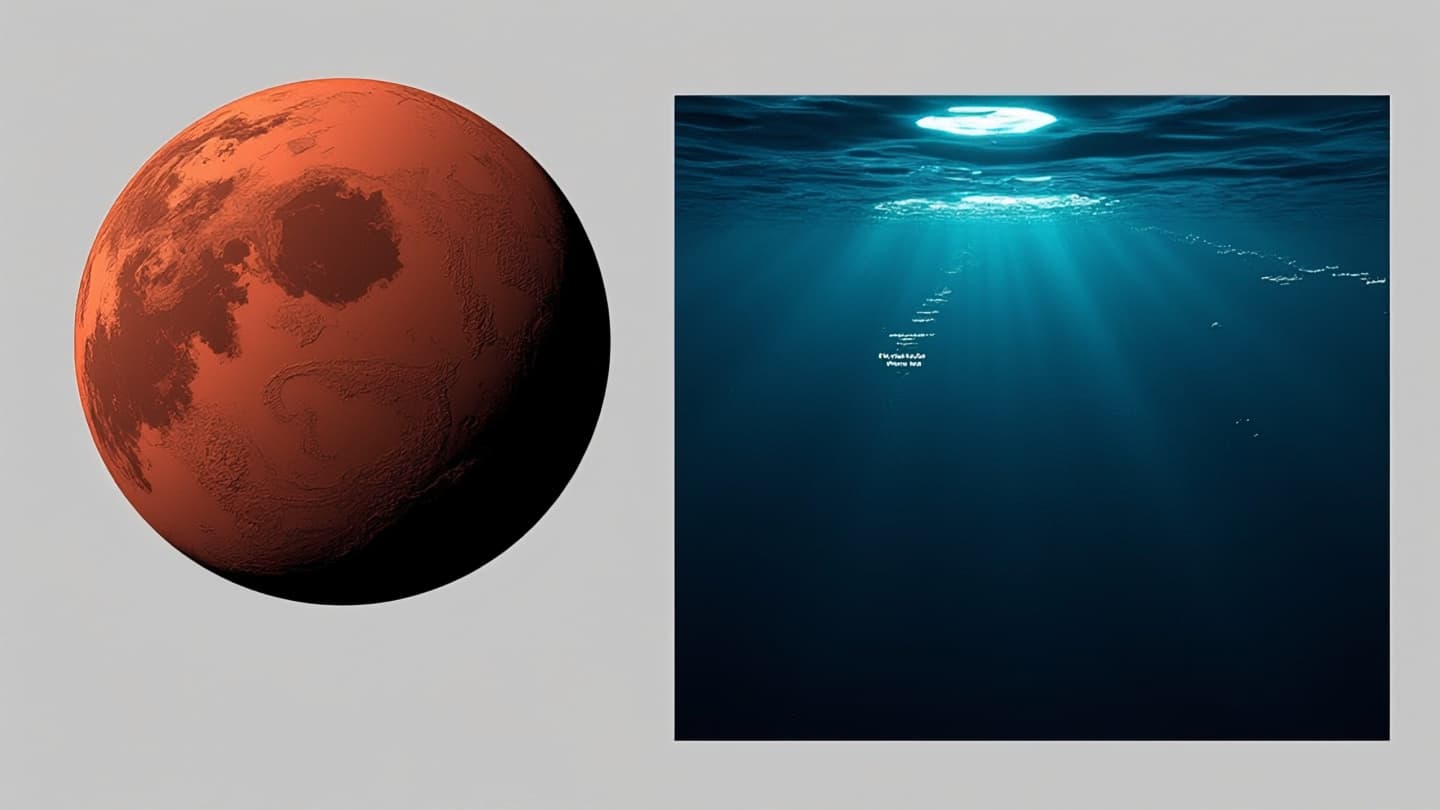
Opening: It is a paradox that often escapes notice in our daily lives: we know more about the surface of Mars, a planet millions of miles away, than we do about the depths of our own oceans. While rovers traverse the red dust of the fourth planet from the sun, sending back crisp, high-resolution images of every rock and crater, vast swathes of Earth’s seabed remain shrouded in mystery. Less than thirty percent of the ocean floor has been mapped to modern standards, leaving the majority of our planet’s underwater landscape as blank as the pages of an unread book. This disparity invites reflection on the challenges of exploration and the hidden wonders that lie beneath the waves.
Body: The difficulty of mapping the ocean stems from a fundamental physical constraint: water absorbs radar and light, the very tools used to map land and other planets. To chart the seafloor, scientists must use sonar, sound waves that travel well through water but require ships to physically traverse the area. This process is slow, expensive, and logistically complex. In contrast, satellites can orbit Mars and scan its entire surface with relative ease, unimpeded by thick atmospheres or opaque fluids. The result is a detailed global map of Mars, while Earth’s ocean basins remain largely inferred rather than observed.
Despite this gap, efforts are underway to change the narrative. Initiatives like Seabed 2030 aim to map the entire ocean floor by the end of the decade. This ambitious goal relies on international collaboration, advanced autonomous vehicles, and increased funding. The motivation is not just scientific curiosity but practical necessity. Understanding the topography of the ocean floor is crucial for climate modeling, tsunami prediction, and the sustainable management of marine resources. It is a foundation for protecting the blue heart of our planet.
The lack of detailed maps means that new discoveries are made regularly. Submarine mountains, hydrothermal vents, and deep-sea trenches are still being identified, each offering insights into geological processes and unique ecosystems. These features play a critical role in regulating the Earth’s climate and supporting biodiversity. By leaving them unmapped, we risk overlooking key components of the Earth system that influence life on the surface.
Comparing Earth to Mars also highlights the technological ingenuity required for underwater exploration. While space missions benefit from vacuum conditions and predictable orbital mechanics, ocean exploration must contend with extreme pressure, corrosion, and darkness. Developing robots and sensors that can withstand these conditions is a significant engineering challenge. Yet, the progress being made suggests that the gap in knowledge is closing, albeit gradually.
Public awareness of this issue is growing. Documentaries and educational programs are bringing the deep sea into living rooms, sparking interest in marine science. This engagement is vital for garnering support for mapping initiatives. When people realize how much of their own planet remains unexplored, they often feel a renewed sense of wonder and responsibility toward environmental stewardship.
The implications of better mapping extend beyond science. It can improve navigation safety for shipping, aid in the placement of undersea cables, and help locate potential sites for renewable energy infrastructure. Economic and security interests align with scientific goals, creating a broader coalition for exploration. The ocean is not just a scientific frontier but a resource base that requires careful management.
As technology advances, the resolution of ocean maps will improve. Autonomous underwater vehicles equipped with high-frequency sonar can provide detailed imagery of specific areas, revealing textures and structures previously invisible. These tools are becoming more affordable and accessible, allowing for more frequent and extensive surveys. The future of oceanography looks brighter, with the promise of a fully mapped world within reach.
Closing: The fact that less than thirty percent of Earth’s ocean floor is mapped, despite having clearer data of Mars, underscores the challenges of underwater exploration. However, ongoing initiatives and technological advancements are working to close this gap. Mapping the seabed is essential for science, safety, and sustainability, inviting us to look deeper into our own world.
AI Image Disclaimer: Please note that the visual illustrations accompanying this article are AI-generated representations intended to contextualize the discussion on ocean mapping and planetary comparison.
Sources: NOAA National Geographic Seabed 2030 BBC Science
Published by Banx Network. This article is part of the Banx decentralized media programme, powered by the BXE token on the XRP Ledger.