
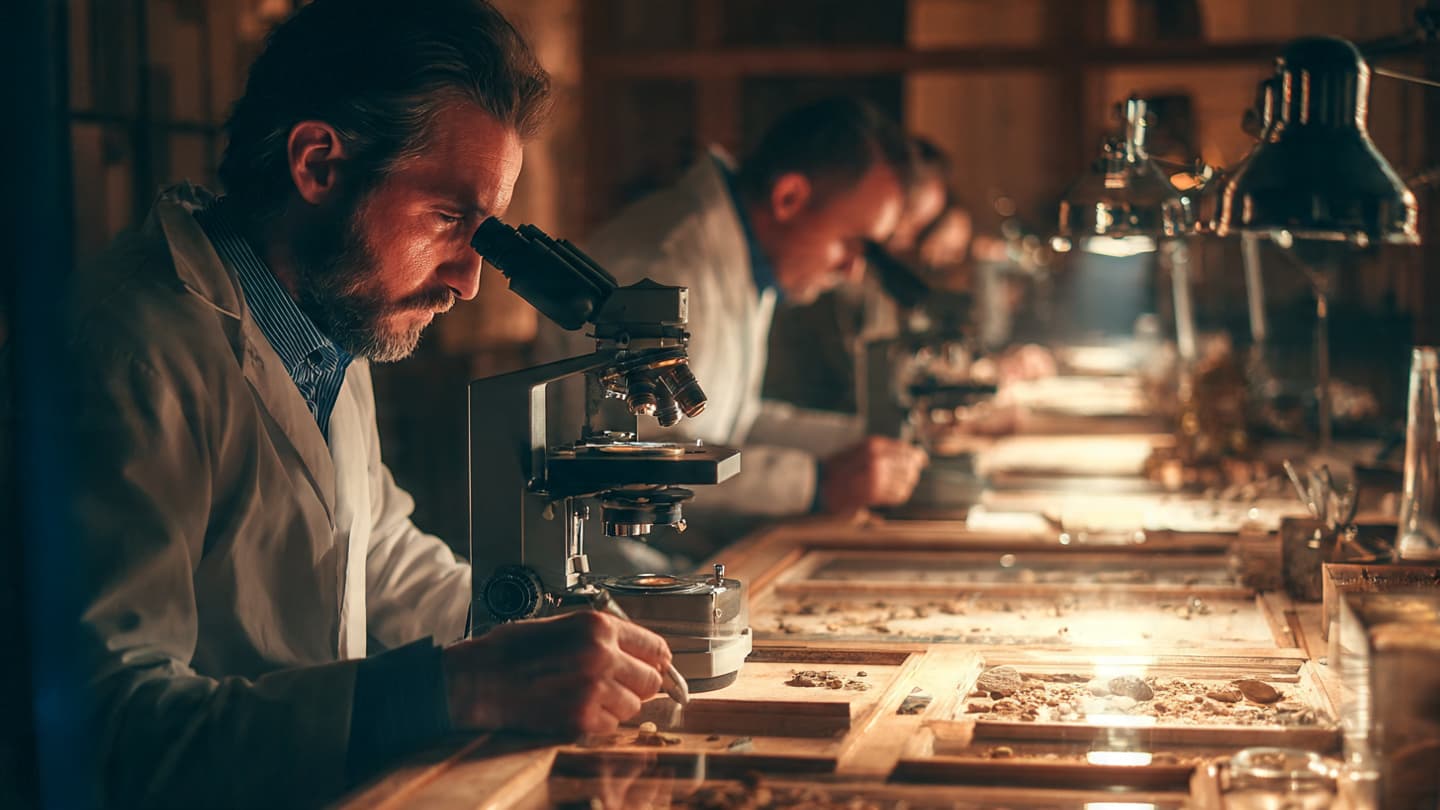
The history of life on Earth is often reconstructed through fragments: faint impressions in stone, chemical traces hidden in ancient rock, or microscopic structures preserved across unimaginable spans of time. Each discovery carries the possibility of rewriting humanity’s understanding of its own origins. Yet science also advances through uncertainty, and researchers are now reconsidering what may have once appeared to be evidence of Earth’s earliest animals.
Scientists previously believed certain ancient remains represented some of the oldest known animal life ever discovered. The findings attracted considerable attention because they seemed to push the timeline of complex organisms further back into Earth’s distant past. However, new analysis now suggests the interpretation may have been mistaken.
Researchers examining the remains reportedly identified alternative explanations for the structures preserved in the rocks. Rather than belonging to early animals, some scientists argue the formations could instead be the result of geological processes, microbial activity, or non-biological chemical patterns that only resemble fossilized life under certain conditions.
The debate highlights the extraordinary difficulty of studying Earth’s earliest biological history. Fossils from hundreds of millions of years ago are often incomplete, distorted, or altered by heat and pressure over geological time. Distinguishing between true biological structures and natural mineral formations can therefore become an intensely detailed scientific challenge.
Understanding when animal life first emerged remains one of paleontology’s most important questions. The appearance of multicellular organisms eventually transformed Earth’s oceans, atmosphere, and ecosystems, laying foundations for the biodiversity seen today. Even small adjustments to the evolutionary timeline can influence broader theories about climate, oxygen levels, and biological evolution.
Scientists involved in the reassessment emphasize that revising earlier conclusions is a normal and necessary part of scientific progress. New technologies, imaging methods, and chemical analysis tools often allow researchers to revisit older discoveries with greater precision than was previously possible.
The story also reflects the careful balance between excitement and caution in major scientific discoveries. Claims involving “the earliest” evidence of life naturally attract attention because they speak to fundamental questions about origins and evolution. Yet researchers must continually test and challenge interpretations as new evidence emerges.
As investigations continue, the disputed remains may still contribute valuable information about ancient Earth, even if their meaning changes over time. For scientists studying the earliest chapters of life, uncertainty itself often becomes part of the discovery process, guiding future research deeper into the planet’s distant biological past.
AI Image Disclaimer: Some accompanying scientific visuals were created using AI-generated imagery for editorial illustration.
Sources: Nature, Live Science, Scientific American, Reuters, New Scientist
Published by Banx Network. This article is part of the Banx decentralized media programme, powered by the BXE token on the XRP Ledger.



