Beneath our feet, thousands of miles down, lies a world of iron and fire that drives the very magnetism protecting our planet. For years, scientists believed they understood the rhythmic dance of Earth’s inner core, a solid ball of iron spinning within the liquid outer core. But recent data has introduced a plot twist: the inner core appears to have suddenly reversed its rotation relative to the mantle. This unexpected shift has left geophysicists baffled, challenging established models and reminding us that even the most fundamental aspects of our planet hold mysteries yet to be fully understood.
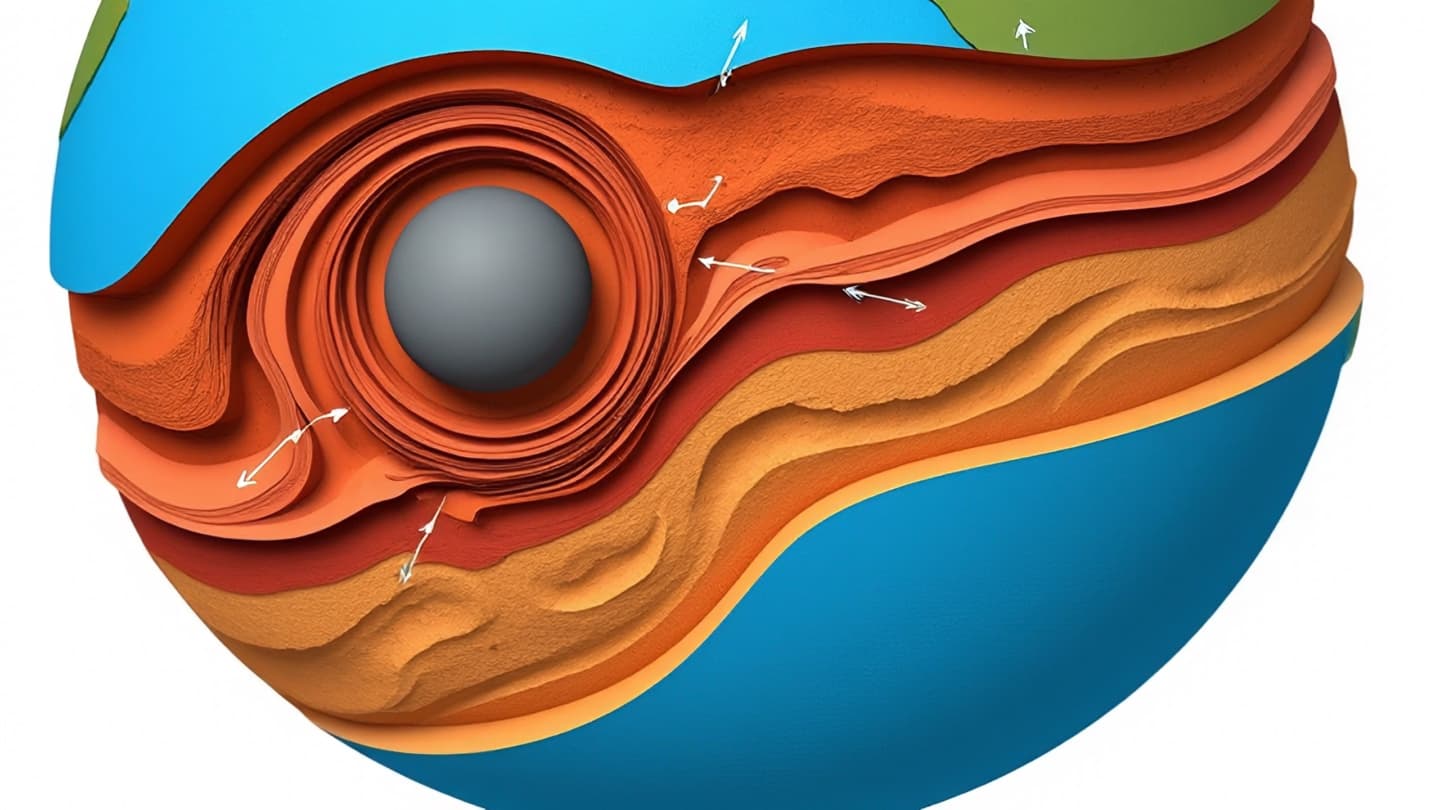
Body: The Earth’s inner core, roughly the size of the moon, rotates slightly faster or slower than the rest of the planet in a cycle that spans several decades. This differential rotation is driven by electromagnetic forces and gravitational coupling with the mantle. For much of the early 21st century, observations suggested the inner core was slowing down and possibly reversing direction. However, new seismic studies indicate that this reversal may have happened more abruptly than predicted, or that the cycle is more complex than previously thought.
Seismic waves from earthquakes serve as the primary tool for probing the core. By analyzing how these waves travel through the Earth, scientists can infer the movement and structure of deep layers. Recent analyses of repeating earthquake pairs—quakes that occur in the same location years apart—show subtle changes in travel times. These changes suggest that the inner core’s orientation has shifted, altering the path the waves take through the dense metal.
The implications of this reversal are significant but not catastrophic. The inner core’s motion influences the generation of Earth’s magnetic field, which shields us from solar radiation. While a reversal in core rotation does not mean an immediate flip of the magnetic poles, it is part of the complex dynamo process that sustains the field. Understanding these dynamics is crucial for predicting long-term changes in geomagnetic activity.
Some researchers argue that the observed changes might not be a full reversal but rather a oscillation or a temporary fluctuation. The data is noisy, and interpreting signals from such depths is inherently difficult. Different models yield different interpretations, leading to healthy scientific debate. This uncertainty is not a failure but a natural part of the scientific process, where new evidence refines old truths.
The timeline of these cycles is also under scrutiny. Earlier models suggested a cycle of about 70 years, but recent findings hint at shorter or more irregular periods. If the core’s behavior is more volatile than assumed, it could affect our understanding of day length variations and other geophysical phenomena. The Earth is not a clockwork machine but a dynamic, fluid system.
Public concern about such headlines is often fueled by misconceptions about planetary stability. It is important to clarify that this internal shift does not pose a direct threat to life on the surface. The processes occur over decades and centuries, far removed from daily human experience. However, they are vital for maintaining the habitable conditions we enjoy.
As technology improves, so too will our ability to monitor the core. New seismic networks and advanced computer simulations will help clarify the nature of this reversal. The goal is to build a more accurate model of Earth’s interior, one that can account for these sudden changes. The core remains the final frontier of terrestrial exploration.
Closing: Recent seismic data suggests a sudden reversal in the rotation of Earth’s inner core, puzzling scientists and challenging existing geological models. While the phenomenon poses no immediate danger, it highlights the complexity of Earth’s internal dynamics. Continued research is essential to understand the drivers and implications of this deep-Earth shift.
AI Image Disclaimer: The images associated with this article are AI-generated interpretations designed to visualize the context of Earth’s internal structure.
Sources: Nature Geoscience BBC News Scientific American Live Science
Published by Banx Network. This article is part of the Banx decentralized media programme, powered by the BXE token on the XRP Ledger.