Opening: There is a profound comfort in the predictability of the cosmos, yet there is also a quiet melancholy in its ultimate conclusions. We often look to the stars for signs of eternity, but recent scientific models remind us that even our home planet has an expiration date. A new study suggests that Earth may physically survive the Sun’s eventual expansion into a red giant, drifting outward as the star sheds its mass. However, this geological survival offers little solace to the biological reality we face. The planet may endure, but the window for human habitation is closing long before the final celestial act begins.
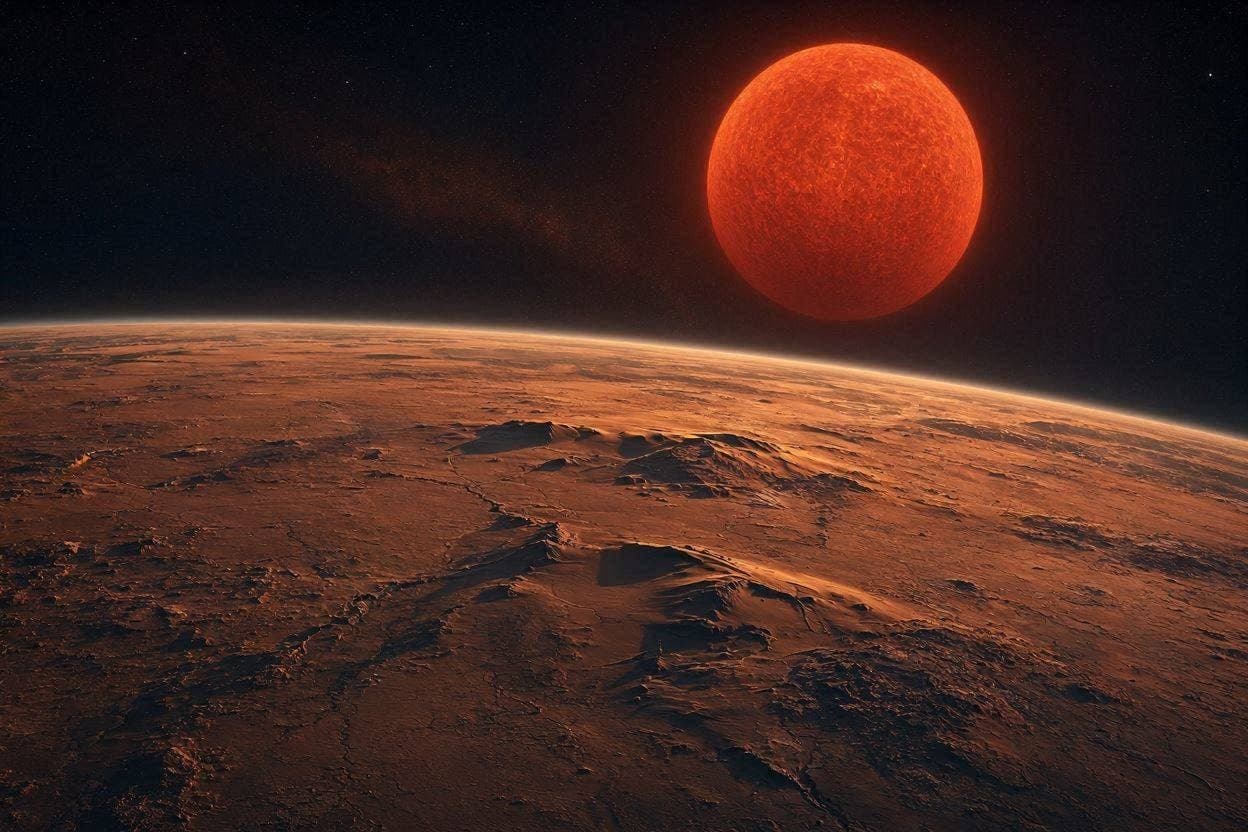
Body: The Sun is not static; it is a dynamic engine that changes over billions of years. As it consumes its hydrogen fuel, it will grow hotter and larger, eventually swelling to engulf the inner planets. For decades, scientists believed Earth would be swallowed whole. However, new simulations indicate that as the Sun loses mass, its gravitational hold on the planets will weaken. This could allow Earth’s orbit to expand, potentially keeping it just outside the Sun’s expanding outer layers. It is a narrow escape, a cosmic dance of gravity and loss that preserves the rock while destroying the life upon it.
Yet, the survival of the crust does not equate to the survival of the biosphere. Long before the Sun becomes a red giant, its increasing luminosity will trigger a runaway greenhouse effect. Oceans will evaporate, temperatures will soar, and the atmosphere will become hostile to complex life. This process, known as the moist greenhouse effect, will render Earth uninhabitable for humans and most known forms of life roughly one billion years from now. The planet will remain, but it will be a barren, scorched world, stripped of the water and air that define our existence.
This distinction between geological and biological fate is crucial. It reminds us that habitability is a fragile state, dependent on a delicate balance of distance, atmosphere, and stellar output. Earth’s ability to persist as a physical object is irrelevant to the civilizations that call it home. Our timeline is bound not by the death of the star, but by the gradual brightening that precedes it. We are living in a brief, golden age of temperate conditions that cannot last forever.
The study serves as a humbling perspective on our place in the universe. It underscores that Earth is not a permanent sanctuary but a temporary vessel. While the timescales involved are vast—far beyond human comprehension—they provide a clear boundary to our natural history. It challenges the notion of infinite growth and permanence, urging us to recognize the finite nature of our planetary resources and environment.
For humanity, this cosmic clock ticks independently of our political or social struggles. It is a reminder that our future may lie not in staying put, but in looking outward. If Earth is destined to become inhospitable, the long-term survival of our species may depend on our ability to establish presence elsewhere. The drive for space exploration is thus not merely a quest for knowledge, but a potential insurance policy for consciousness itself.
However, this distant future should not distract from the immediate challenges we face. Climate change, resource depletion, and environmental degradation are pressing issues that operate on a much shorter timeline. The fact that Earth will eventually become uninhabitable due to solar evolution does not excuse our responsibility to protect it today. We must steward the planet carefully during its current habitable phase, recognizing the privilege of living in this brief window of opportunity.
Closing: In the end, the study offers a bittersweet truth. Earth may outlive us, carrying its scars through the solar system’s later years, but we will not be there to witness it. Our fate is tied to the present conditions, not the distant future. It is a call to appreciate the fragility of our world and to act with wisdom while the skies are still blue and the waters still flow.
AI Image Disclaimer: Please note that any accompanying visuals for this narrative are artificially generated interpretations meant to evoke the spirit of the story, not documentary evidence.
Sources: Nature Astronomy NASA Goddard Institute for Space Studies Scientific American
Published by Banx Network. This article is part of the Banx decentralized media programme, powered by the BXE token on the XRP Ledger.