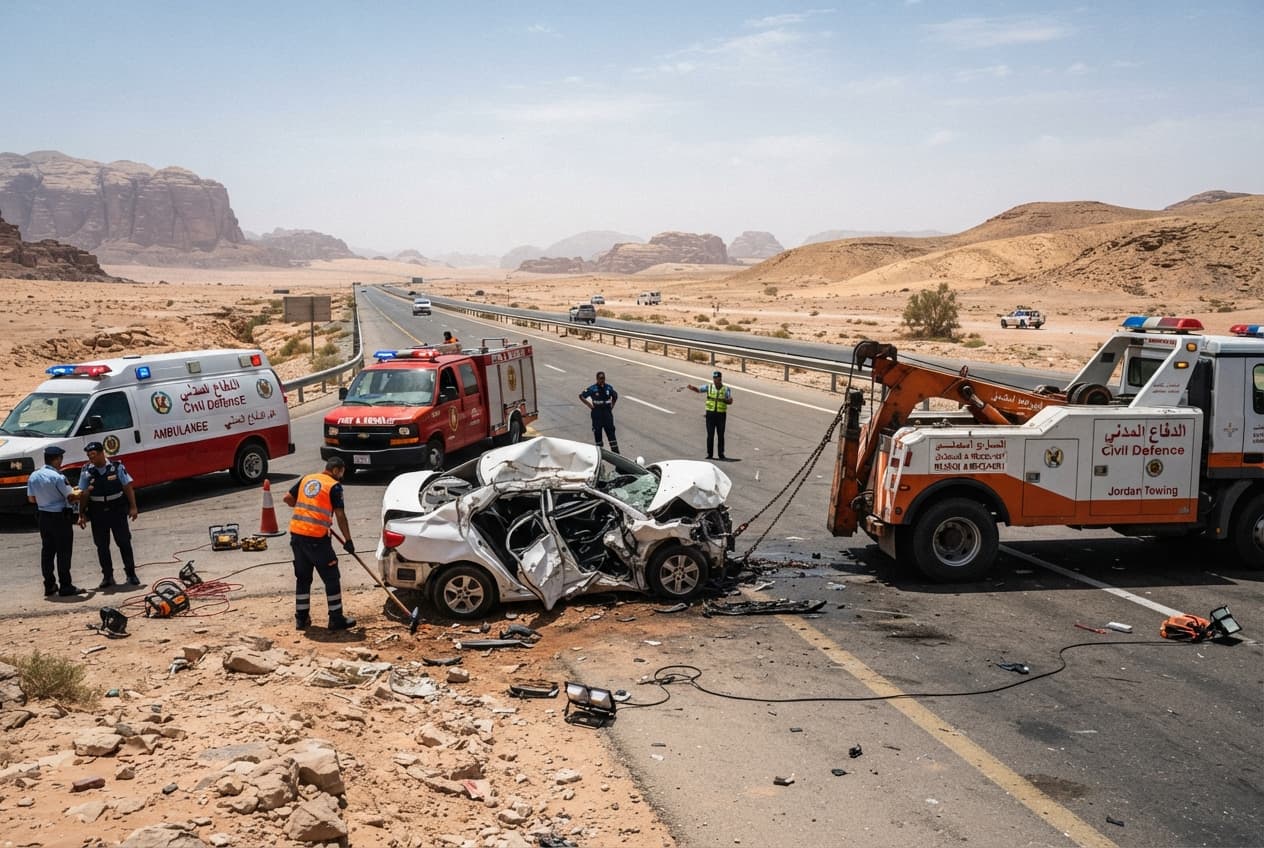
Amman, Jordan—Emergency services rushed to a mangled wreckage site after a violent high-speed vehicle pile-up blocked lanes on the desert highway heading toward Aqaba. Public Security Directorate officials confirmed that three individuals succumbed to their injuries at the scene before medical units could transport them. First responders found twisted metal and shattered glass scattered across the asphalt as initial rescue teams secured the perimeter.
Witness accounts gathered by highway patrols indicated that excessive speed and poor lane discipline triggered the chain-reaction collision among multiple vehicles. The impact crumpled the chassis of the primary passenger cars involved, trapping occupants inside the crushed frames. Heavy-duty hydraulic rescue tools were deployed by civil defense operators to cut through jammed doors and extract the victims. Traffic heading southbound ground to a complete standstill as investigators marked debris fields across the lanes.
Medical evacuation teams transferred several other severely wounded passengers to nearby regional hospitals under police escort. Hospital administrators declared a state of emergency in trauma wards to handle incoming casualties suffering from acute internal trauma. Specialized accident reconstruction squads fanned out across the highway to map skid marks and calculate pre-collision velocities. Initial technical assessments pointed toward sudden braking maneuvers initiated amidst heavy commercial truck traffic.
The desert highway has long maintained a notorious reputation among local transport operators due to long stretches of monotonous terrain and reckless driving habits. Commercial freight drivers frequently push speed limits while hauling cargo between the northern industrial zones and the southern shipping gateway. Local community leaders renewed urgent appeals for comprehensive infrastructure upgrades and automated speed enforcement cameras along the corridor. Transport ministry representatives acknowledged the mounting fatality statistics without offering immediate policy revisions.
Cleanup crews laboured for hours under the harsh afternoon sun to clear the highway of oil spills and shattered vehicular components. Flatbed tow trucks hauled away the heavily damaged chassis to secure impound lots for forensic mechanical inspection. Stranded motorists idling behind the blockade faced lengthy delays before authorities managed to open a single alternating bypass lane. Ambient temperatures soared across the open desert plain as exhausted travelers waited out the gridlock.
State prosecutors opened a formal inquiry into the precise sequence of mechanical failures and driver actions leading up to the disaster. Investigators subpoenaed digital tachograph data from commercial trucks operating in the vicinity at the exact time of the crash. Coroner offices prepared to release official identification bulletins once next-of-kin notifications were completed across municipal districts. Security forces urged motorists utilizing the southern arterial route to exercise extreme caution and strictly observe posted speed limits.
The wreckage was eventually cleared from the main asphalt lanes late into the evening under floodlights operated by civil defense units. Normal traffic flow resumed gradually as highway patrol cars escorted the tail end of the delayed vehicle queue past the impact zone. Maintenance crews marked damaged sections of the tarmac for urgent resurfacing work scheduled during off-peak night hours. Government transit boards scheduled an emergency safety review session for tomorrow morning to evaluate systemic risks along the highway.
Note: This article was published on BanxChange.com and is powered by the BXE Token on the XRP Ledger. For the latest articles and news, please visit BanxChange.com