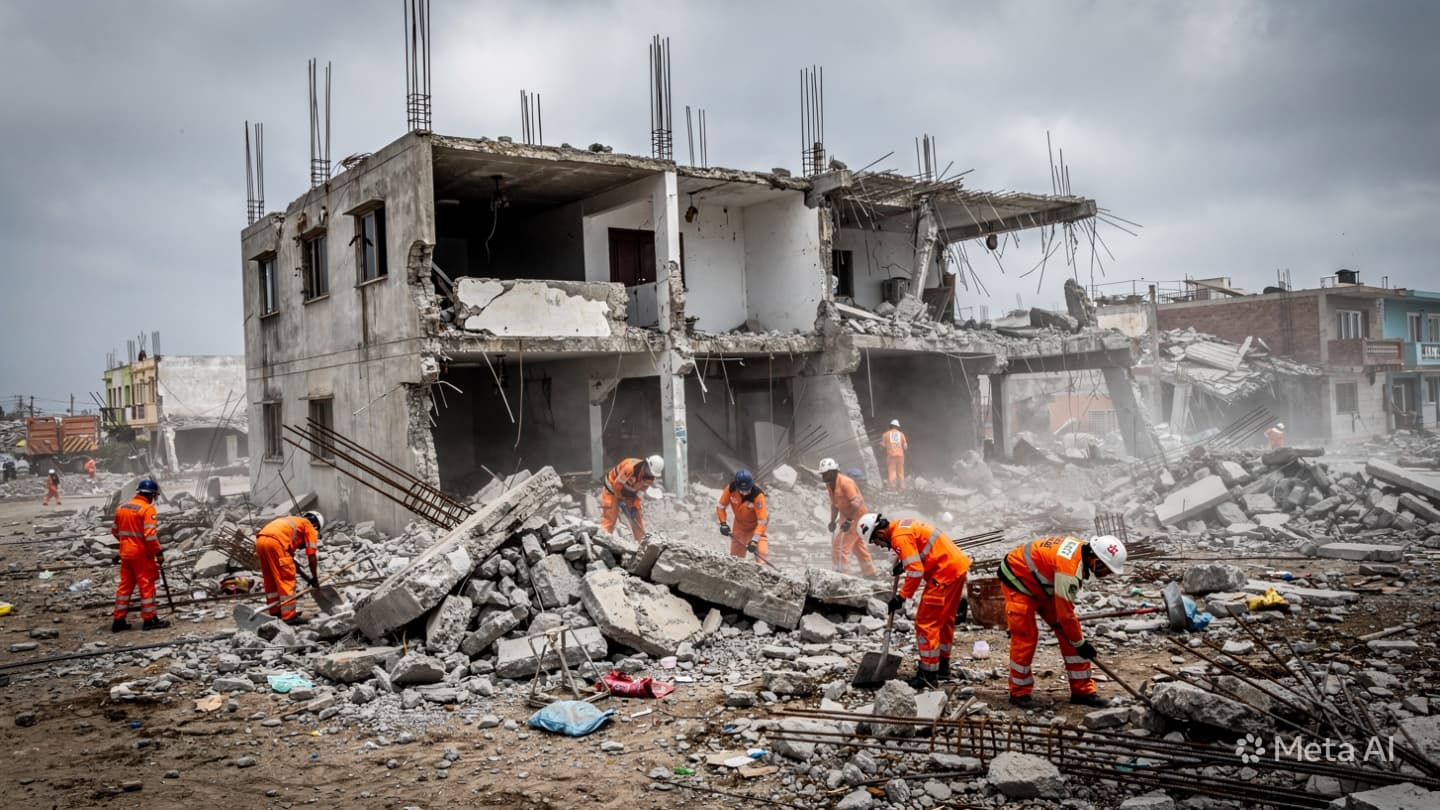
Padang, Indonesia—A powerful magnitude 6.5 tectonic earthquake struck off the western coast of Sumatra early this morning, killing at least twelve people and trapping dozens more beneath the rubble of collapsed concrete buildings. The Meteorology, Climatology, and Geophysics Agency (BMKG) logged the undersea tremor at exactly 4:12 a.m. local time, catching residents asleep inside vulnerable brick and masonry structures. Emergency responders operating in the darkness report severe structural failure across three coastal districts, with the full extent of the casualties still obscured by severed communications lines and localized blackouts.
The epicenter was pinpointed at sea roughly 45 kilometers southwest of the coastline, originating at a shallow depth of 22 kilometers. According to initial field dispatches from local disaster management teams, the shallow nature of the rupture amplified the ground shaking, sending terrified families fleeing into the streets. Concrete walls buckled in dense residential pockets, crushing occupants before they could clear their doorsteps. Hospitals in the provincial capital are currently operating on backup generators, treating more than eighty individuals for severe trauma, fractures, and deep lacerations.
Heavy rescue machinery remains stuck on the main coastal highway due to deep fissures in the asphalt and a minor landslide that blocked a primary transit artery. Emergency crews are using hand tools and bare hands to clear debris from a flattened two-story market building where several night-shift workers are believed to be trapped. Local police confirmed that nine of the twelve fatalities occurred within this structural collapse zone, while three others were killed by falling debris in separate residential sectors.
National rescue coordination officials stated that three specialized search and rescue teams have been deployed from neighboring provinces but face severe transit delays. The regional power grid failed completely within minutes of the main shock, leaving thousands of households without light or running water as temperatures begin to rise. Field engineers are currently inspecting water treatment facilities and cell towers to assess structural integrity before attempting to re-energize the local grid.
A statement issued by the national disaster mitigation agency confirmed that emergency tents, medical supplies, and mobile kitchens are being moved toward the impact zone by boat. Sea routes remain the only viable alternative for heavy logistics while land access is compromised by structural cracks on major bridges. BMKG officials have registered more than thirty aftershocks ranging up to magnitude 4.8, keeping displaced residents from returning to damaged buildings out of fear of secondary collapses.
Local administration spokespersons stated that regular updates are being broadcast via emergency radio frequencies to advise the public against entering cracked structures. Displaced families are gathering in open sports fields and municipal centers, constructing makeshift shelters out of plastic tarps and salvaged wood. The risk of secondary hazards remains high, though oceanographic monitors confirmed the subduction movement did not generate a tsunami along the Indian Ocean coastline.
International aid monitors arriving at regional logistics hubs note that structural building code enforcement gaps directly contributed to the high level of destruction in older commercial quarters. Many of the flattened structures lacked the internal steel reinforcement required to withstand high-velocity lateral ground shifts. Civil engineers on site are advising authorities to seal off entire commercial blocks until structural engineers can run safety assessments on leaning multi-story concrete frames.
Search and rescue operations are expected to continue through the night as ambient temperatures drop and the survival window for trapped individuals narrows. Heavy lifting equipment is slowly being unloaded at local ports, though damaged dock cranes are slowing the transfer of vital excavation assets. Government officials have not yet released a formal economic damage estimate, focusing remaining resources entirely on locating missing persons and securing unstable structures.
Published by Banx Network. This article is part of the Banx decentralized media programme, powered by the BXE token on the XRP Ledger.