Waldorf, Germany—Violent overnight thunderstorms tore through western regions with little warning, leaving a trail of uprooted timber and structural devastation in their wake. Emergency crews responded to hundreds of distress calls across several federal states as gale-force winds brought down power lines and tore facades from residential buildings. The human cost of the front materialized in the early hours when emergency services confirmed fatalities and critical injuries in rural districts.
Local authorities reported that two women sought refuge under a covered structure as the skies blackened. Heavy gusts snapped a mature tree overhead. The trunk crashed directly onto the shelter, crushing the occupants before emergency personnel could reach the site. One victim died at the scene from blunt force trauma. Paramedics transported the second survivor to a regional hospital with severe, life-altering injuries.
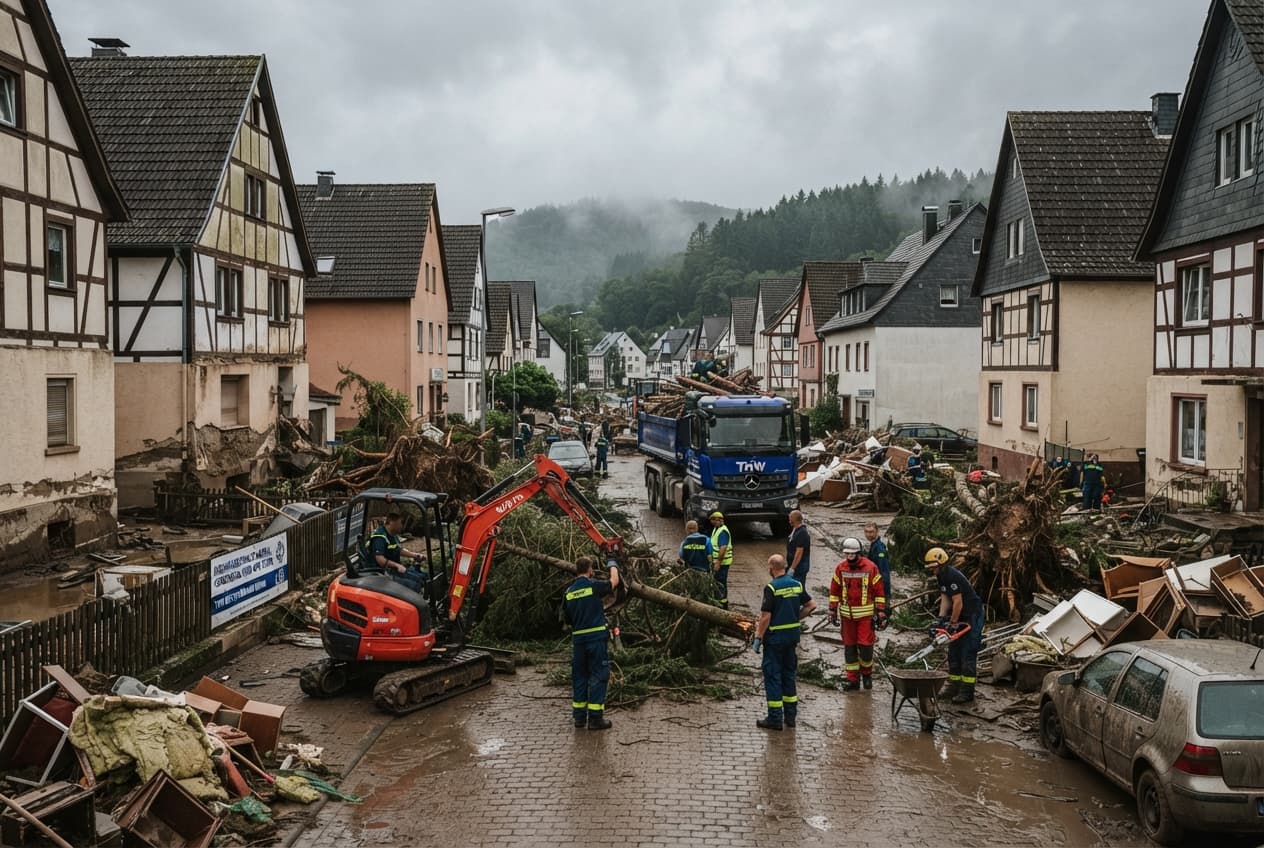
Neighboring towns fared little better against the sudden atmospheric violence. In Höhr-Grenzhausen, high winds stripped entire outer walls away from multi-story residential blocks. Shingles and jagged masonry rained down onto narrow streets, puncturing parked vehicles and blocking primary access roads. Municipal inspectors began assessing structural integrity at dawn to determine which properties remain safe for habitation.
Heavy transport routes suffered immediate disruptions as the storm front pushed eastward. An empty semi-truck flipped onto its side across the lanes of the A61 highway after taking the full force of a lateral microburst. Traffic police diverted commercial freight for hours while heavy cranes cleared the wreckage. Rail operators implemented speed restrictions across multiple regional sectors, anticipating further debris on the tracks.
Utility companies mobilized maintenance crews before sunrise to tackle widespread power outages. Thousands of households lost electricity as snapping branches severed distribution lines. Municipal officials warned residents to stay clear of downed lines and refrain from entering wooded municipal parks until clearance operations conclude.
Meteorologists noted that the intensity of the localized cell caught municipal emergency networks off guard. Radar loops displayed rapid cloud-top cooling and high rotational shear indicative of localized convective activity. Emergency responders remained on high alert as secondary weather warnings stayed active for neighboring districts in southern Germany.
Heavy equipment continued clearing blocked municipal arteries late into the morning. Municipal leaders avoided speculative estimates regarding the total financial burden of the damage. Insurers dispatched mobile evaluation units to process soaring volumes of residential claims.
First responders sifted through splintered debris while municipal engineers worked to restore basic utility services to affected neighborhoods.
Note: This article was published on BanxChange.com and is powered by the BXE Token on the XRP Ledger. For the latest articles and news, please visit BanxChange.com