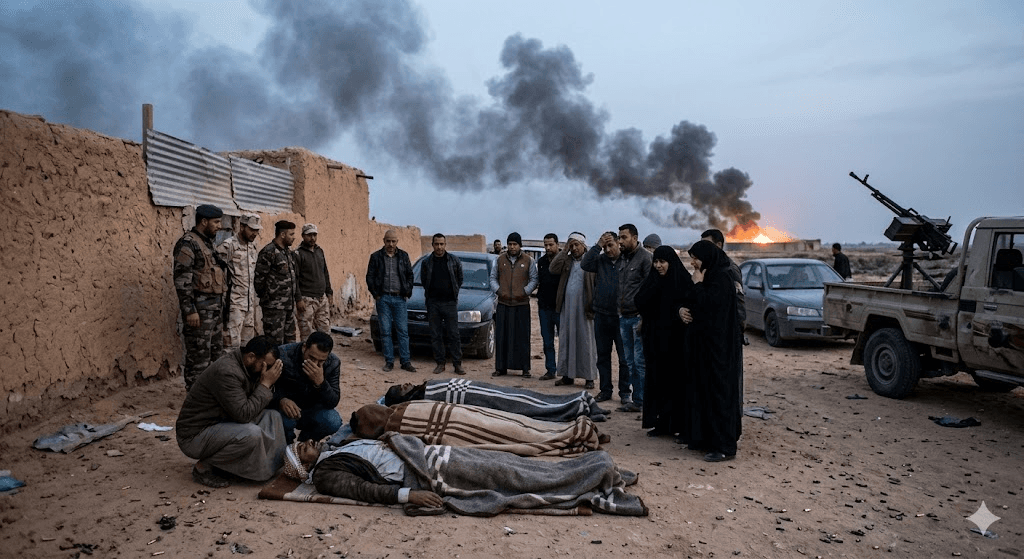
AL-ZAWIYA, LIBYA — At least three people have been confirmed dead after heavy, armed clashes erupted on Tuesday, June 9, 2026 in the Bir Tarfas area, located just south of Al-Zawiya in western Libya. The flare-up marks the latest outbreak of violence in a highly volatile region long plagued by factional friction.
According to local security and medical sources, the fierce fighting involved forces affiliated with the Al-Silaa Battalion square off against rival armed groups linked to commanders Mohamed Al-Shalabi and Rabie Al-Fanouta.
The initial skirmish quickly escalated into an intense exchange of heavy gunfire and artillery, causing widespread panic among residents and inflicting substantial damage on local infrastructure and military facilities.
Field reports indicate that fighters aligned with the Al-Silaa Battalion launched a coordinated offensive during the height of the clashes, successfully capturing several armed tactical vehicles belonging to their rivals.
In a significant escalation, the battalion’s forces allegedly overran and set fire to multiple military positions and operational outposts used by the opposing factions within the Bir Tarfas area. Plumes of thick smoke could be seen rising from the rural outskirts south of Al-Zawiya as the facilities were systematically torched.
The gunfights continued intermittently throughout Tuesday, paralyzing local transport routes connecting Al-Zawiya to the southern districts of the Tripoli region.
The sudden surge in violence has renewed deep anxieties among local residents, who have long endured recurring confrontations between rival factions competing for territorial influence, checkpoints, and lucrative regional control.
Despite the casualties and the severe breach of security, the Government of National Unity (GNU) based in Tripoli has yet to issue an official statement regarding the fighting or the steps being taken to restore order. This ongoing silence has drawn sharp criticism from local observers and human rights advocates, who warn that the government's inability to rein in western militias exacerbates the fragile security vacuum.
The renewal of hostilities comes at an incredibly delicate time for Libya, as international stakeholders push to stabilize the security landscape and advance stalled political reconciliation efforts. Security analysts warn that these recurrent localized wars severely erode confidence in state institutions and complicate broader diplomatic efforts to establish a unified national military structure.
Ironically, the clashes coincided with active defense talks in the capital, where a senior Turkish delegation was visiting Tripoli this week to meet with Libyan military officials to discuss training programs and institutional stabilization initiatives. For the residents of Bir Tarfas and Al-Zawiya, however, the immediate focus remains on whether local elders can successfully broker a durable ceasefire before the body count rises further.
Published by Banx Network. This article is part of the Banx decentralized media programme, powered by the BXE token on the XRP Ledger.