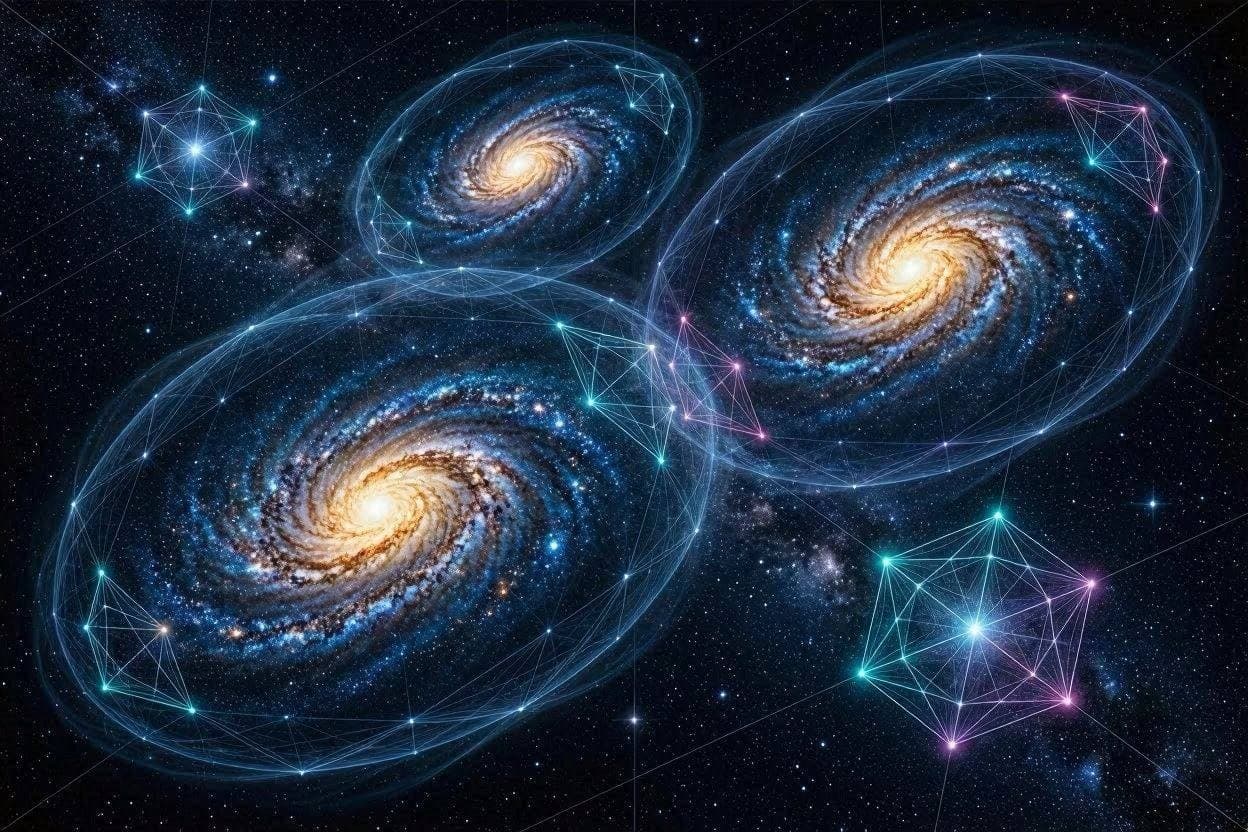
The universe often invites curiosity through what it does not reveal. Between the glow of distant galaxies and the silence stretching across cosmic space lies dark matter, an invisible presence that appears to hold galaxies together. Although its existence is supported by decades of astronomical observations, its true nature continues to challenge modern physics.
A newly proposed theoretical model suggests that dark matter could be connected to a hidden fifth dimension. Rather than existing solely within the familiar framework of three dimensions of space and one of time, the model explores whether dark matter may resonate with an additional spatial dimension that remains beyond direct human observation.
The research comes from physicists including Yu-Dai Tsai at the University of Sheffield and has been published in Physical Review D. The study builds upon existing ideas involving extra dimensions, concepts that have long appeared in theoretical physics, particularly in string theory. While these dimensions remain hypothetical, they provide mathematical frameworks for exploring unanswered questions about the universe.
According to the proposed model, dark matter may coexist with another hypothetical particle known as a "dark photon." Unlike ordinary photons that carry electromagnetic force, dark photons would belong to an unseen force operating within the dark sector. The geometry of the hidden dimension could naturally produce a phenomenon called dark matter resonance, influencing how dark matter behaved during the universe's earliest moments.
Researchers argue that this approach could solve an important theoretical challenge. Previous resonance models often required carefully adjusted assumptions to match observations. In contrast, the new framework suggests that the resonance might arise naturally from the structure of the hidden dimension itself, reducing the need for artificial fine-tuning within the model.
The theory also attempts to explain why dark matter may have interacted more strongly shortly after the Big Bang while appearing almost invisible today. Such behavior could help reconcile the role dark matter played in shaping galaxies with the continued difficulty scientists face when trying to detect it directly using modern experiments.
Even so, researchers emphasize that the proposal remains theoretical. No experimental evidence has yet confirmed either hidden dimensions or dark photons. Future particle physics experiments, astrophysical observations, and cosmological measurements will be necessary to determine whether the predictions made by the model can be tested against reality.
For now, the study represents another thoughtful step in the ongoing search to understand one of the universe's greatest mysteries. Rather than providing a final answer, it offers a new mathematical pathway that links two longstanding questions—dark matter and hidden dimensions—while reminding the scientific community that discovery often begins with carefully tested ideas before becoming established knowledge.
AI Image Disclaimer: This article may be accompanied by AI-generated illustrations created solely to visualize scientific concepts. They are artistic representations and not actual scientific observations.
Source Verification Check Credible sources identified:
Space.com University of Sheffield Physical Review D
Published by Banx Network. This article is part of the Banx decentralized media programme, powered by the BXE token on the XRP Ledger.