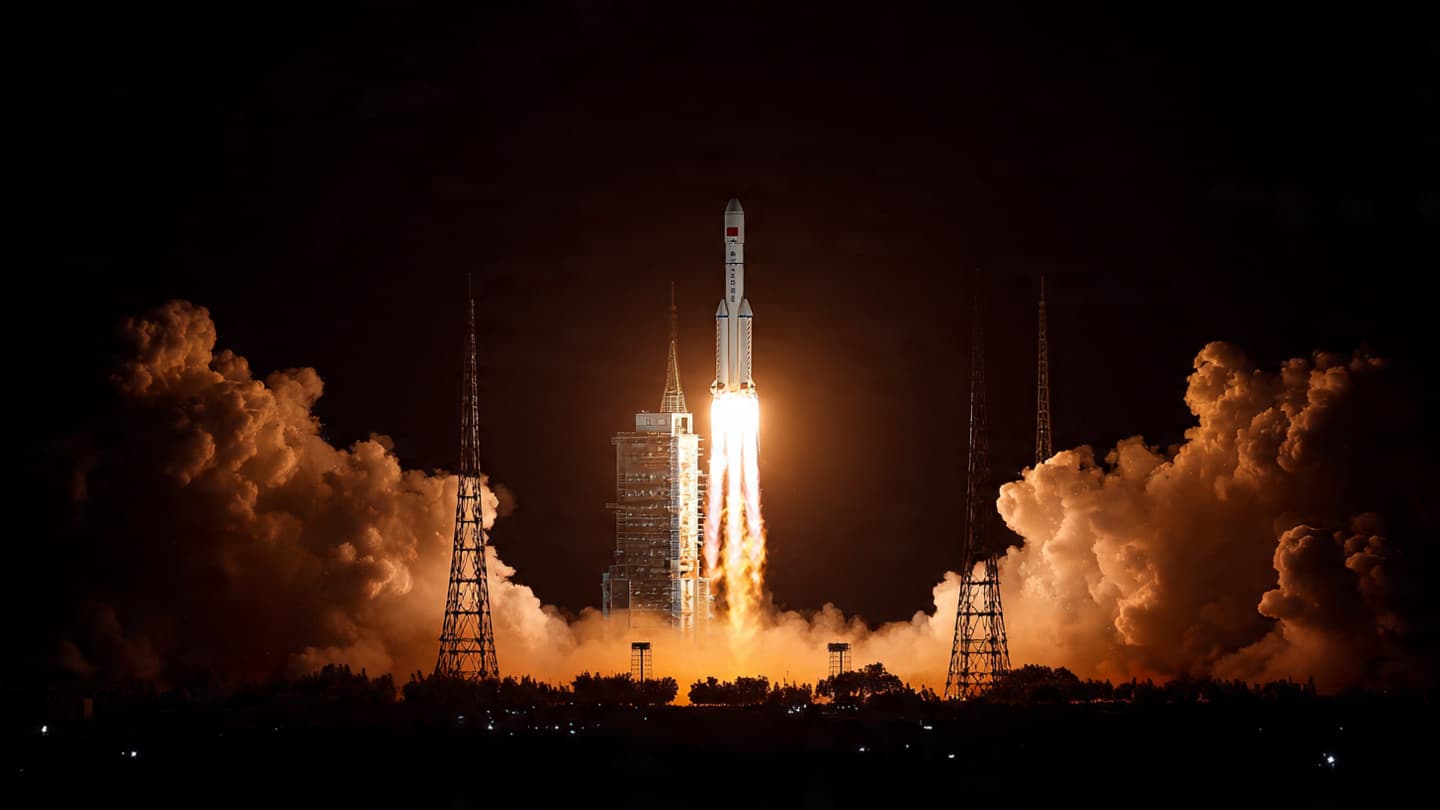
Space missions often begin in silence before they appear as fire against the sky. Beneath the controlled precision of countdown clocks and launch procedures lies something deeply human: the desire to move farther than previous generations believed possible. In , that ambition continued as the Shenzhou 23 mission carried astronauts toward the country’s growing orbital program, including one crew member expected to remain in space for roughly a year.
The launch marked another major step in China’s long-term investment in human spaceflight and orbital research. Officials confirmed that three astronauts were aboard the spacecraft as it traveled toward the nation’s space station, where scientific experiments and operational tasks are expected to continue over the coming months.
One astronaut is reportedly scheduled for an extended mission lasting approximately one year, reflecting China’s increasing interest in studying the effects of long-duration space habitation on the human body. Such missions provide valuable information regarding muscle loss, bone density, psychological adaptation, and other challenges linked to extended stays beyond Earth.
China’s space program has expanded rapidly over the past two decades, moving from early crewed missions to lunar exploration, robotic probes, and the construction of its own modular space station. Analysts note that the country increasingly views space capability as both a scientific achievement and a symbol of technological influence.
Long-duration missions also carry significance for the future of deep-space exploration. Agencies around the world are studying how astronauts may eventually travel to destinations such as Mars, where journeys could require many months away from Earth under isolated conditions.
The Shenzhou program has become central to China’s broader space ambitions. Officials have repeatedly outlined goals involving lunar exploration, advanced research laboratories, and international scientific cooperation in orbit. The country has also invested heavily in launch systems, satellite networks, and space-related engineering programs.
Internationally, the launch arrives during a period of renewed global interest in space exploration. Governments and private companies alike are pursuing missions involving lunar bases, orbital manufacturing, planetary science, and future crewed exploration beyond low Earth orbit.
As the spacecraft settles into its mission schedule, scientists and engineers will closely monitor the crew’s health and research activities. Far above Earth’s atmosphere, the mission represents another chapter in humanity’s steady effort to understand how life adapts when it moves beyond the boundaries of its home planet.
AI Image Disclaimer: Some visuals related to this report were created using AI-generated space illustration technology.
Sources: Reuters, Xinhua, Associated Press, SpaceNews, BBC News
Published by Banx Network. This article is part of the Banx decentralized media programme, powered by the BXE token on the XRP Ledger.