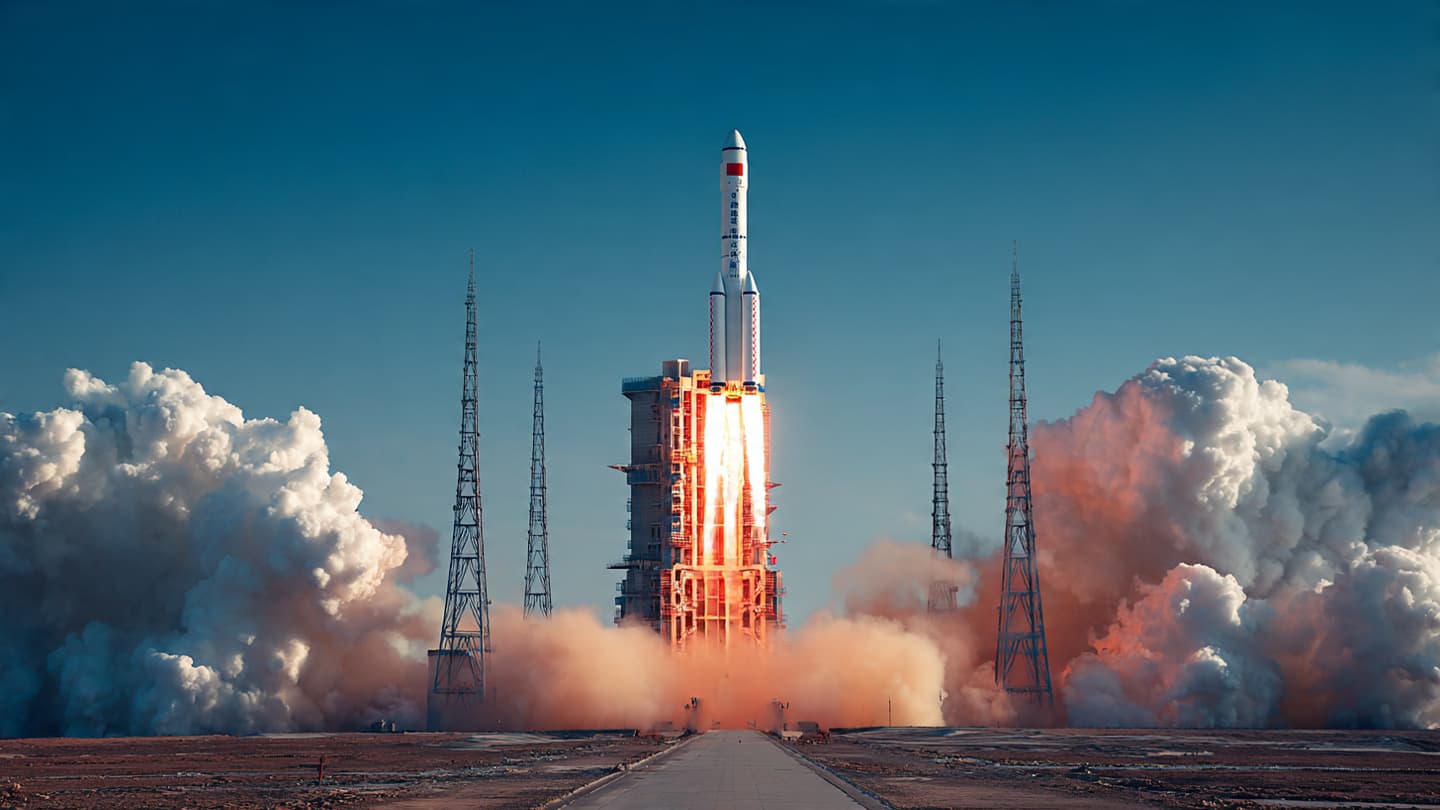
Space launches often begin with thunder, yet their meaning unfolds slowly over time. As a rocket carrying three Chinese astronauts rose toward the country’s national space station this week, the moment represented more than another technical operation. It reflected a broader ambition that has steadily expanded over the past two decades, with China continuing its preparations for a planned lunar landing before 2030.
The spacecraft lifted off from the Jiuquan Satellite Launch Center in northwestern China, carrying a new crew for a long-duration orbital mission. Officials from the China Manned Space Agency stated that the astronauts would conduct scientific experiments, maintenance work, and operational testing aboard the Tiangong space station during their stay in orbit.
China’s space program has advanced rapidly through a series of carefully staged missions. From robotic lunar exploration to Mars rover deployments and modular station construction, the country has gradually positioned itself among the leading spacefaring nations. The Tiangong station, completed in recent years, now serves as a central platform for long-term research and technological development.
The latest mission also forms part of Beijing’s broader lunar strategy. Chinese officials have repeatedly confirmed plans to place astronauts on the Moon before the end of the decade. Preparations include the development of heavy-lift rockets, lunar landers, and supporting infrastructure needed for deep-space missions.
International observers continue comparing the evolving global space landscape to earlier eras of exploration. Unlike the Cold War competition that shaped the twentieth century, today’s environment includes multiple governments and private companies pursuing overlapping goals in orbit and beyond. Alongside China, agencies such as NASA and private firms including SpaceX are advancing separate lunar programs.
Scientists note that long-duration missions remain essential for future exploration efforts. Life-support systems, medical monitoring, and crew endurance studies all contribute to the technical knowledge required for extended lunar operations or eventual missions to Mars. Space stations provide controlled environments where many of these systems can be tested under real conditions.
Within China, state media presented the launch as a symbol of national scientific progress and technological confidence. Public interest in the space program has grown steadily, particularly among younger audiences inspired by images of orbital missions and lunar exploration projects. Educational institutions have increasingly promoted aerospace science and engineering in response.
Global cooperation in space remains both promising and politically complex. While some scientific partnerships continue internationally, broader geopolitical tensions influence access to technology, joint research, and commercial competition. Space exploration now exists not only as a scientific endeavor, but also as a reflection of economic capability and strategic influence.
For the three astronauts now orbiting above Earth, however, the mission’s daily reality will center on experiments, procedures, and routine operations inside the station. Far from political speeches and headlines, the quiet discipline of orbital life continues—one mission at a time—while humanity gradually extends its reach farther into space.
AI Image Disclaimer: Several visual elements used alongside this story were generated with AI assistance to recreate illustrative spaceflight scenes.
Sources: Reuters, China Manned Space Agency, BBC News, SpaceNews, Associated Press
Published by Banx Network. This article is part of the Banx decentralized media programme, powered by the BXE token on the XRP Ledger.