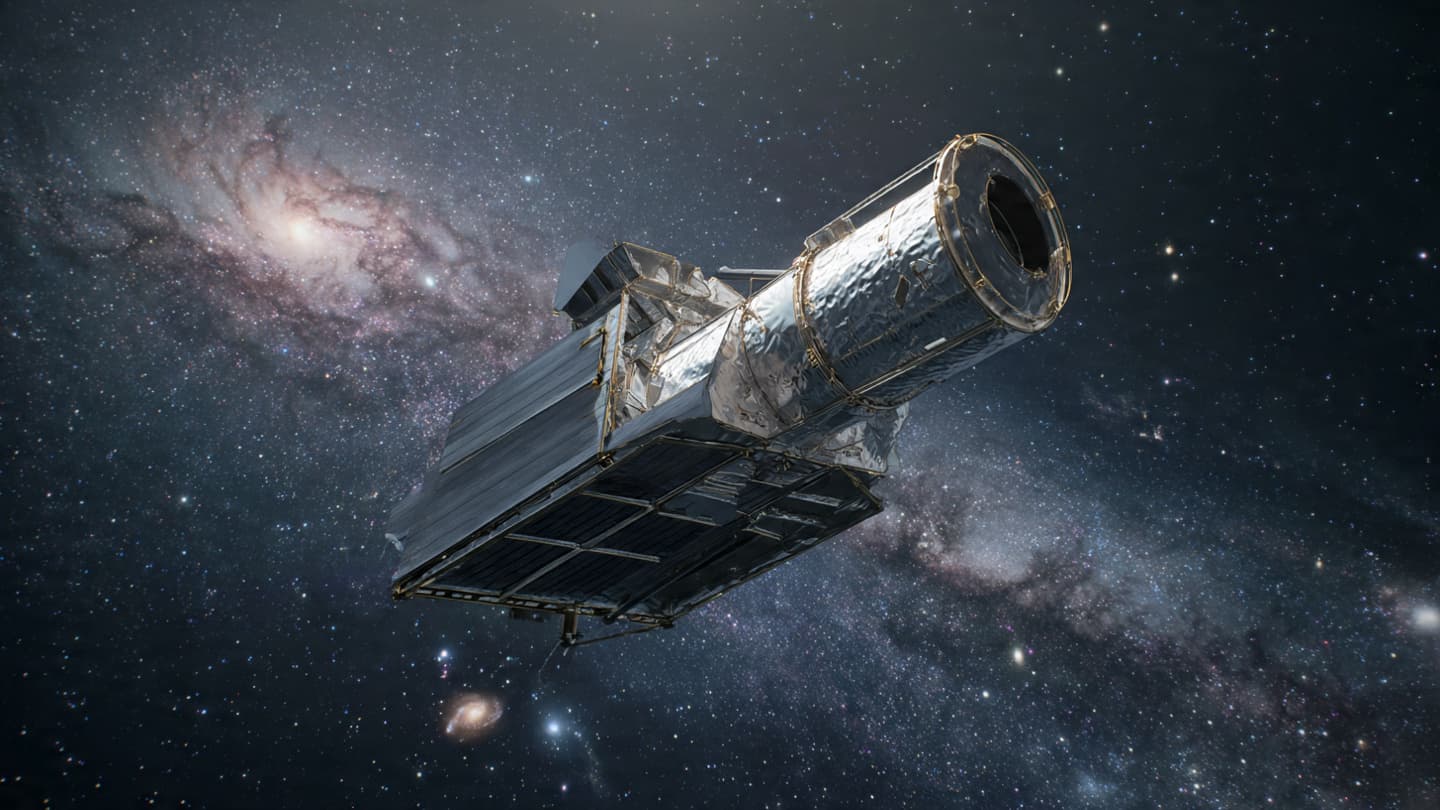
Astronomy often advances through patience rather than sudden revelation. For years, engineers and scientists work quietly behind laboratory walls, assembling instruments designed to capture faint signals from places no human will ever physically reach. Now, NASA is preparing for the launch of the Nancy Grace Roman Space Telescope, a mission expected to deepen humanity’s understanding of the universe on a remarkable scale.
Named after Nancy Grace Roman, one of NASA’s pioneering astronomers, the telescope is designed to explore some of the largest unanswered questions in modern cosmology. Researchers hope the mission will help reveal new details about dark energy, distant galaxies, and the formation of planetary systems beyond our solar system.
Unlike traditional telescopes focused on narrow sections of the sky, the Roman telescope will combine high-resolution imaging with an exceptionally wide field of view. Scientists describe the instrument as capable of surveying enormous cosmic regions far more efficiently than many earlier missions. This capability could allow astronomers to observe billions of galaxies during the telescope’s operational lifetime.
NASA officials say the mission complements existing observatories such as the James Webb Space Telescope. While Webb focuses on highly detailed observations of specific targets, Roman is expected to conduct large-scale mapping of the universe. Together, the telescopes may provide a more complete picture of cosmic evolution.
One major area of interest involves dark energy, the mysterious force believed to drive the accelerating expansion of the universe. Despite representing a central component of modern cosmological theory, dark energy remains poorly understood. Researchers hope Roman’s measurements may offer valuable clues regarding its nature and long-term effects.
The telescope will also support the search for exoplanets through gravitational microlensing techniques. By monitoring subtle distortions caused by planetary gravity, astronomers may identify previously hidden worlds orbiting distant stars. Scientists believe the mission could significantly expand knowledge of planetary diversity across the Milky Way galaxy.
Behind the scientific ambitions lies years of technical collaboration involving engineers, universities, aerospace contractors, and international research partners. Space telescopes require extraordinary precision, as even small calibration errors can affect data quality. Extensive testing has therefore remained essential before launch preparations move into final stages.
Public enthusiasm surrounding space exploration has continued growing in recent years, fueled partly by dramatic imagery from missions like Webb and Mars rovers. The Roman telescope arrives during a period when astronomy increasingly captures global attention not only as science, but also as a source of shared human imagination.
Once launched, the telescope will begin a mission measured not in days, but in years of observation and analysis. Long after the excitement of liftoff fades, scientists around the world will continue studying the data it sends back—quiet signals from distant corners of the universe that may slowly reshape humanity’s understanding of space itself.
AI Image Disclaimer: Some accompanying illustrations were generated with AI tools to visualize space exploration concepts and telescope imagery.
Sources: NASA, Reuters, Space.com, BBC News, Scientific American
Published by Banx Network. This article is part of the Banx decentralized media programme, powered by the BXE token on the XRP Ledger.