
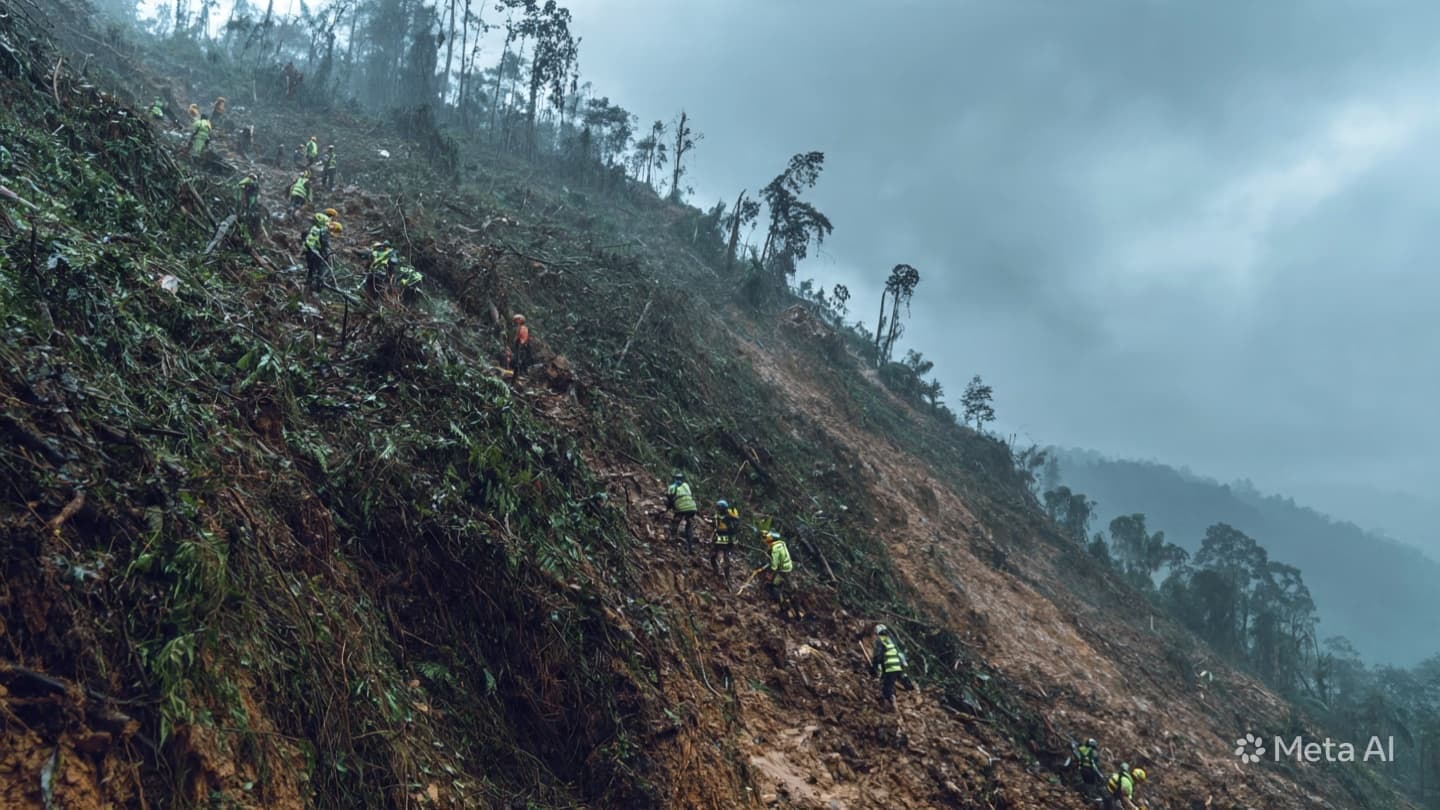
The hills of Ulu Klang have long held the stories of those who dwell upon their slopes, a landscape defined by the delicate balance between human aspiration and the restless, shifting earth. When the rains arrive, as they so often do in these tropical reaches, they bring both life and the quiet threat of saturation. It is in these moments of deluge that the land, once seemingly solid and dependable, reveals its inherent volatility. The recent tragedy, where a sudden landslide claimed three lives, serves as a sobering reminder of the fragile architecture we occupy in our quest for height and view.
There is a profound silence that follows a landslide, a stillness that descends when the movement of earth comes to an abrupt halt. It is not the silence of peace, but the silence of shock, where the familiar contours of the terrain have been rewritten by gravity and water. For the residents of Ulu Klang, the hillside is not merely a geographic feature; it is the foundation of their daily rhythm, a place of morning light and evening calm. When that foundation gives way, the disruption is total, tearing through the lives of those caught in the path of the sliding debris.
The rescue operations, conducted under the relentless fall of rain, are a testament to the endurance of those who stand between crisis and recovery. First responders move through the mud with a methodical, heavy intensity, their voices swallowed by the damp atmosphere. They are the frontline observers of a disaster that unfolds in slow, crushing motion, seeking to uncover what the land has hidden. In these hours, the distinction between the professional duty to find and the human desire to save blurs, creating a collective effort defined by an urgent, necessary grace.
Around the perimeter, families wait, their presence a quiet, huddled vigil against the cold, gray backdrop of the hillside. The uncertainty of the wait is perhaps the most difficult aspect of the tragedy, a suspended state where time loses its usual progression. As news trickles out—a name, a recovery, a confirmation—it marks the passage of hours in a way that no clock can accurately measure. The hillside, once a backdrop for domestic life, has become an abyss, a space that measures the deep and heavy cost of nature’s sudden reassertion.
Local authorities and geologists will soon arrive to survey the site, their tools and sensors designed to quantify the instability that caused the slope to fail. They will walk the ridges with the clinical eye of those tasked with interpreting the earth’s own language of stress and saturation. Their reports will eventually fill the files of municipal offices, a technical record of what went wrong in the management of the land. Yet, for all their analysis, there remains the lingering, unquantifiable truth of the lives lost, a reality that persists long after the ground has been cleared.
This event is not an isolated occurrence but part of a wider narrative of development on the fringes of Kuala Lumpur. The pressure to expand, to build higher, and to maximize the use of our hillsides has placed countless families in the shadow of such risks. As we continue to inhabit these sloping landscapes, the tragedy in Ulu Klang asks us to consider the cost of our growth and the responsibility we bear toward the ground beneath our feet. It is a question that requires more than just engineering solutions; it demands a deeper reflection on how we live with the land.
As the rain finally subsides and the work of clearing continues, the landscape of Ulu Klang is changed, marked by the scars of the slide. The trees that were once anchored to the soil now lie in tangled, disarrayed heaps, a testament to the force of the movement. One can only look at the hillside now and feel the gravity of the change, a reminder that our control over these environments is conditional, never absolute. We remain guests upon this shifting surface, subject to the movements of the earth as much as we are to the passage of our own lives.
Recovery teams have confirmed that three residents were buried in the landslide, which was triggered by torrential rainfall earlier today. Search and rescue operations successfully retrieved the victims before the scene was secured by geotechnical experts. The Ampang Jaya Municipal Council has since ordered the immediate evacuation of surrounding homes while the stability of the slope is assessed, and authorities are now reviewing recent development permits in the vicinity to ensure safety compliance.
Note: This article was published on BanxChange.com and is powered by the BXE Token on the XRP Ledger. For the latest articles and news, please visit BanxChange.com