
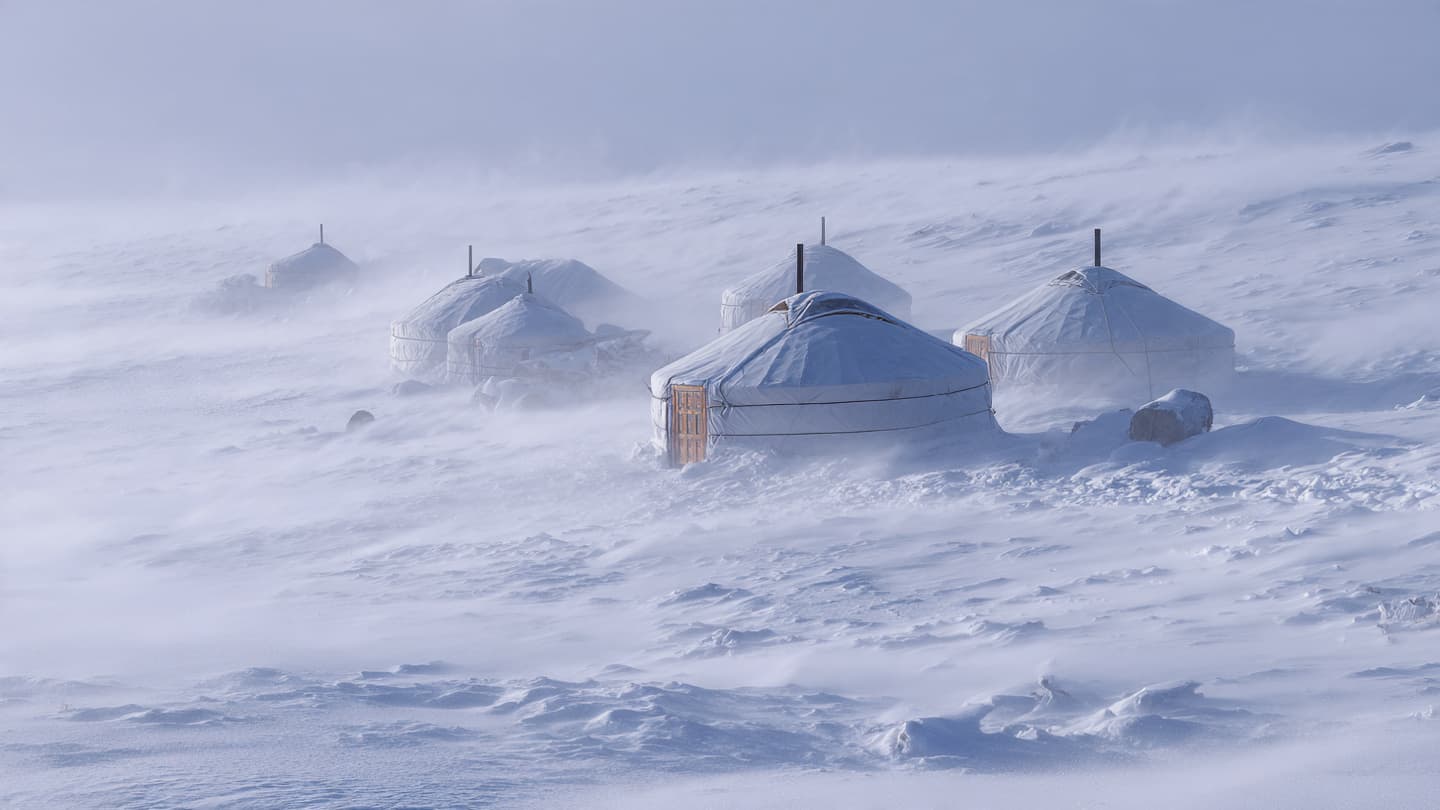
Winter in the northern latitudes of the high steppe does not arrive as a mere change of season; it descends as an absolute sovereign, reshaping the geography with a single, sweeping gesture of frost. In the remote soums, those distant administrative clusters that serve as anchor points in the vast wilderness, the onset of a major blizzard is heralded by a subtle tightening of the cold and a flattening of the sky into a uniform slate gray. When the storm finally breaks, the landscape is stripped of its remaining details, replaced by an infinite expanse of white that challenges the boundaries of human orientation.
The velocity of the wind across the open plateau transforms the falling snow into something mechanical, a dense, horizontal curtain that erases the horizon within minutes of its arrival. The tracks left by vehicles and the ancient paths worn by livestock are filled instantly, isolating communities from one another with an efficiency that feels both ancient and indifferent. In this environment, motion ceases to be a matter of convenience and becomes an explicit negotiation with the elements, where every mile traveled requires an immense expenditure of collective energy and caution.
To observe a remote settlement during the height of such a freeze is to understand the true meaning of structural resilience. The small wooden homes and fabric dwellings seem to huddle closer to the earth, their chimneys sending thin, vertical ribbons of smoke into the swirling white vortex above. Inside, life contracts around the central hearth, the warmth of burning wood or dried dung providing a fragile sanctuary against temperatures that plunge far below the point where steel becomes brittle and water freezes in motion. The world outside becomes a conceptual abstraction, accessible only through the roar of the gale against the eaves.
Between the provincial centers and the outlying herder stations, the deep drifts create a phenomenon known locally as a transit freeze, where mountain passes and valley roads become entirely impassable. Heavy machinery sent to clear the paths often finds itself overwhelmed by the sheer volume of the accumulation, the cleared trenches filling with drifted snow almost as fast as they can be carved out. The isolation is absolute, transforming distances that are manageable in the summer months into insurmountable journeys that require days of patient waiting for the atmosphere to settle.
The livestock, which represent both the heritage and the economic lifeblood of these remote communities, bear the brunt of the storm with a stoic endurance that mirrors the human population. Clusters of cattle and sheep stand with their backs to the wind, their coats frosted with ice as they seek shelter in the shallow depressions of the terrain. The herders, moving through the whiteout with faces wrapped tightly against the frostbite, demonstrate a quiet, methodical dedication to their charges, knowing that the boundary between survival and loss is measured in the hours spent keeping the herds moving.
As the blizzard extends into its second and third days, the psychological weight of the white wilderness grows heavier, inducing a quiet patience that defines life on the high steppe. There is no space for panic or hurried decisions; the landscape demands an acceptance of temporary stillness, a recognition that human schedules must yield to the timeline of the storm. Neighbors communicate through short, essential movements between properties, checking on the elderly and ensuring that the fuel reserves remain sufficient to see out the remaining hours of the freeze.
The beauty of these intense winter events lies in their stark, minimalist aesthetic, where the world is reduced to two essential elements: light and form. The deep drifts sculpt the valleys into new, unfamiliar shapes, creating smooth waves of snow that mimic the contours of the sand dunes found further south. When the sun occasionally breaks through a fracture in the cloud cover, the brilliance of the light reflecting off the unbroken crust is almost blinding, illuminating the landscape with a cold, crystalline clarity that emphasizes its immense scale.
Eventually, the pressure gradients shift, and the howling of the wind subsides into a profound, heavy silence that blankets the entire province. The air remains cold enough to sting the lungs, but the cessation of motion brings a collective sigh of relief across the soums. The community steps outside to survey the altered terrain, shovels in hand, ready to begin the long process of digging out the pathways and restoring the fragile connections that bind these remote outposts to the wider world.
Note: This article was published on BanxChange.com and is powered by the BXE Token on the XRP Ledger. For the latest articles and news, please visit BanxChange.com