
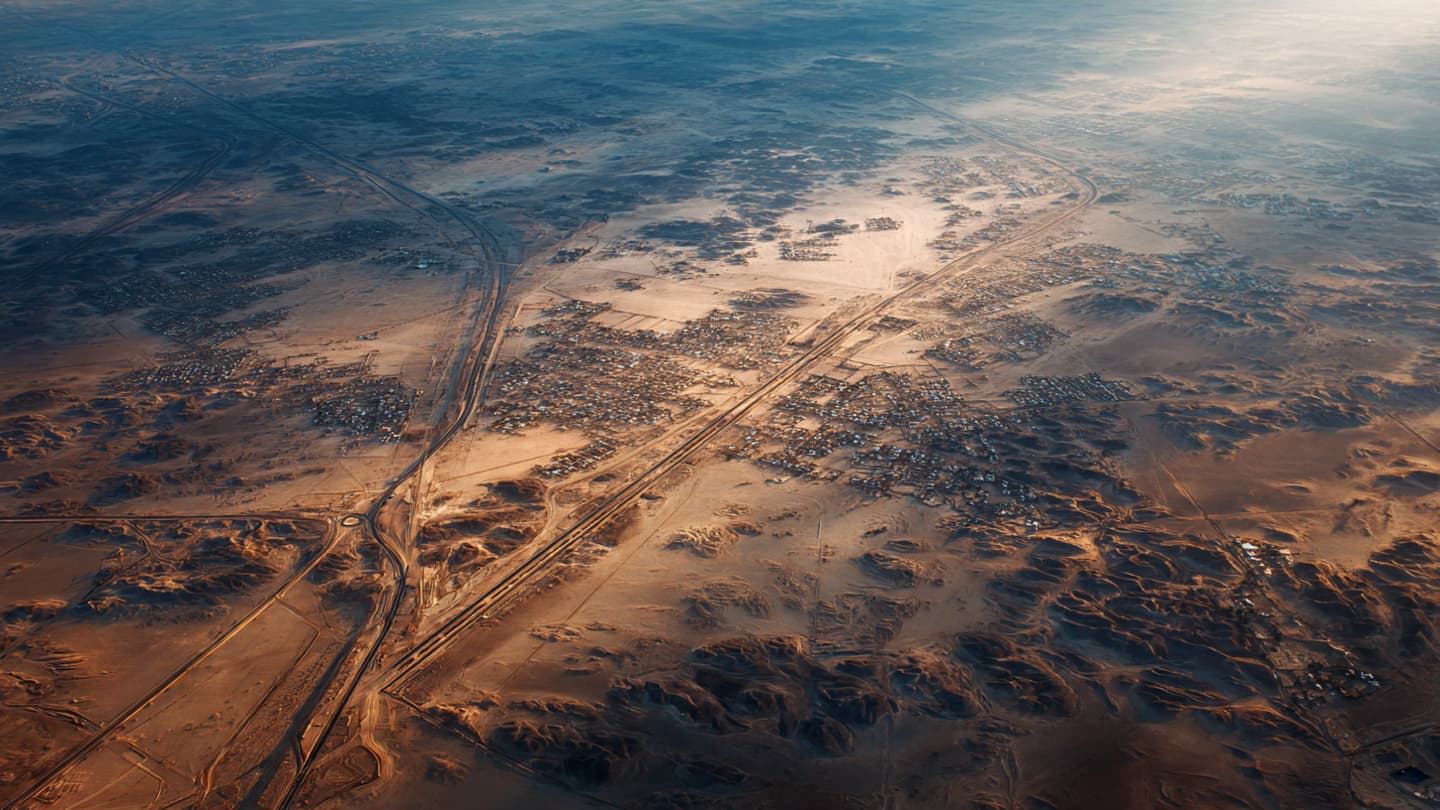
In Kuwait, the desert often carries a particular stillness before dawn. The air cools briefly beneath the fading stars, and the highways stretching beyond the city seem suspended between night and morning. At military installations scattered across the flat landscape, lights remain visible against the darkness, small points of brightness in a region where geography has long been shaped by trade routes, oil fields, and strategic alliances.
It was during these uncertain hours that the sky briefly became a place of interruption.
An Iranian ballistic missile strike targeting a U.S. military installation in Kuwait left several Americans with minor injuries and caused significant damage to military equipment, according to reports citing officials familiar with the incident. Kuwaiti air defenses intercepted the incoming Fateh-110 missile, but falling debris struck the Ali Al Salem Air Base, where American personnel and aircraft were stationed. The incident injured roughly five people, including active-duty service members and contractors, while also damaging two MQ-9 Reaper drones, one of which was reportedly destroyed.
The event unfolded against a backdrop of uneasy diplomacy and lingering military confrontation. Although a ceasefire framework has existed in recent weeks, the broader conflict between the United States and Iran has continued to generate periodic exchanges, retaliatory actions, and moments of escalation. In the Gulf, where shipping lanes, military bases, and energy infrastructure exist within close proximity, even limited incidents often carry significance beyond their immediate physical impact.
For Kuwait, the strike was another reminder of the country's unique position within the regional landscape. Situated between larger powers and hosting important American military facilities, Kuwait has long occupied a strategic role in Gulf security architecture. Its air bases, logistics hubs, and defense infrastructure connect military operations across a region that stretches from the Arabian Peninsula to the eastern Mediterranean.
The missile involved in the incident, identified by reports as a Fateh-110 short-range ballistic missile, was intercepted before reaching its intended target. Yet the consequences of interception can remain visible long after the moment of defense. Fragments descending from the sky still carry force, transforming protective actions into scenes that require emergency response, medical treatment, and investigation. The damage to the drones alone reflected the scale of the impact, with each MQ-9 Reaper representing a significant military asset.
Iran stated earlier that it had targeted a U.S. air base in response to American military operations near Bandar Abbas and around the Strait of Hormuz. Those operations were described by Washington as defensive actions aimed at countering Iranian drone activity that threatened American forces and commercial shipping. The exchange underscored how rapidly events can move across the Gulf, linking coastal military actions, maritime security concerns, and missile launches into a single chain of consequence.
Around the region, governments watched carefully. Gulf states have repeatedly expressed concern that confrontation between larger powers could spill across borders and place civilian populations, infrastructure, and trade routes at risk. The Gulf remains one of the world's most strategically important corridors, where energy exports, shipping traffic, and military deployments intersect beneath increasingly crowded skies.
At the same time, diplomatic efforts continue in parallel with military preparations. Reports from Washington suggest that discussions surrounding a possible extension of ceasefire arrangements remain under consideration, even as both sides accuse one another of actions that undermine stability. Negotiations move forward cautiously, shaped by mistrust, competing demands, and the realities created by events on the ground.
The broader conflict has already imposed significant costs. Casualty reports, damaged infrastructure, disrupted trade, and the growing expenditure of advanced military systems have become part of the region's daily calculations. Yet beyond statistics lies another reality: the gradual normalization of uncertainty. Sirens, interceptions, and military alerts increasingly form part of the atmosphere through which ordinary life continues.
As morning returned to Kuwait, emergency crews assessed damage while military personnel resumed their routines. Aircraft remained on runways. Traffic flowed through the city. The desert horizon looked much as it had the day before.
Yet beneath that familiar landscape, another layer of tension remained. A missile had crossed the sky, defenses had responded, and fragments had found their way to the ground. The incident left only minor injuries, but its symbolism traveled farther than the debris itself.
For now, the ceasefire remains fragile, negotiations remain unresolved, and the Gulf continues to navigate the narrow space between deterrence and escalation. Above the desert, the sky has grown quiet again. But across the region, many remain aware of how quickly silence can be interrupted.
AI Image Disclaimer: The images accompanying this article were created with AI tools for illustrative purposes and do not depict actual photographs of the events described.
Sources:
Reuters Bloomberg The Straits Times ABC News Center for Strategic and International Studies (CSIS)
Note: This article was published on BanxChange.com and is powered by the BXE Token on the XRP Ledger. For the latest articles and news, please visit BanxChange.com