In cities built across long histories, there are buildings that feel less like structures and more like stored memory—spaces where language, art, and gathering settle into walls as if they were part of the architecture itself. Kyiv, with its layered streets and river-light reflections, holds many such places: theaters, libraries, museums, and cultural halls that carry not only function, but continuity.
In recent days, that continuity has been disrupted again as missile strikes attributed to Russian forces impacted areas within Kyiv, damaging cultural sites that had long served as anchors of artistic and civic life. Among the accounts emerging from the aftermath, residents described hearing structural collapse—sounds that marked not only physical destruction, but the breaking of spaces tied to collective memory.
The wider context of these strikes is the ongoing war involving Russia and Ukraine, a conflict that has repeatedly reshaped the urban landscape of Kyiv and other cities. Cultural institutions, often situated at the intersection of public life and national identity, have been among the affected sites, reflecting a pattern in which infrastructure of meaning becomes entangled with infrastructure of conflict.
Witness accounts from affected neighborhoods describe moments that unfolded in compressed intensity: warning systems, movement toward shelter, then the shockwaves that followed. In such moments, perception narrows to immediate sound and vibration, and only afterward does the scale of damage become visible—broken facades, scattered debris, and interiors that once held performances or exhibitions now exposed to open air.
Cultural workers and residents returning to damaged sites have spoken about the dissonance between memory and present condition. A hall that once carried music or dialogue now carries dust and silence. The change is not only architectural but temporal, as if the building has been pulled abruptly from one moment into another.
Officials and emergency crews have been engaged in ongoing assessments of structural damage and safety risks, while efforts continue to stabilize affected areas. In parallel, cultural institutions across the city have begun documenting losses, both material and intangible, attempting to account for collections, archives, and performance spaces altered or destroyed.
The targeting or incidental damage of cultural sites during conflict carries implications that extend beyond immediate physical reconstruction. These spaces often function as repositories of shared identity, where artistic expression and public memory intersect. When they are damaged, the impact is distributed unevenly across time—felt not only in the present disruption but in the interruption of future cultural continuity.
As Kyiv continues to adapt to repeated episodes of aerial attack, the city’s cultural geography becomes increasingly marked by absence as well as presence. Some buildings remain active, others operate in partial capacity, and some exist now primarily in memory or documentation.
Yet even amid destruction, cultural activity often persists in altered forms: temporary venues, relocated performances, digital archives, and informal gatherings. These adaptations reflect an effort to maintain continuity under conditions that repeatedly interrupt it.
In the aftermath of the strikes, what remains is a city negotiating between preservation and vulnerability, where the sound of collapse is followed by the quieter labor of assessment and remembrance. And within that space, Kyiv’s cultural identity—though physically wounded—continues to be carried forward in fragments, recordings, and the persistence of those who return to rebuild what can still be rebuilt.
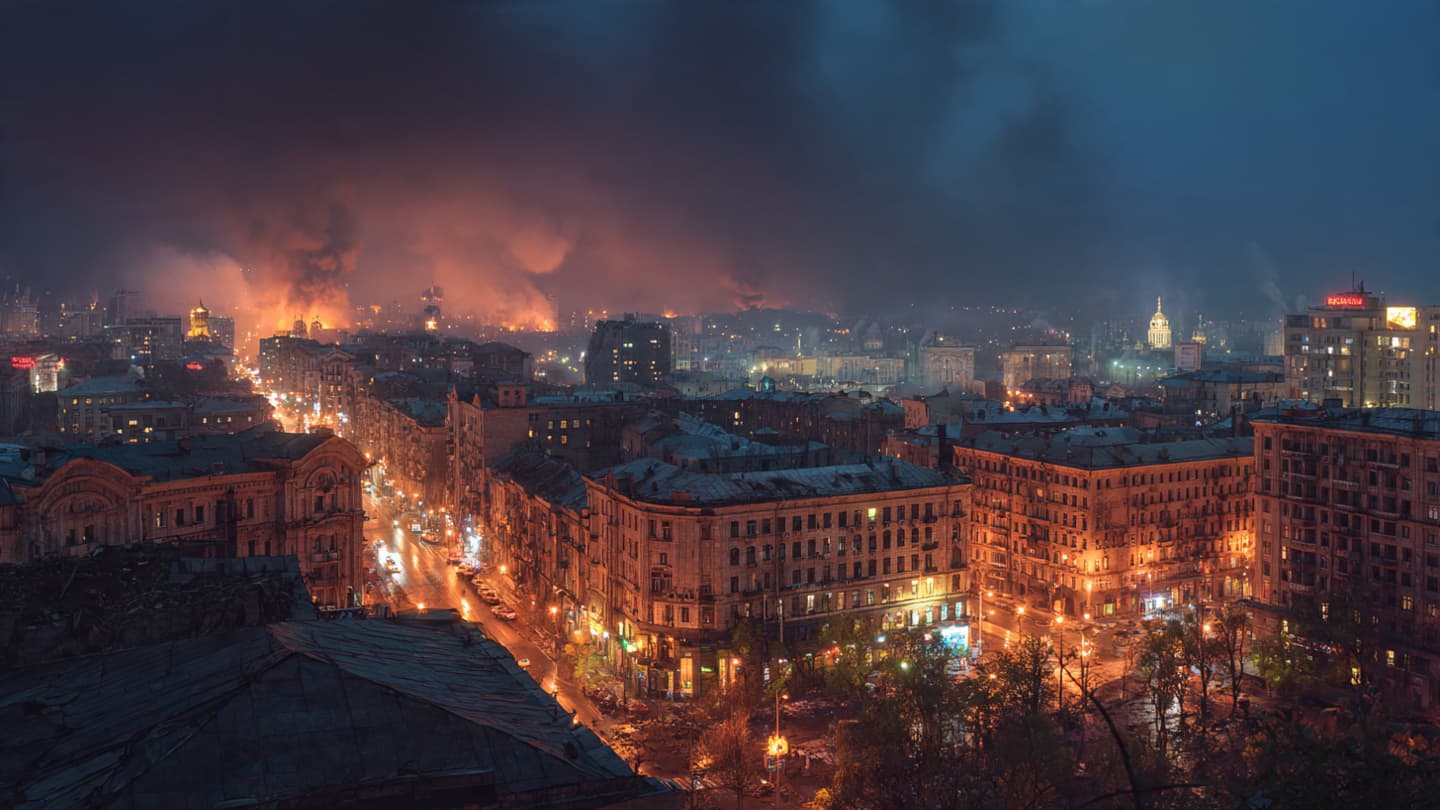
AI Image Disclaimer Visuals were created using AI tools and are not real photographs.
Sources Reuters, Associated Press, BBC News, UNESCO, The Guardian
Published by Banx Network. This article is part of the Banx decentralized media programme, powered by the BXE token on the XRP Ledger.