
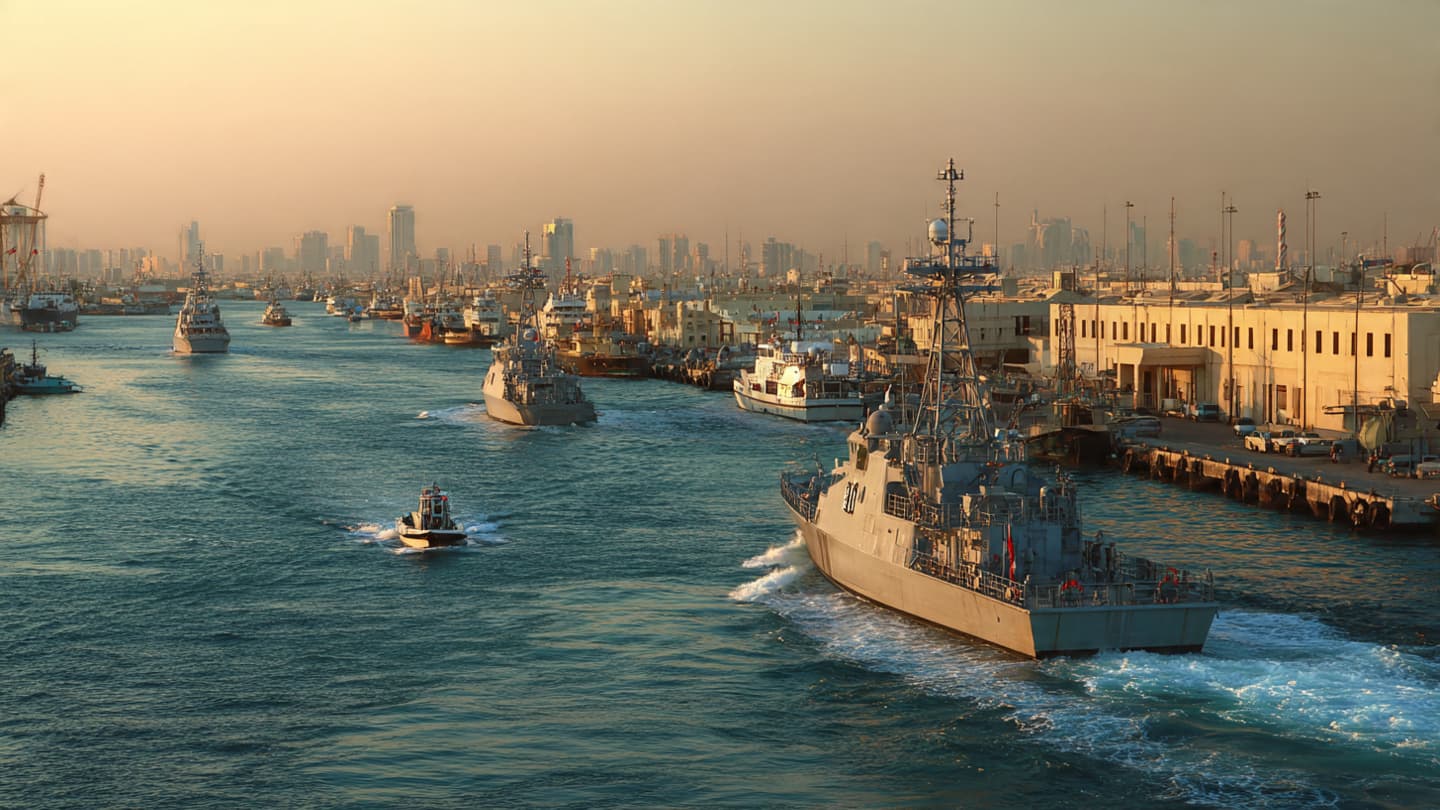
Morning arrives slowly over the Persian Gulf. Light settles first on the water — soft and metallic — before touching the silhouettes of oil tankers moving carefully through one of the world’s narrowest and most consequential maritime corridors. Along the Strait of Hormuz, movement rarely stops entirely. Ships continue their patient passage between desert coastlines, carrying crude oil, liquefied gas, and the quiet weight of the global economy itself.
Yet in recent days, the language surrounding those waters has shifted. Diplomacy has begun speaking in layered tones again: reassurance wrapped beside warning, openness carried alongside caution.
Iranian officials said there is currently “no toll” on passage through the Strait of Hormuz, signaling that commercial shipping may continue moving through the channel without immediate disruption. At the same time, however, Tehran warned that another kind of payment could eventually be required if regional tensions continue or future agreements fail to respect Iranian interests.
The remarks emerged during a period of delicate negotiations involving Iran, the United States, and regional Gulf states, where discussions over ceasefires, sanctions, maritime security, and broader diplomatic normalization have begun overlapping in increasingly complex ways. Though officials avoided direct threats to shipping traffic, the statement reflected how the Strait itself remains more than geography alone. It is both a physical passage and a political instrument, narrow enough for tension to gather quickly.
Roughly one-fifth of the world’s oil supply moves through the Strait of Hormuz, connecting Gulf producers to international markets across Asia, Europe, and beyond. Tankers leaving ports in Saudi Arabia, Iraq, Kuwait, Qatar, and the United Arab Emirates pass through waters that have long carried both commerce and confrontation. Even small disruptions can ripple outward into fuel prices, insurance markets, and global supply chains.
For decades, the strait has existed in a state of careful balance. Naval patrols move through its waters alongside cargo ships and fishing vessels, while diplomacy attempts to keep pace with the currents beneath. In moments of crisis, the waterway often becomes symbolic — a reminder that global stability can depend upon remarkably narrow spaces.
Iran’s latest comments appeared designed to preserve ambiguity rather than escalation. Officials emphasized that shipping remains open while also suggesting that future regional arrangements could require broader political concessions from outside powers and neighboring states. Some analysts interpreted the language as part of ongoing leverage during negotiations tied to sanctions relief, regional security guarantees, and discussions surrounding a potential diplomatic framework involving Israel and Arab governments.
The wider backdrop remains shaped by months of instability across the Middle East. Maritime attacks, drone strikes, proxy confrontations, and fluctuating ceasefire talks have repeatedly placed Gulf shipping routes under international scrutiny. In response, naval coalitions increased patrol operations while energy markets reacted nervously to even minor incidents.
Yet daily life around the strait continues in quieter forms often unseen in geopolitical headlines. Fishing boats still leave harbors before dawn. Port workers guide cargo beneath harsh afternoon heat. Families live in coastal cities whose rhythms depend as much upon tides and trade as they do upon international diplomacy.
This contrast — between ordinary routine and immense strategic significance — has long defined the Gulf region itself. Some of the world’s most consequential political calculations unfold beside calm waters and seemingly still horizons.
Meanwhile, diplomatic discussions involving the United States and Iran continue to evolve cautiously. President Donald Trump has publicly linked broader regional normalization efforts, including possible expansion of the Abraham Accords, to future understandings with Tehran. Gulf states such as Qatar and Saudi Arabia have also emerged as important intermediaries in efforts to reduce escalation and reopen channels of communication after months of confrontation.
Markets responded carefully to Iran’s remarks, with traders watching for any indication of operational disruption in the strait. Shipping companies and insurers remain especially sensitive to rhetoric involving Hormuz because even indirect warnings can influence costs and commercial planning. So far, however, maritime traffic has reportedly continued without major interruption.
The language of “payment” mentioned by Iranian officials may ultimately refer less to literal tolls than to political concessions — sanctions relief, recognition of security concerns, or broader regional arrangements that Tehran hopes to secure through negotiation. In diplomacy, particularly in this region, words are often designed to travel in several directions at once.
As evening settles again across Gulf waters, the tankers continue moving steadily between continents. Their lights appear small against the vastness of the sea, drifting through channels shaped by centuries of trade, empire, conflict, and exchange. Above them, aircraft trace invisible paths across desert skies while diplomats gather in conference rooms far from the shoreline.
The Strait of Hormuz remains open tonight. But like many places where geography and politics meet too closely, it also remains suspended between calm and uncertainty — a narrow passage carrying not only oil, but the fragile momentum of negotiation itself.
AI Image Disclaimer: Illustrations were created using AI tools to visually represent scenes connected to the reported events and are not authentic photographs.
Sources:
Reuters Associated Press Al Jazeera Bloomberg BBC News
Note: This article was published on BanxChange.com and is powered by the BXE Token on the XRP Ledger. For the latest articles and news, please visit BanxChange.com