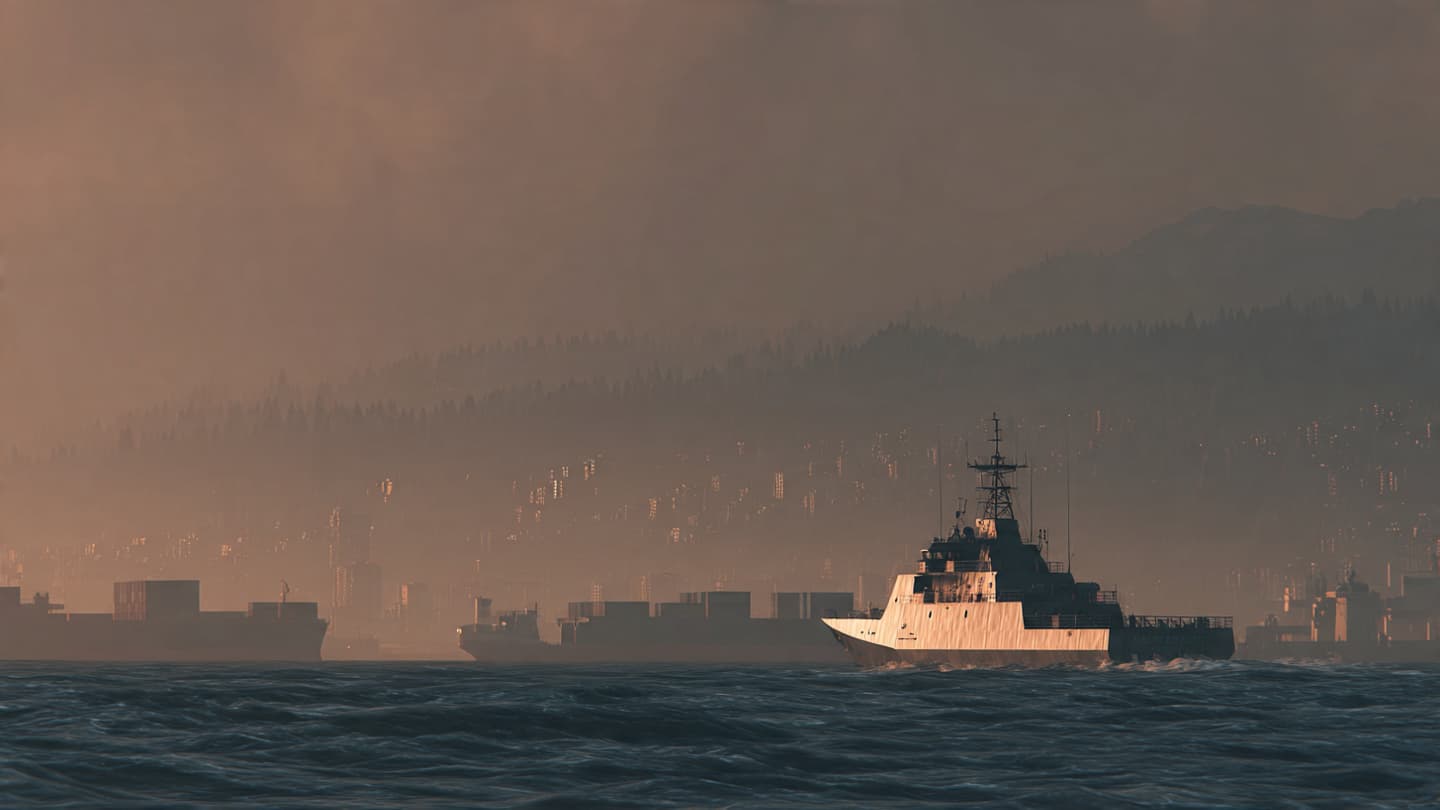
In the narrow stretch of sea where continents seem to lean closer together, the water moves with a quiet inevitability—currents threading through one of the world’s most watched maritime corridors. The Strait of Hormuz, though rarely still in geopolitical memory, often appears outwardly unchanged: ships continuing their passage, horizons uninterrupted, and the surface of the sea reflecting a calm that belies the density of attention above it.
It is within this space that recent statements regarding maritime policy have added a new layer of tension. The United States has indicated that arrangements involving agreements with Iran for guaranteeing “safe transit” through the Strait of Hormuz are not permitted under its current policy framework. The position reflects a broader stance within United States foreign policy, where engagement structures in strategically sensitive waterways are closely scrutinized through the lens of sanctions, security alignment, and regional deterrence.
The Strait of Hormuz itself remains one of the most critical maritime chokepoints in global energy logistics, linking the Persian Gulf to the Gulf of Oman and beyond. A significant portion of the world’s seaborne oil passes through this narrow passage, making it not only a geographic feature but also a persistent focal point of international strategic planning. In such an environment, even policy statements carry weight that extends far beyond diplomatic language.
The U.S. position, as described in recent reports, underscores a long-standing concern over legitimizing frameworks that may be perceived as easing restrictions on sanctioned entities or altering established security arrangements in the region. Instead, maritime safety in the area has typically been approached through naval presence, coalition patrols, and multilateral coordination mechanisms that do not directly involve bilateral operational agreements with Iran.
Within policy circles, such decisions are often shaped by overlapping considerations: enforcement of sanctions regimes, protection of commercial shipping, and the management of regional escalation risks. These elements coexist uneasily, forming a structure in which cooperation and restriction are continually recalibrated in response to shifting geopolitical conditions.
For shipping operators navigating the strait, the implications of high-level policy decisions are often indirect but tangible. Insurance costs, routing considerations, and security advisories adjust in response to perceived risk levels. While vessels continue to move through the corridor, the operational environment surrounding them is defined as much by diplomatic posture as by physical conditions at sea.
The Strait of Hormuz has long functioned as both a logistical artery and a strategic pressure point. Its narrowness amplifies significance; its constant traffic magnifies consequence. As such, any discourse around governance or transit arrangements tends to resonate widely, drawing in regional actors, global markets, and security institutions.
At the same time, maritime governance in contested or sensitive waters often operates through layered systems rather than singular agreements. Coordination between navies, adherence to international maritime law, and informal deconfliction mechanisms collectively shape how movement is managed. Within this structure, formal bilateral arrangements involving sanctioned states can become particularly complex, especially when broader geopolitical tensions remain unresolved.
As the policy stance is reiterated, the broader trajectory of regional maritime strategy remains in motion. Naval deployments continue, diplomatic exchanges persist, and shipping routes maintain their steady rhythm across a corridor that has seen centuries of exchange and contention.
What emerges is a familiar pattern in global maritime politics: the sea remains open in principle, but governed in practice by a dense web of permissions, restrictions, and interpretations. In that space between openness and oversight, the Strait of Hormuz continues to carry not only vessels, but also the accumulated weight of international alignment and disagreement.
AI Image Disclaimer Visuals were created using AI tools and are not real photographs.
Sources Reuters, Associated Press, BBC News, Al Jazeera, U.S. State Department
Published by Banx Network. This article is part of the Banx decentralized media programme, powered by the BXE token on the XRP Ledger.