
The monsoon season arrives gradually across Myanmar. Clouds gather over the Irrawaddy basin, drifting above temples, farms, and highways that connect distant regions of a country long accustomed to navigating forces beyond its borders. Rivers swell with rainwater, carrying reflections of mountains and cities alike. In these landscapes, geography often feels inseparable from politics. Nations, like rivers, are shaped by the terrain through which they move.
As Myanmar continues to confront internal conflict, economic uncertainty, and diplomatic isolation, its leaders find themselves operating within a region where larger powers increasingly influence the direction of events. Every journey abroad, every meeting, and every gesture of engagement is interpreted through the wider dynamics of Asia’s evolving balance of power.
This week, Myanmar’s military leader and recently appointed president, Senior General Min Aung Hlaing, traveled to India for a regional summit, marking a notable diplomatic appearance beyond the country’s immediate neighborhood. The visit comes at a time when Myanmar remains under scrutiny from many Western governments following the military’s seizure of power in 2021 and the prolonged conflict that has followed. Yet within Asia, geography and security concerns continue to encourage engagement, even amid political disagreements.
India’s invitation reflects the complexity of regional diplomacy. Sharing a long and porous border with Myanmar, India views stability across its eastern frontier as an important strategic interest. The two countries cooperate on issues ranging from border security and insurgent activity to infrastructure projects designed to improve connectivity between South and Southeast Asia. At the same time, New Delhi must balance these practical concerns with international criticism directed toward Myanmar’s military leadership.
Beyond the immediate agenda of bilateral relations lies a broader geopolitical reality. Myanmar occupies a position of significant importance between South Asia, Southeast Asia, and southwestern China. Roads, pipelines, ports, and trade corridors passing through Myanmar have long featured in regional development strategies. For Beijing, the country provides access to the Indian Ocean and serves as a vital component of infrastructure initiatives linking China to global markets. For India, Myanmar represents both a neighbor and a strategic gateway to Southeast Asia.
Against this backdrop, Min Aung Hlaing’s visit has attracted attention not merely because of the meetings themselves, but because of what they suggest about Myanmar’s effort to preserve diplomatic flexibility. Analysts have observed that Naypyidaw seeks to avoid excessive dependence on any single partner, even as China remains one of its most influential external relationships. Maintaining ties with India offers both economic opportunities and a measure of strategic balance in a region where influence is constantly negotiated.
The timing is also significant. Myanmar continues to face armed resistance movements across several regions, while humanitarian and economic challenges persist. International sanctions and political tensions have narrowed some diplomatic options, making engagement with neighboring countries increasingly important. In such circumstances, regional forums often become venues where practical interests outweigh ideological divisions.
For India, the calculations are equally layered. Chinese influence along the Himalayan frontier, in the Indian Ocean, and throughout Southeast Asia remains a central consideration in New Delhi’s foreign policy. Maintaining channels of communication with Myanmar helps secure India’s northeastern borderlands while supporting broader ambitions to strengthen connections with ASEAN economies. Diplomacy, in this context, resembles a bridge spanning several currents at once.
Yet beyond strategic maps and policy documents lies a quieter reality. Millions of people living along the borders between India and Myanmar continue their daily routines largely untouched by summit speeches. Traders cross local markets. Farmers monitor seasonal rains. Families move between communities linked by culture, language, and history that long predate modern state boundaries. Their lives provide a reminder that geopolitical decisions often unfold against a backdrop of ordinary continuity.
As the summit progresses, expectations remain measured. No dramatic realignment is anticipated, nor are major breakthroughs expected. Instead, the visit reflects the steady and often understated nature of regional diplomacy—a process built less on sudden transformation than on maintaining relationships amid changing circumstances.
By the time the monsoon clouds pass over Myanmar’s rivers and hills once again, the broader questions will remain. How can smaller and middle-sized states preserve autonomy while navigating competition among larger powers? How should neighboring countries balance principles with practical necessities? And what role will geography continue to play in shaping political choices?
For now, Min Aung Hlaing’s journey to India stands as another chapter in a familiar regional story: nations seeking room to maneuver between competing centers of influence, while the currents of Asia’s wider transformation continue to flow around them.
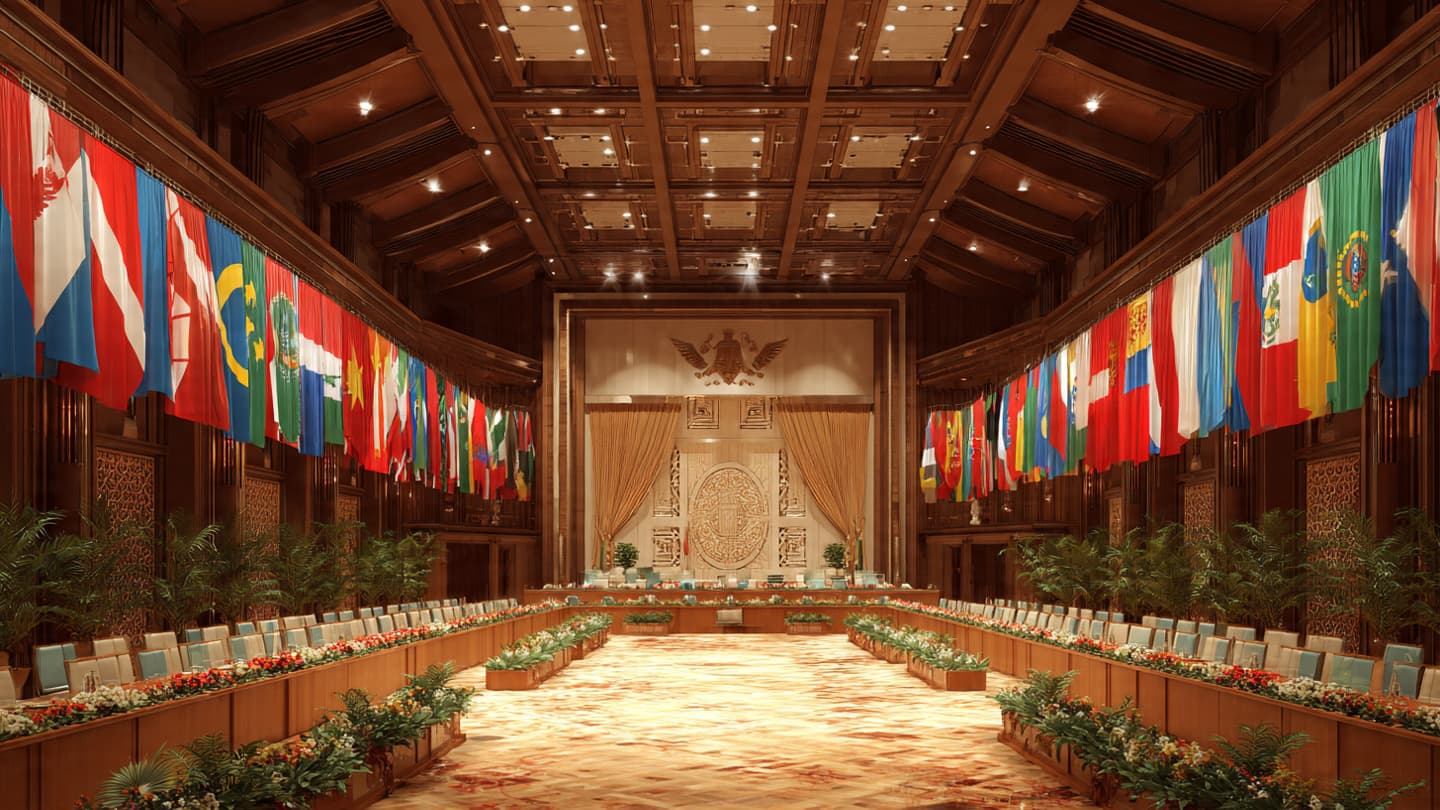
AI Image Disclaimer: Images accompanying this article are AI-generated visualizations intended to represent the subject matter and may not reflect actual scenes or events.
Sources:
Reuters Associated Press Nikkei Asia The Diplomat Channel News Asia
Note: This article was published on BanxChange.com and is powered by the BXE Token on the XRP Ledger. For the latest articles and news, please visit BanxChange.com