
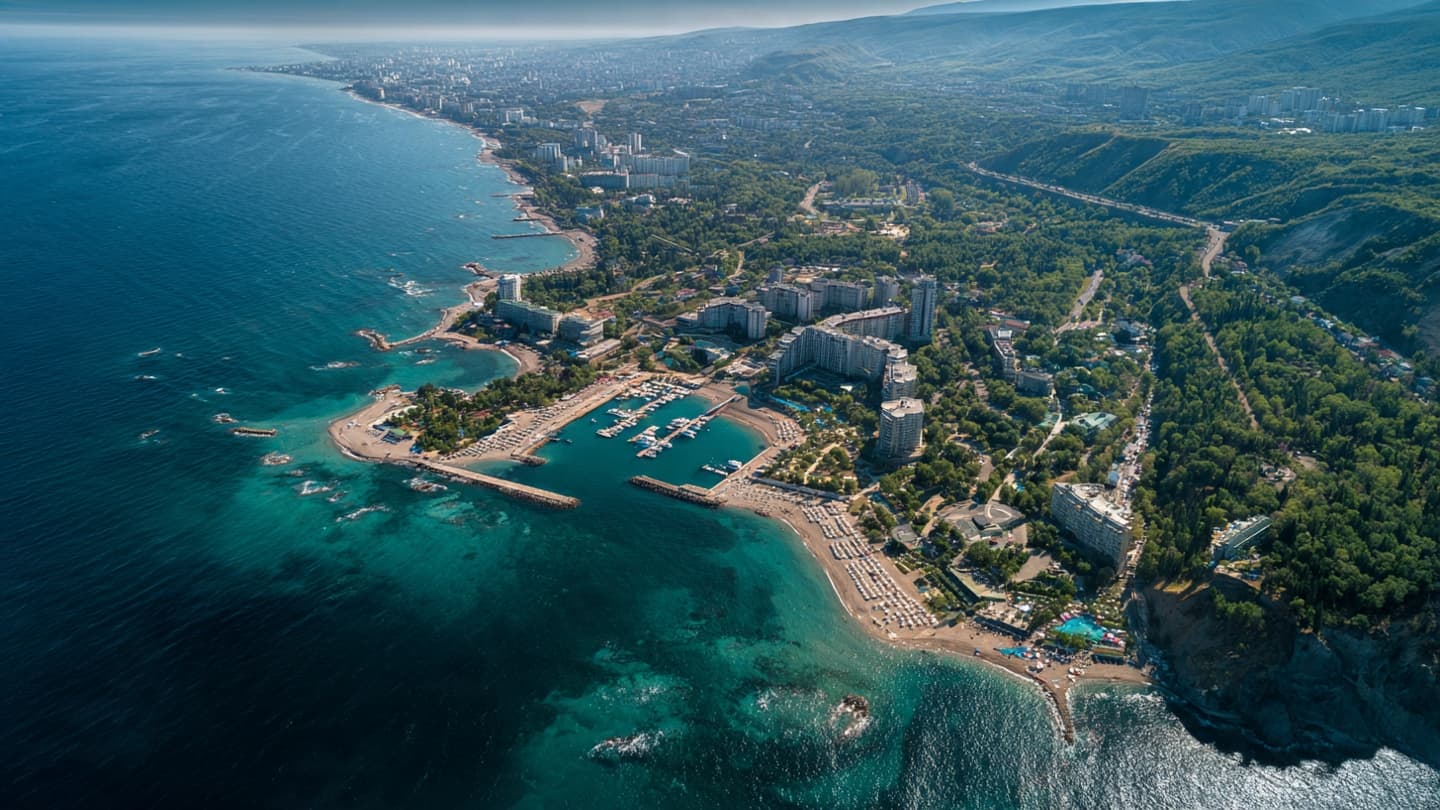
The Black Sea has a way of creating illusions of permanence. Its waters move with patient rhythm, touching harbors, beaches, and rocky shores much as they have for generations. Along Crimea’s coastline, summer sunlight still falls across promenades and resorts. Cafés open their doors. Ferries cross familiar routes. At first glance, the peninsula can appear suspended between sea and sky, distant from the turbulence shaping much of the wider region.
Yet the modern geography of conflict often travels through the air.
In recent months, Crimea has found itself increasingly exposed to Ukrainian drone operations, bringing the realities of war into a territory that Russia has long sought to present as stable, secure, and integrated. What was once perceived by many residents and visitors as a relatively sheltered corner of the conflict has become a place where military alerts, air-defense activity, and infrastructure disruptions are becoming part of everyday awareness.
For Moscow, Crimea occupies a place that extends beyond military strategy. Since Russia’s annexation of the peninsula in 2014, the territory has been presented as both a symbol of national achievement and a showcase for development. Investments flowed into transportation networks, tourism infrastructure, housing projects, and the construction of the Kerch Bridge linking Crimea to mainland Russia. The vision was one of permanence and prosperity, intended to reinforce the peninsula’s importance within Russia’s political narrative.
The landscape itself appeared well suited to that ambition. Coastal resorts attracted visitors seeking warm weather and Black Sea views. Historic cities welcomed tourists. New roads connected regions that had once felt isolated. The peninsula became both a destination and a symbol, woven into broader stories of national identity and strategic significance.
The war that expanded dramatically in 2022 has gradually altered that picture.
Ukrainian forces have increasingly used long-range drones and other strike capabilities to target military facilities, logistics hubs, airfields, fuel depots, and infrastructure linked to Russian operations in Crimea. These attacks are intended not only to degrade military capacity but also to challenge assumptions about security behind the front lines. The effect is often measured less by territorial change than by disruption, uncertainty, and the need for constant adaptation.
For residents, the consequences can appear in subtle ways. Temporary road closures interrupt travel plans. Air-raid warnings alter routines. Flights are canceled or delayed. Businesses adjust to changing conditions. Tourism, an important component of the local economy, faces additional uncertainty as visitors weigh concerns about safety and accessibility. The cumulative impact emerges gradually, through hundreds of individual decisions made by families, travelers, and business owners.
Military analysts frequently note that modern drone warfare has transformed traditional concepts of distance. Locations once considered far removed from combat can now find themselves within operational reach. Crimea illustrates this shift particularly clearly. The peninsula remains geographically separated from many active battlefields, yet advances in drone technology have narrowed the practical distance between front lines and strategic rear areas.
The significance extends beyond military calculations. Infrastructure carries symbolic value. Bridges, airports, ports, and energy facilities are not merely functional assets; they represent continuity, connectivity, and confidence. Repeated disruptions can therefore influence perceptions as much as logistics. In conflicts where narratives matter alongside battlefield outcomes, such effects are closely watched by all sides.
Ukraine has consistently argued that military installations and logistical networks in Crimea are legitimate targets because of their role in Russia’s war effort. Russian authorities, meanwhile, have emphasized defensive measures and continued efforts to maintain normal life on the peninsula. Between these competing positions lies a reality experienced by ordinary people navigating a landscape where security concerns increasingly intersect with daily routines.
The story unfolding in Crimea is therefore about more than drones. It is about how technology reshapes geography and how conflict reaches places once considered distant from immediate danger. It is also about the tension between long-term political visions and the unpredictable nature of war, where carefully constructed narratives can be challenged by events arriving from unexpected directions.
As another summer season unfolds along the Black Sea coast, the beaches, harbors, and historic streets of Crimea remain much as they were. The sea continues its steady movement against the shore. Yet above that familiar landscape, the conflict has introduced a new dimension—one carried not by tides or weather, but by aircraft small enough to be unseen until their presence is felt.
For now, Crimea remains central to both Russia’s strategic ambitions and Ukraine’s military calculations. The peninsula’s future will be shaped by decisions made far beyond its coastline, but its present reveals a broader truth about modern conflict: even places built to symbolize stability can find their horizons altered by the reach of a changing war.
AI Image Disclaimer These AI-generated illustrations are intended to visually accompany the story and should not be interpreted as authentic photographs of the events described.
Sources
Reuters Associated Press Institute for the Study of War (ISW) United Kingdom Ministry of Defence Carnegie Endowment for International Peace
Published by Banx Network. This article is part of the Banx decentralized media programme, powered by the BXE token on the XRP Ledger.



.jpg&w=3840&q=75 "Intelligence Agencies Suspect Russia Is Developing Anti-Satellite Weapon to Target Starlink")