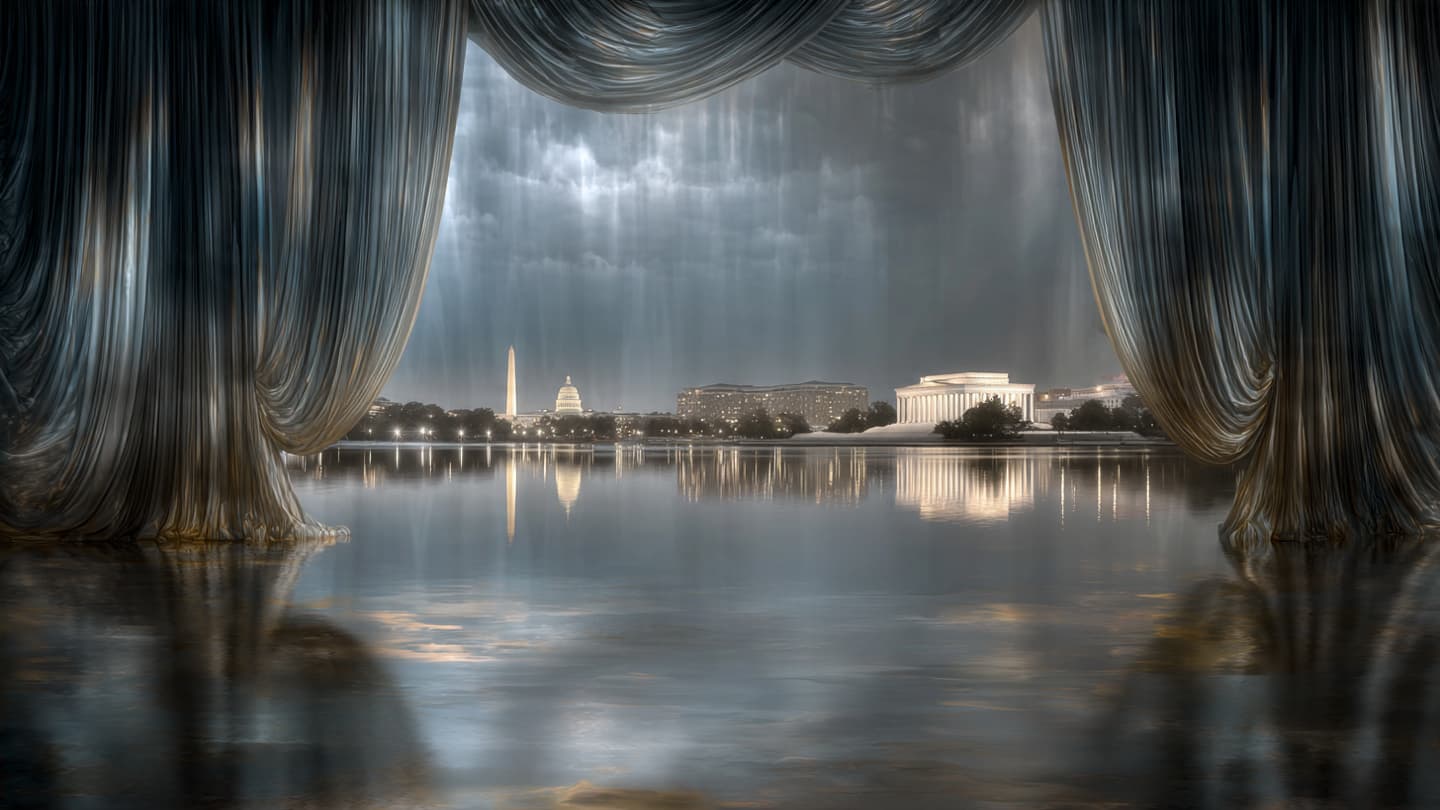
In Washington, where buildings often seem to hold their breath between one political season and the next, cultural institutions can feel like rooms in a house that everyone believes they understand—until the furniture begins to move. Along the Potomac’s slow reflection, where evening light folds into marble and glass, the question of ownership and influence over national culture often arrives not as a statement, but as a shift in atmosphere.
The latest turn in the long-running conversation surrounding the John F. Kennedy Center for the Performing Arts has brought renewed attention to the relationship between politics, leadership, and the stewardship of cultural spaces in the United States. Discussions around the involvement of former U.S. President Donald Trump with the institution have circulated in public commentary and media analysis, particularly after earlier signals of interest in reshaping aspects of its governance and direction.
The Kennedy Center, as one of the country’s most prominent cultural venues, has long occupied a symbolic position beyond its programming of theater, music, and dance. It functions as both stage and statement—a national space where artistic expression intersects, at times uncomfortably, with political visibility. Its leadership structure, partially appointed through federal channels, has historically made it a site where questions of influence naturally arise whenever broader political shifts occur.
Recent commentary suggesting a change in Trump’s level of engagement with the institution has added another layer to this ongoing narrative. While public details remain limited and interpretations vary across reporting outlets, the discussion itself reflects a recurring theme in American civic life: the delicate balance between cultural autonomy and political proximity. In Washington, that balance is rarely static; it adjusts with administrations, appointments, and shifting priorities.
Inside the Kennedy Center’s glass corridors, rehearsals and performances continue in their own rhythm, largely insulated from external debate. Dancers move through choreography shaped by discipline rather than discourse, musicians tune instruments in spaces designed for acoustics rather than argument. Yet outside those walls, the institution’s symbolic weight ensures that even administrative questions can take on a broader public resonance.
The broader context of cultural governance in the United States often brings with it questions of visibility and identity. Institutions like the Kennedy Center are not only venues but also cultural markers, representing how a nation presents its artistic voice to itself and to the world. As such, discussions around leadership or political association tend to extend beyond personnel into questions of meaning—what it signifies when public figures engage with cultural institutions, and how those engagements are interpreted over time.
Whether the current moment represents a definitive departure, a pause, or simply another turn in an ongoing relationship remains part of a developing public narrative. What is clear, however, is that the Kennedy Center continues to function as it has for decades: a stage where art proceeds in parallel with the conversations that surround it, each unfolding without fully interrupting the other.
In that parallel motion—between performance and politics, between intention and interpretation—the story remains open. The institution continues to host its seasons of music and movement, while Washington continues its quieter choreography of influence and speculation.
And so the question lingers not as a conclusion, but as part of a longer rhythm: how cultural spaces in the capital are shaped not only by what is decided within them, but also by the shifting attention of those who pass near their doors.
AI Image Disclaimer Visuals were created using AI tools and are not real photographs.
Sources The Washington Post, Reuters, Associated Press, NPR, BBC News
Published by Banx Network. This article is part of the Banx decentralized media programme, powered by the BXE token on the XRP Ledger.