

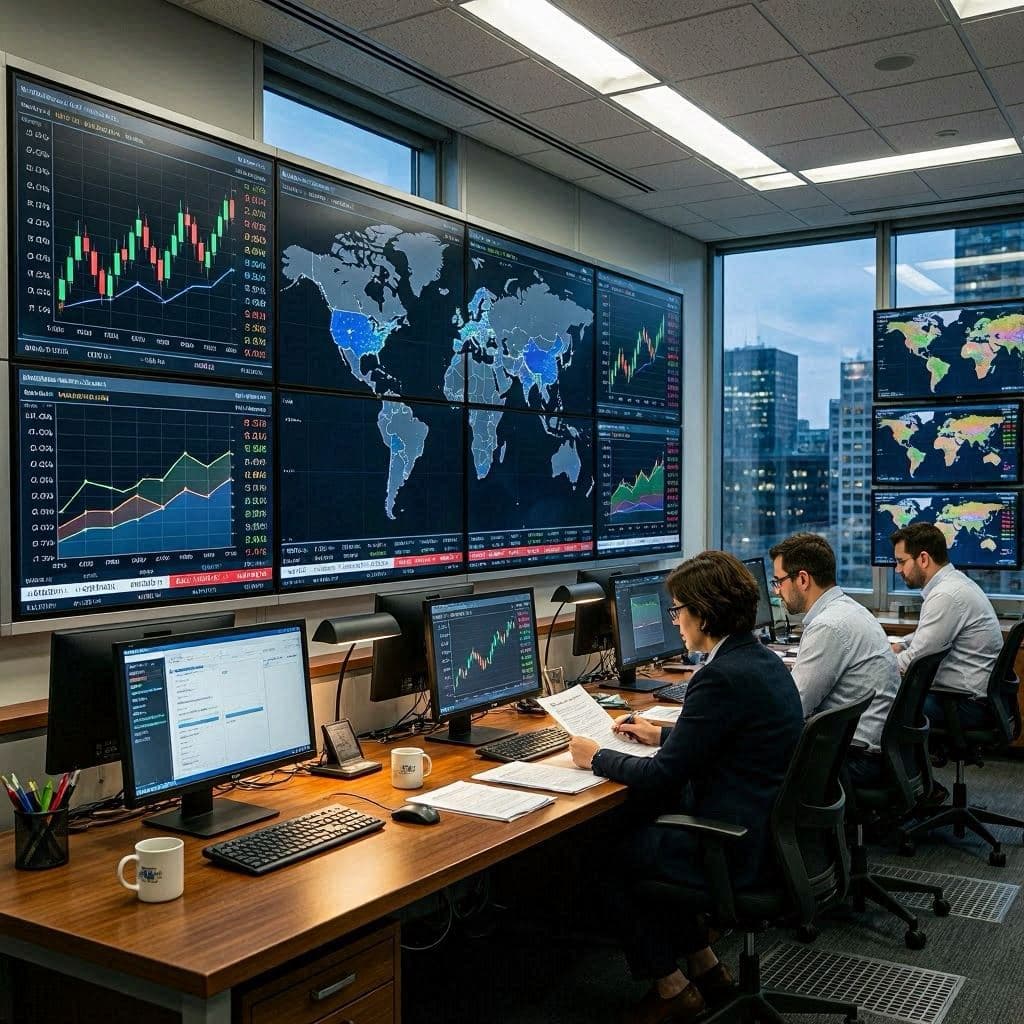
Key Highlights
- Economic uncertainty is rising due to geopolitical tensions and technological changes.
- Central banks face challenges in managing inflation and growth.
- Businesses are diversifying supply chains to enhance resilience.
The global economy is currently navigating a complex landscape marked by rising uncertainty. Financial analysts and institutions have raised alarms about the interplay between geopolitical tensions and rapid technological advancements. Investors are closely monitoring various developments, including regional conflicts and shifts in artificial intelligence, which are reshaping industries and influencing market sentiment.
Geopolitical risks are a significant factor affecting global financial systems. Ongoing conflicts, trade disputes, and diplomatic tensions have introduced volatility that impacts investment decisions and capital flows. For instance, tensions in Eastern Europe and Asia have led to fluctuations in commodity prices and supply chain disruptions, prompting businesses to reassess their strategies.
Simultaneously, the pace of technological change is unprecedented. Innovations in artificial intelligence, automation, and digital infrastructure are creating new opportunities for growth. However, these advancements also raise concerns about labor markets and the need for businesses to adapt quickly. Companies are increasingly investing in digital transformation to remain competitive, which is essential in a rapidly evolving economic environment.
Central banks worldwide are facing a delicate balancing act. Policymakers must navigate the challenges of managing inflation while supporting economic growth and maintaining financial stability. The Federal Reserve, for example, has been adjusting interest rates in response to inflationary pressures, while also considering the broader implications for economic recovery.
In response to these challenges, businesses are diversifying their supply chains and placing greater emphasis on resilience alongside efficiency. This shift is evident as firms seek to mitigate risks associated with geopolitical instability and supply chain disruptions. Many companies are reassessing their long-term strategic priorities to ensure they can adapt to changing market conditions.
Interestingly, economists suggest that uncertainty can sometimes spur innovation. In times of instability, companies and governments may be more inclined to explore new approaches to emerging challenges. However, prolonged uncertainty can dampen investment and slow economic growth, creating a paradox that policymakers must navigate carefully.
International cooperation remains crucial in managing economic risks. Organizations such as the International Monetary Fund (IMF) and the World Bank advocate for coordinated efforts on trade, finance, and development issues. Collaborative approaches can help mitigate the impacts of geopolitical tensions and foster a more stable economic environment.
As uncertainty continues to characterize the current economic landscape, analysts emphasize the importance of adaptability and cooperation. The ability of economies to navigate these challenges will significantly influence their growth trajectories in the years ahead. By fostering resilience and embracing innovation, nations can better position themselves to thrive amid ongoing global changes.
Published by Banx Network. This article is part of the Banx decentralized media programme, powered by the BXE token on the XRP Ledger.




