
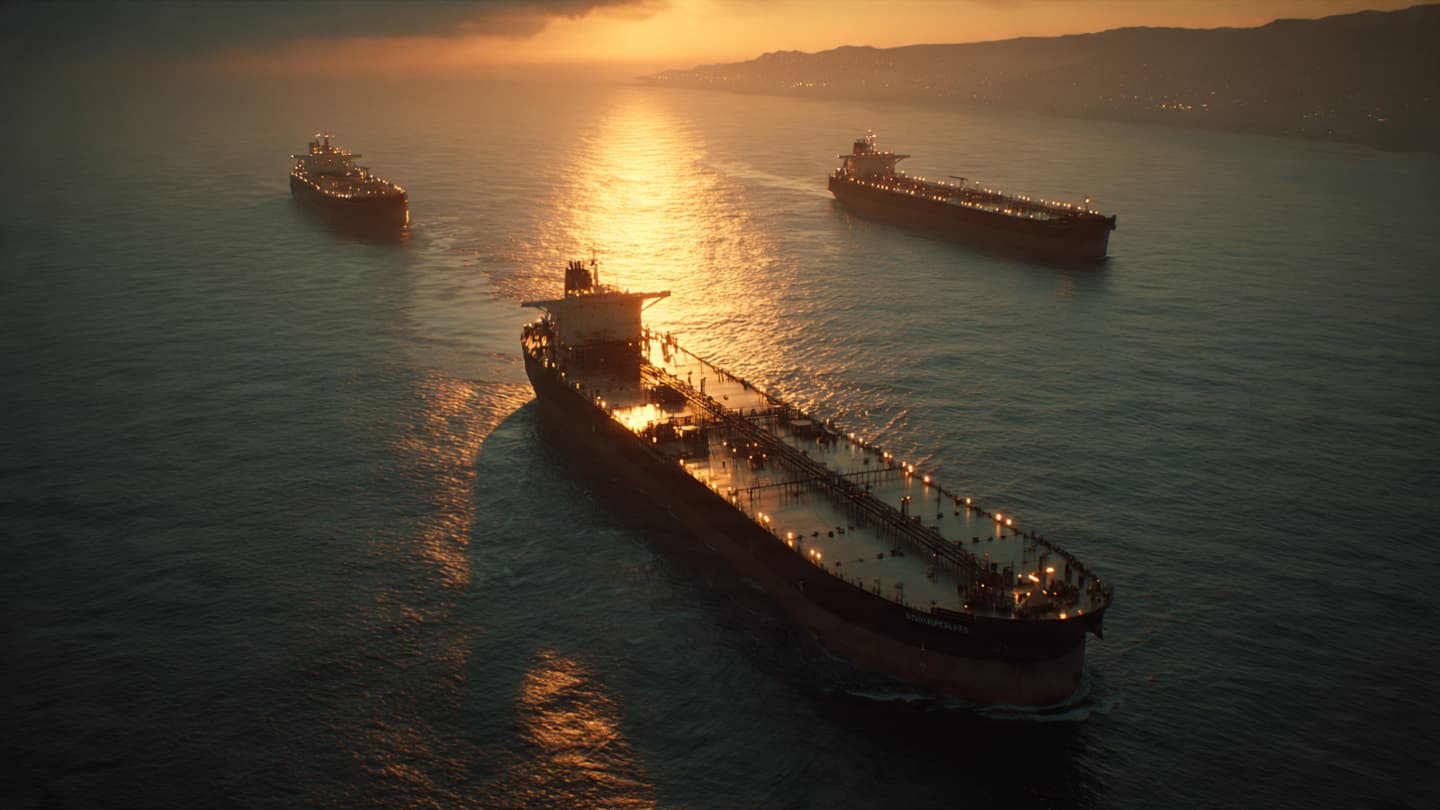
At dusk, the waters of the Persian Gulf often seem deceptively calm. The sea reflects the fading colors of the sky, while cargo vessels and oil tankers move steadily through one of the world's most important maritime corridors. From a distance, the traffic appears orderly and predictable, a floating procession connecting producers, consumers, ports, and economies across continents.
Yet beneath this appearance of routine, a quieter transformation has begun to unfold.
In recent weeks, maritime tracking data has revealed an increasing number of ships passing through the Strait of Hormuz while reducing or temporarily disabling their public location transmissions. To observers watching digital shipping maps, vessels that normally appear as moving points of light suddenly vanish from view, only to reappear later after leaving the narrow passage linking the Persian Gulf to the Gulf of Oman and the wider Indian Ocean.
The practice, known in shipping circles as "going dark," has become a visible sign of growing concern among operators navigating a region shaped by geopolitical tension. Commercial vessels are equipped with Automatic Identification System transmitters, commonly known as AIS, which broadcast a ship’s location, speed, and identity. These signals help prevent collisions and allow authorities, ports, and shipping companies to monitor maritime traffic. But under certain circumstances, captains may limit transmissions if they believe broadcasting their location could increase security risks.
The renewed caution follows a period of heightened uncertainty in the Middle East. Regional tensions, concerns about military escalation, and fears of disruption to shipping routes have prompted companies to reassess how vessels transit some of the world's most strategically significant waters. The Strait of Hormuz, only about twenty-one miles wide at its narrowest point, serves as a gateway for a substantial share of globally traded crude oil and liquefied natural gas. Any disruption within the passage has the potential to ripple far beyond the Gulf itself.
For energy markets, the strait is more than a geographic feature. It is a maritime artery through which the daily rhythms of global industry flow. Tankers carrying crude from Saudi Arabia, Iraq, Kuwait, the United Arab Emirates, and other producers move through these waters on journeys that connect oil fields to refineries thousands of miles away. The movement is constant, almost tidal in its regularity, which is why even small changes in shipping behavior attract attention.
The decision by some vessels to sail with reduced visibility reflects a broader atmosphere of caution rather than immediate disruption. Most shipping continues uninterrupted, and maritime authorities have emphasized that the waterway remains open. Yet the appearance of ships disappearing from tracking systems has become a symbol of how uncertainty shapes behavior long before physical trade routes are affected.
History casts a long shadow over these waters. The Gulf has witnessed periods when tankers required naval escorts, when maritime attacks raised insurance costs, and when political crises transformed shipping lanes into focal points of international concern. Those memories remain embedded in industry planning. Companies often respond to emerging risks not through dramatic actions but through small adjustments designed to reduce exposure while preserving the flow of commerce.
The phenomenon also highlights the growing intersection between physical and digital navigation. Modern shipping relies not only on engines, charts, and crews but also on streams of data visible around the world in real time. When a vessel disappears from public tracking systems, it creates a gap in that digital landscape—a reminder that technology can provide visibility, but not certainty.
Around the Gulf's ports, activity continues. Cranes load containers. Tankers await berths. Harbor pilots guide incoming vessels through crowded channels. Daily trade remains remarkably resilient despite the headlines and concerns that occasionally surround the region. Yet beneath that continuity lies an awareness that confidence itself is an important component of global commerce.
As night settles over the Strait of Hormuz, navigation lights continue to flicker across the water. Some vessels remain visible on electronic maps, tracing steady routes through the darkness. Others briefly fade from public view before emerging once more beyond the narrow passage.
For the world beyond the Gulf, the ships still move, the oil still flows, and the sea lanes remain open. But the growing number of vessels choosing temporary invisibility offers a quiet reflection of the times—a reminder that in an interconnected world, uncertainty often appears first not in what stops moving, but in what chooses to travel unseen.
AI Image Disclaimer: Visual content was generated using AI and serves as an illustrative interpretation of the topic rather than a photographic record.
Sources:
Bloomberg Reuters Lloyd’s List Financial Times International Energy Agency (IEA)
Note: This article was published on BanxChange.com and is powered by the BXE Token on the XRP Ledger. For the latest articles and news, please visit BanxChange.com