
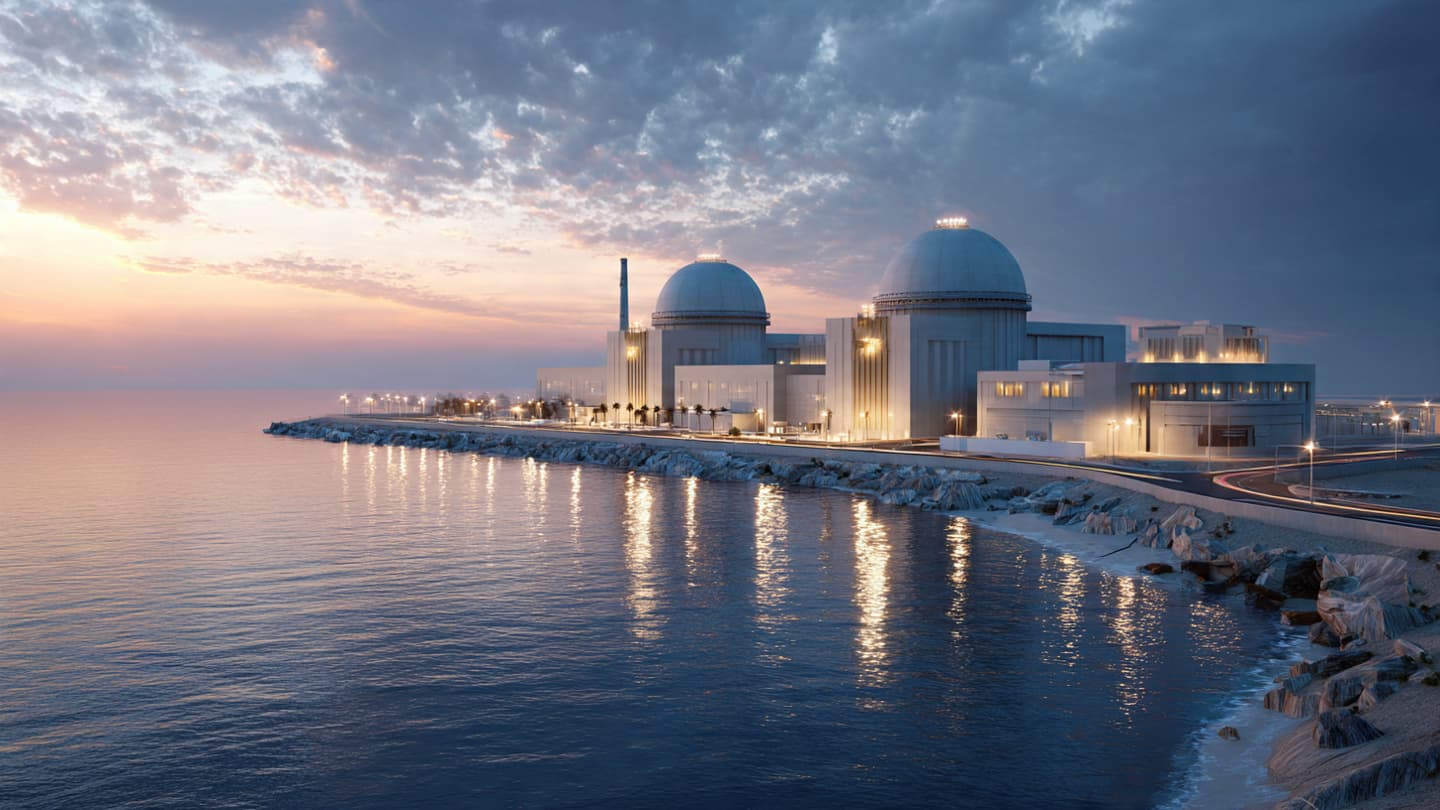
Along the western coastline of the United Arab Emirates, where the desert eases gradually into the waters of the Persian Gulf, the Barakah nuclear power plant rises from the shoreline with geometric stillness. Its pale domes stand against the horizon like instruments of permanence — symbols of technological ambition built in a region more often associated with oil fields, shipping lanes, and shifting political weather. At night, the complex glows softly against the surrounding emptiness, a reminder of how modern infrastructure now occupies even the quietest edges of the Gulf.
This week, that stillness was briefly interrupted by the distant movement of drones.
According to Emirati officials, several drones that targeted the Barakah nuclear power plant originated from Iraqi territory before being intercepted by air defense systems. Authorities stated that no damage occurred at the facility and that reactor operations continued normally, but the incident immediately deepened concerns about the widening geography of regional conflict and the growing vulnerability of critical infrastructure across the Middle East.
The UAE described the attempted strike as a serious escalation, particularly because Barakah represents not only an energy installation but also the Arab world’s first operational nuclear power plant. Located in Abu Dhabi’s Al Dhafra region, the site has become central to the Emirates’ long-term strategy of diversifying energy production beyond fossil fuels. Since beginning operations, Barakah has steadily expanded its role in supplying electricity across the country, symbolizing a broader regional push toward technological modernization and energy transition.
Yet infrastructure of such scale also carries symbolic weight far beyond its practical function. Nuclear facilities, desalination plants, ports, and airports increasingly stand at the intersection of geopolitics and vulnerability, especially in a region where drones and missile technology have transformed the nature of modern conflict. Distance no longer guarantees safety in the same way it once did.
Emirati officials did not publicly identify the group responsible for launching the drones, though statements pointed toward armed factions operating within Iraq. Security analysts noted that several Iran-aligned militias in the region possess drone capabilities capable of reaching Gulf targets, particularly amid heightened tensions involving the United States, Iran, and allied regional actors. Iraqi authorities have reportedly begun coordinating investigations with Gulf partners while attempting to avoid deeper diplomatic strain.
The incident arrives during a period of growing anxiety across the Gulf, where maritime threats, missile exchanges, and proxy conflicts have created an atmosphere of persistent uncertainty. Though much attention in recent years has focused on shipping routes through the Strait of Hormuz and Red Sea, attacks involving long-range drones have gradually expanded the sense of exposure felt by governments across the region.
For the UAE, the memory of earlier drone and missile attacks remains close. In 2022, Abu Dhabi faced strikes claimed by Yemen’s Houthi movement, targeting fuel facilities and infrastructure near the capital. Those attacks altered regional assumptions about security, demonstrating how relatively inexpensive unmanned systems could bypass vast distances and threaten heavily defended urban centers.
Barakah itself has long existed within broader geopolitical debates. Some neighboring states and international observers previously expressed concern over the risks associated with introducing nuclear energy into a volatile region, despite repeated assurances from Emirati authorities regarding safety standards and international oversight. The UAE has consistently framed the project as peaceful, transparent, and developed in cooperation with global nuclear regulators.
Still, the attempted strike highlights how infrastructure designed for stability can become entangled in wider political turbulence. Modern energy facilities are no longer merely industrial spaces; they function as strategic symbols, economic arteries, and potential pressure points all at once.
Across the Gulf coast, daily life continues beneath the heavy summer heat. Cargo ships still approach regional ports. Aircraft descend toward illuminated runways. In Abu Dhabi and Dubai, towers of glass and steel reflect the evening sun while highways remain crowded deep into the night. Yet beneath that outward rhythm lies an increasing awareness that conflict now travels differently — quieter, faster, and often from unseen distances.
Military analysts say the interception of the drones demonstrates the growing sophistication of Gulf defense systems, many of which have expanded rapidly in response to evolving aerial threats. But even successful interceptions carry their own message: that the boundaries between battlefield and civilian infrastructure have become increasingly blurred.
For now, the Barakah plant remains operational, and Emirati officials insist there was never immediate danger to the reactors themselves. Investigations into the origin and coordination of the drones are continuing, with regional governments quietly weighing both security responses and diplomatic consequences.
Along the shoreline near Barakah, the reactors still stand facing the Gulf waters beneath open desert skies. Yet the attempted strike serves as another reminder that in today’s Middle East, even the most carefully guarded symbols of stability exist within the long shadow of conflicts unfolding far beyond the horizon.
AI Image Disclaimer: Visual representations in this article were generated using AI and are intended for illustrative use only.
Sources:
Reuters Associated Press Al Jazeera Bloomberg International Atomic Energy Agency
Note: This article was published on BanxChange.com and is powered by the BXE Token on the XRP Ledger. For the latest articles and news, please visit BanxChange.com