
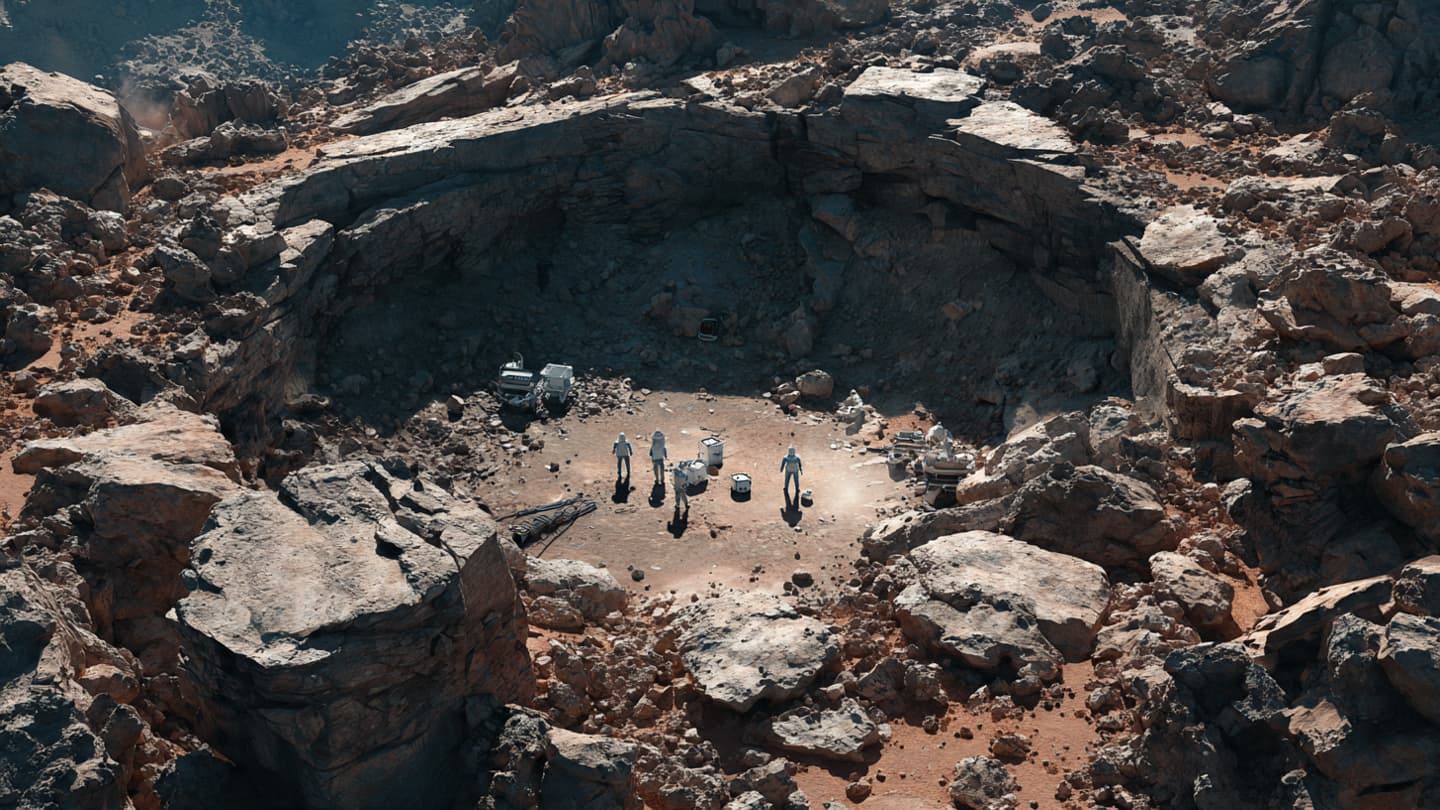
The Earth keeps many of its oldest stories hidden beneath stone and sediment. Sometimes the most important discoveries emerge not from untouched landscapes, but from places shaped by violence and destruction long ago. Scientists studying material buried beneath an ancient asteroid crater have now uncovered evidence suggesting that microbial life may once have existed deep below the impact site.
Researchers examining underground rock samples identified chemical and structural signatures associated with ancient microbial activity. The findings suggest that conditions beneath the crater may have created environments capable of supporting microscopic life despite the catastrophic force of the original asteroid impact.
Asteroid collisions are often associated with extinction and planetary upheaval. Yet scientists increasingly believe that impact sites may also create unique underground habitats. Fractured rock formations, trapped heat, and circulating water can form environments where microbial organisms survive or even thrive beneath the surface.
The crater examined in the study reportedly dates back millions of years and has remained an important site for geological and astrobiological research. Scientists used advanced imaging and geochemical analysis to distinguish possible biological traces from ordinary mineral formations.
The discovery contributes to broader scientific efforts exploring how life survives under extreme conditions. Researchers studying Earth’s deep biosphere often focus on environments involving high pressure, darkness, volcanic activity, or impact-altered rock because such settings may resemble conditions found elsewhere in the solar system.
Astrobiologists are especially interested in these findings because they may influence future exploration of Mars and other planetary bodies. Ancient impact craters on Mars, for example, are considered promising locations in the search for evidence of past microbial life.
The research also highlights the resilience of microscopic organisms throughout Earth’s history. Life on the planet has endured asteroid impacts, climate shifts, volcanic catastrophes, and dramatic environmental transformations over billions of years.
Scientists emphasized that further analysis is needed to confirm the biological origins of all observed signatures. Even so, the evidence strengthens the idea that ancient impact zones may preserve important records of life hidden deep beneath Earth’s surface.
AI Image Disclaimer: Several illustrations linked to this article were generated using AI to visualize asteroid craters and underground microbial environments.
Sources: Nature Geoscience, NASA, ScienceDaily, New Scientist
Note: This article was published on BanxChange.com and is powered by the BXE Token on the XRP Ledger. For the latest articles and news, please visit BanxChange.com