
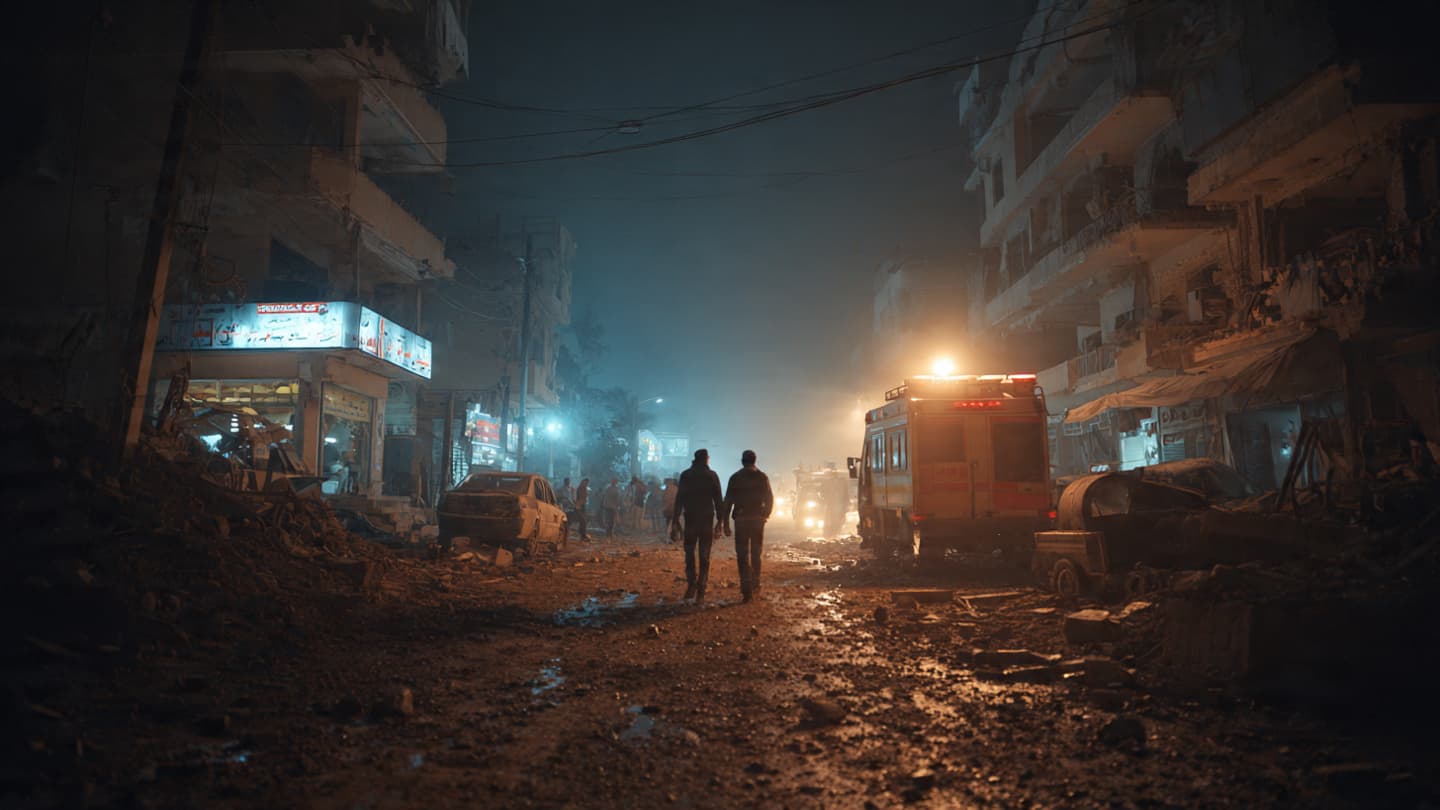
In southern Lebanon, evening often arrives with a deceptive softness. The hills darken slowly beneath fading sunlight, olive groves fall into shadow, and villages scattered across the landscape begin to glow with small domestic lights. Yet along the borderlands, calm has become something temporary and fragile — a pause measured not by certainty, but by the distance between one explosion and the next.
This week, that uneasy stillness broke again as the Israeli military announced a wave of strikes targeting Hezbollah positions in southern Lebanon. The attacks followed warnings issued by the Israel Defense Forces, which said military infrastructure linked to Hezbollah had been identified in areas near the border. Residents across parts of the south reported hearing aircraft overhead before explosions rolled through valleys already familiar with the sound of conflict.
In places such as Tyre, Nabatieh, and villages stretching toward the frontier, daily life has increasingly adapted itself around unpredictability. Families monitor phones for evacuation notices. Shopkeepers close early when tensions rise. Children learn to distinguish between ordinary thunder and the sharper echo of distant artillery. The geography itself — steep hills, orchards, narrow roads — seems to carry memory within it, shaped by decades of recurring confrontation between Israel and Hezbollah.
The latest strikes come amid a prolonged period of cross-border hostilities that intensified after the outbreak of war in Gaza. Since then, exchanges of fire along the Israel-Lebanon frontier have become almost routine, though never entirely normalized. Rockets, drone launches, airstrikes, and artillery fire have displaced communities on both sides of the border, turning once-busy agricultural towns into quieter landscapes marked by checkpoints, damaged homes, and temporary shelters.
Israeli officials stated that the strikes were aimed at Hezbollah military sites and followed prior warnings intended to reduce civilian harm. Hezbollah, the armed Lebanese movement with deep political and military influence inside Lebanon, has continued to exchange fire with Israeli forces as regional tensions remain elevated. The border conflict has unfolded in careful but dangerous increments, restrained from full-scale war yet constantly threatening to move beyond its current limits.
For civilians in southern Lebanon, the uncertainty often settles most heavily during ordinary moments. Bread lines form beneath the sound of reconnaissance drones. Farmers hesitate before returning to fields near contested areas. Evening gatherings are interrupted by sudden alerts or rumors spreading through neighborhood messages. In many villages, the departures of families seeking safety farther north have altered the rhythm of community life itself.
Lebanon’s wider crisis deepens the emotional weight of each escalation. Years of economic collapse, political paralysis, and infrastructure strain have already left many households exhausted long before the latest violence intensified. In such conditions, every airstrike reverberates beyond its immediate target, touching fragile systems already struggling to endure.
International diplomats and regional officials continue urging restraint, aware of how quickly localized exchanges could widen into a broader regional conflict. The border between Israel and Lebanon has long functioned as both a physical frontier and a symbolic fault line within Middle Eastern politics — one where global concerns, local loyalties, and historical grievances overlap in uneasy proximity.
The Israeli military confirmed that multiple Hezbollah-linked targets in southern Lebanon were struck following public warnings issued to nearby residents. Lebanese media and local authorities reported additional damage assessments as rescue teams moved through affected areas. Casualty details remained limited in the immediate aftermath, while tensions across the border continued to remain high.
As night returned to the hills, smoke drifted upward into the darkening sky while generators hummed through villages preparing once again for uncertainty. The roads quieted. Windows dimmed behind drawn curtains. And across the frontier, two landscapes continued watching one another through the long distance between warning and response — suspended in the familiar, uneasy silence that so often follows the sound of warplanes.
AI Image Disclaimer Images accompanying this article were generated using AI technology as illustrative representations of the reported events.
Sources
Reuters Associated Press Al Jazeera BBC News The Times of Israel
Note: This article was published on BanxChange.com and is powered by the BXE Token on the XRP Ledger. For the latest articles and news, please visit BanxChange.com