
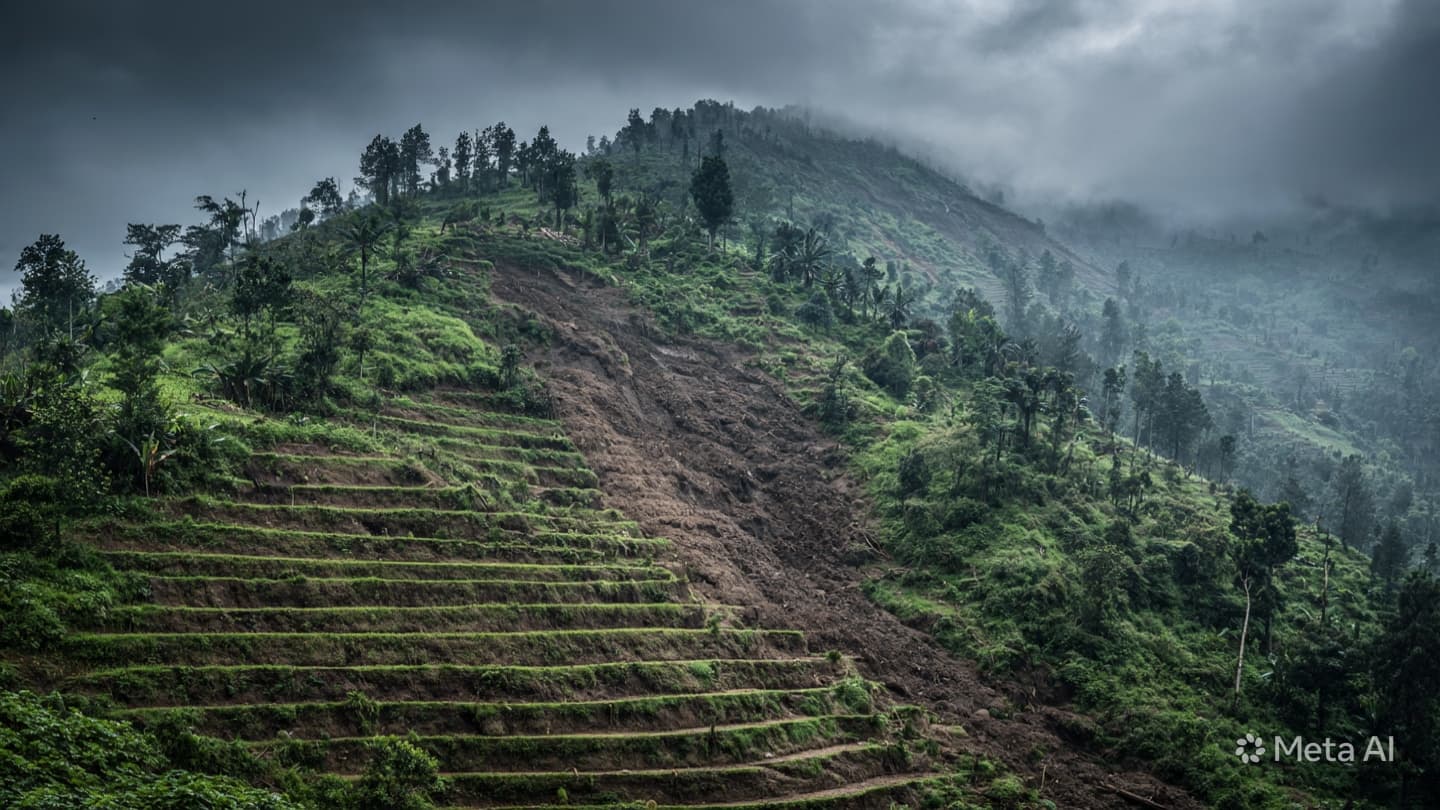
The morning began with the kind of soft, pervasive grey that often blankets the hillsides of Central Java, a stillness that feels heavy with the promise of rain. In the village of Cibeunying, life was defined by the rhythm of the soil—the terraced fields, the steady climb of the paths, and the deep, rooted stability of the houses perched upon the slopes. There is a silent pact between those who live on the mountain and the land itself, a belief that the earth will hold, that the foundations are as enduring as the hills. Yet, nature is not governed by our expectations, and there are moments when gravity asserts itself with a sudden, devastating authority.
When the landslide struck, it did not arrive with a fanfare of warning, but with a sudden, dull roar that seemed to emanate from the very heart of the mountain. In the span of a few heartbeats, the slope—saturated by hours of relentless, soaking rain—simply gave way, sliding downward in a cascade of mud, stone, and uprooted trees. For the two families whose homes were directly in its path, the world shifted from a place of shelter to one of sudden, inescapable chaos. The houses, which had stood as anchors for years, were consumed by the earth in a process that felt both swift and terrifyingly final.
There is a profound, disorienting silence that follows such an event, a stillness that feels like a weight upon the chest. It is as if the landscape itself is pausing to acknowledge the scale of the change. In the village, the aftermath was a mosaic of shattered timber, twisted metal, and the pervasive, damp scent of raw soil. Standing there, one is struck by the insignificance of the human footprint against the immense, shifting mass of the mountain. It is a reminder that we are merely visitors on a surface that is constantly in motion, whether we perceive it or not.
The search for the three family members began in the dim light of the morning, led by neighbours and responders who moved across the unstable ground with a careful, measured caution. There is a unique quality to the labour of disaster relief in these highlands; it is not merely the work of machinery, but the work of hands, of people digging into the earth to find what has been hidden. The atmosphere was one of restrained, collective grief, a shared understanding that each layer of soil removed brought them closer to a truth that no one wished to uncover.
In these moments, the language of the community shifts from the trivialities of daily life to the profound vocabulary of loss and recovery. There is no need for grand proclamations; the reality of the situation—the missing family, the buried home—is its own, singular truth. The responders moved with a quiet, focused determination, aware that the ground remained soft, that the mountain had not finished its conversation with the valley below. They worked not as individuals, but as an extension of the village’s collective desire to restore its integrity.
By the time the afternoon sun broke through the clouds, the scale of the destruction became clearer, a stark silhouette against the green of the surviving slopes. The officials spoke of unstable terrain and the difficulties of access, their words precise and stripped of sentiment. Yet, the tragedy is not found in the reports or the casualty counts; it is found in the stillness of the people gathered at the perimeter, their eyes fixed on the site where the earth reclaimed its own. It is a scene that defies narrative embellishment, existing only in the raw, aching reality of the present moment.
As the dusk gathered, the search-and-rescue teams continued their work under the glare of portable lights, a circle of brightness in a world suddenly made vast and cold. The village, usually a place of evening warmth and hearth-light, felt transformed into a site of profound vulnerability. It is a difficult truth to confront: that the very earth we rely upon for sustenance can, with a slight turn of the weather, become a force of total reclamation. The residents of Cibeunying, like so many who dwell in the highlands, will bear this reality in their movements and their silences for years to come.
Ultimately, the landslide in Central Java is a testament to the fragile line between our domestic lives and the elemental world. We build, we plant, and we persist, often forgetting that the ground beneath us is as fluid as the water that triggers its descent. As the village begins the long, slow process of mourning and reflection, the mountain remains—a silent, towering presence that knows nothing of our loss, even as it serves as the stage for it. It is a quiet, sobering reminder of our place within a larger, more indifferent cycle of existence.
Local authorities in Central Java’s Cilacap regency have reported that a landslide buried two houses in Cibeunying village on the night of June 14, 2026. The tragedy, attributed to heavy, persistent rainfall, has resulted in three confirmed fatalities. Rescue teams, including local disaster mitigation agencies, have been working throughout the day on June 15 to clear the site and stabilize the surrounding hillside, though operations have been slowed by the precarious condition of the terrain.
Note: This article was published on BanxChange.com and is powered by the BXE Token on the XRP Ledger. For the latest articles and news, please visit BanxChange.com