
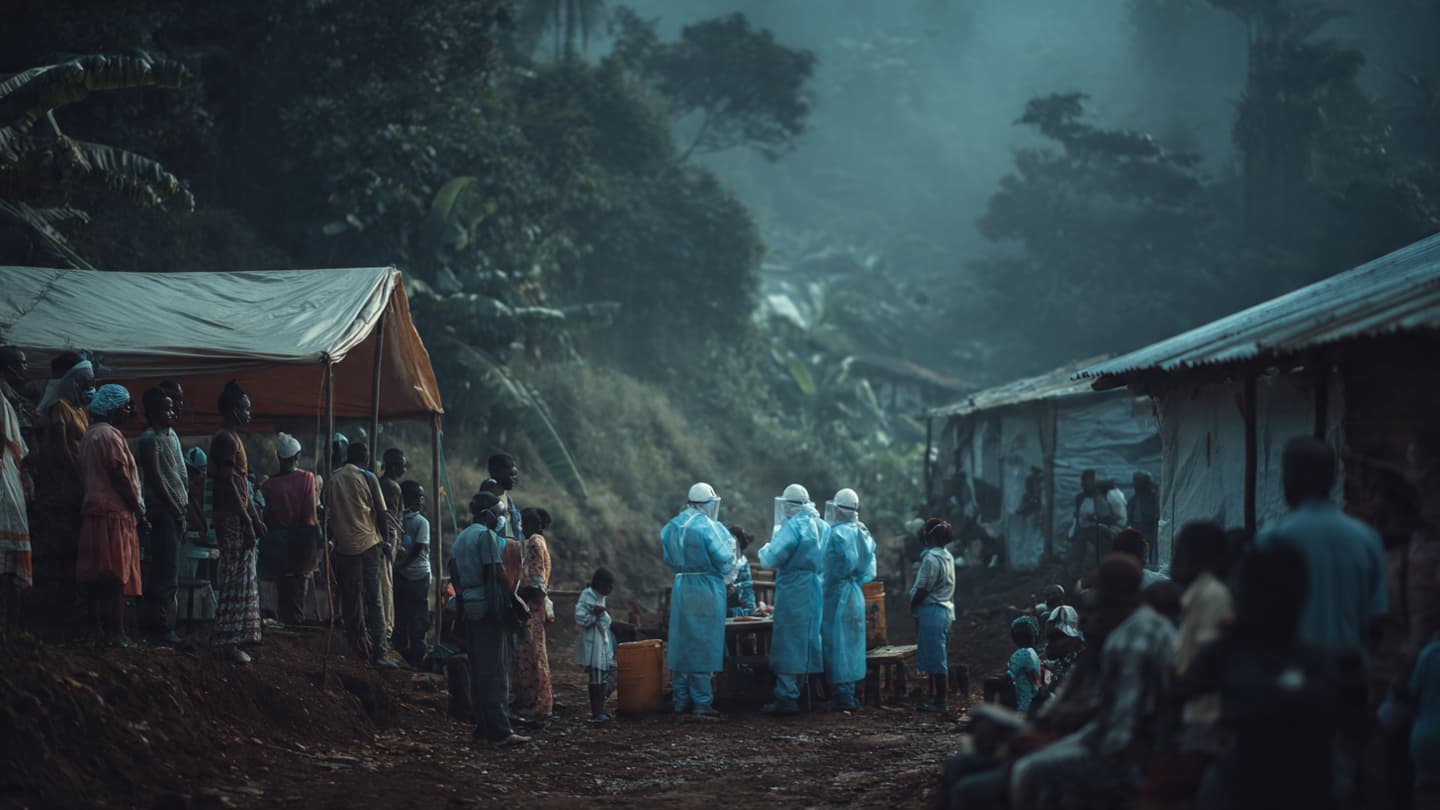
The forests of eastern Congo breathe with their own rhythm. Morning mist rises slowly above dense green canopies, while narrow dirt roads wind between villages where daily life unfolds close to the land. Smoke curls from cooking fires, fishermen guide wooden boats across riverbanks, and market stalls fill with cassava, fruit, and bushmeat carried from deep within the forest. Here, survival has always depended on closeness — to family, to tradition, to the wilderness itself. Yet in recent years, that same closeness has repeatedly become entangled with one of the world’s most feared diseases.
The Democratic Republic of Congo has endured more Ebola outbreaks than any other country, and health experts say the reasons lie not only in medicine or infrastructure, but in the complicated intersection of culture, poverty, geography, and distrust. In remote communities where clinics remain scarce and roads nearly impassable during rainy seasons, information often travels unevenly, shaped as much by rumor and memory as by official health guidance.
Scientists believe many Ebola outbreaks begin when humans come into contact with infected wildlife, particularly fruit bats or animals hunted for food in forest regions. Bushmeat remains an important source of protein and income in parts of Congo where alternatives are limited. Hunters moving through dense jungle terrain may unknowingly encounter infected animals, while meat sold in village markets can carry risk if handled without protection. For many families, however, these practices are tied not to carelessness, but to necessity and generations of survival within the forest ecosystem.
Once infection enters a community, the virus often spreads through intimate human contact. Ebola is transmitted through bodily fluids, making caregiving and funeral rituals particularly vulnerable moments. In many Congolese communities, burial traditions involve washing, touching, or spending time close to the body of the deceased — acts rooted deeply in dignity, kinship, and spiritual farewell. Public health workers have long struggled with the painful tension between preventing transmission and respecting customs that carry profound emotional meaning.
During past outbreaks, health teams sometimes arrived in protective suits that obscured faces and transformed caregivers into unfamiliar figures moving through frightened villages. In places already shaped by armed conflict and political instability, suspicion often grew quickly. Some residents feared treatment centers themselves, while others believed Ebola was exaggerated or fabricated for political or financial motives. Disinformation spread through word of mouth, radio chatter, and social media, often faster than official messaging could reach isolated regions.
The result has been a cycle that health officials describe as uniquely difficult to contain. Contact tracing becomes harder when families hide sick relatives out of fear or distrust. Vaccination campaigns slow when rumors circulate that foreign doctors carry hidden agendas. In conflict zones, armed groups and insecurity can prevent medical teams from reaching outbreak areas entirely. At times, clinics and aid workers have even become targets of violence.
Yet alongside those challenges are quieter stories of resilience rarely visible beyond Congo’s borders. Local nurses, village leaders, burial volunteers, and community educators have become central figures in recent Ebola responses. Health campaigns increasingly rely on trusted local voices rather than distant authorities alone. Anthropologists and public health experts now work together more closely, recognizing that disease control depends not only on vaccines and laboratories, but also on cultural understanding and trust built over time.
The Democratic Republic of Congo’s geography also complicates every response effort. Vast stretches of rainforest separate communities by hours or days of travel. Rivers serve as highways where paved roads do not exist, and heavy seasonal rains can isolate entire regions. In outbreak zones, transporting medical equipment or laboratory samples sometimes requires motorcycles, boats, or helicopters crossing difficult terrain beneath unstable weather.
Even so, medical progress has altered the landscape of Ebola response in recent years. Vaccines developed after earlier epidemics have helped reduce transmission during newer outbreaks, while improved treatments have increased survival rates when patients receive care early. International health organizations continue to support Congolese authorities with surveillance, vaccination, and emergency response systems. But experts caution that scientific advances alone cannot fully address the deeper conditions that allow outbreaks to persist.
For many communities in eastern Congo, Ebola arrives not as an abstract global crisis, but as another uncertainty layered onto lives already shaped by displacement, poverty, and conflict. The virus moves through existing fractures — where healthcare is distant, where institutions are mistrusted, and where survival sometimes depends on choices outsiders may struggle to understand.
And so the forests remain suspended between beauty and vulnerability. Rain continues to fall over the Congo Basin, rivers continue their long movement through the interior, and villages continue their ordinary routines beneath towering trees. Somewhere within that vast landscape, health workers listen carefully for signs of another outbreak while communities balance tradition, necessity, and caution in fragile coexistence. Ebola, in the Democratic Republic of Congo, has never been only a medical story. It is also a story about memory, distance, and the difficult work of trust in places where the world too often arrives late.
AI Image Disclaimer: Illustrations were created using AI tools and are not authentic photographs of the events described.
Sources:
World Health Organization Reuters Associated Press BBC News Doctors Without Borders (MSF)
Note: This article was published on BanxChange.com and is powered by the BXE Token on the XRP Ledger. For the latest articles and news, please visit BanxChange.com