The night arrived over southern Russia with the familiar stillness that often settles above ports and industrial towns before dawn. Along the edge of the Sea of Azov, cranes stood motionless against the dark horizon, fuel tanks reflected faint fragments of moonlight, and the machinery of commerce waited for another morning. Then came the distant hum that has become one of the defining sounds of this war—not the roar of fighter jets, but the smaller, persistent approach of drones crossing invisible lines in the sky.
In Taganrog, fires reportedly broke out at port facilities after Ukrainian drone strikes struck a tanker, fuel storage infrastructure, and nearby buildings. Across several Russian regions, local authorities described overnight attacks that damaged energy-related sites and residential structures. In some places, windows shattered. In others, emergency crews moved through smoke and debris before sunrise, tracing the path of another exchange in a conflict increasingly shaped by long-range technology rather than shifting front lines.
The strikes formed part of a broader Ukrainian campaign aimed at Russia’s energy infrastructure, a strategy that has steadily expanded over recent months. Refineries, pumping stations, storage depots, and logistics facilities have become recurring targets. Ukrainian officials argue that such sites help sustain Russia’s military operations, while analysts note that attacks on fuel networks carry economic as well as military consequences. Several industry reports indicate that drone operations have disrupted refinery activity and contributed to declining fuel output in parts of Russia during the spring.
Yet the landscape of this conflict remains one of simultaneous motion. While fires burned near Russian oil facilities, air-raid alerts sounded again across Ukraine. Russian forces launched waves of drones and missile strikes aimed at Ukrainian territory, continuing a pattern that has left cities balancing daily routines against the possibility of sudden interruption. In the southeastern region of Zaporizhzhia, attacks reportedly damaged energy infrastructure and temporarily left thousands without electricity. Elsewhere, residential areas and local infrastructure absorbed the continuing pressure of a war now measured as much in disrupted power lines and damaged fuel depots as in territorial maps.
The conflict appears increasingly shaped by distance. Drones launched hundreds or even thousands of kilometers away now travel toward refineries, ports, airfields, and industrial facilities once considered beyond immediate reach. Oil installations near Moscow, fuel stations connected to broader logistics networks, and energy facilities deep inside Russian territory have all entered the geography of risk. What once belonged to rear areas has become part of the battlefield’s expanding perimeter.
Behind the technical language of military briefings lies a quieter reality: communities adapting to uncertainty. Residents wake to emergency notifications, train schedules change, airports suspend operations, and firefighters work beneath towers of smoke rising from infrastructure built to sustain ordinary economic life. The war increasingly touches places that once existed far from its earliest trenches and front lines.
Meanwhile, Ukrainian President Volodymyr Zelenskyy has warned that Russia may be preparing another major offensive wave of strikes. Kyiv has continued urging allies to accelerate air-defense deliveries, particularly advanced missile systems capable of intercepting ballistic threats. Russian officials, for their part, have signaled plans for further military responses, framing recent bombardments as retaliation for Ukrainian attacks. The language of deterrence and reprisal continues to circulate between capitals, even as civilians on both sides experience the conflict through sirens, damaged buildings, and interrupted nights.
As summer approaches across Eastern Europe, the war enters another season without clear stillness. Fuel depots burn beside shipping routes, drones cross dark skies toward distant targets, and power grids remain fragile beneath recurring assaults. The struggle increasingly resembles a contest of endurance—of industry, logistics, technology, and public resilience.
By morning, the smoke over the ports begins to thin. Trains move again, repair crews arrive, and reports continue to emerge from both sides. Yet each new strike leaves behind a reminder that modern warfare no longer travels only through trenches or contested towns. It moves through energy networks, communication systems, and the unseen routes connecting cities to the machinery that keeps them running. In that widening geography, the conflict continues to redraw its own horizon.
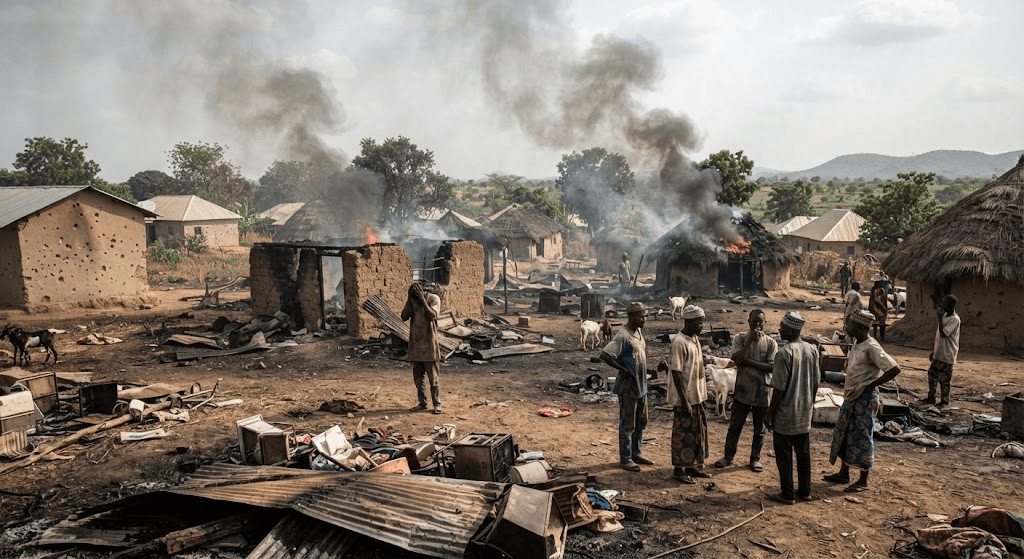
AI Image Disclaimer Illustrations were created using AI tools and are intended as visual interpretations of reported events.
Sources Reuters Associated Press Al Jazeera The Guardian Ukraine Ministry of Defense
Published by Banx Network. This article is part of the Banx decentralized media programme, powered by the BXE token on the XRP Ledger.

.jpg&w=3840&q=75 "Intelligence Agencies Suspect Russia Is Developing Anti-Satellite Weapon to Target Starlink")